
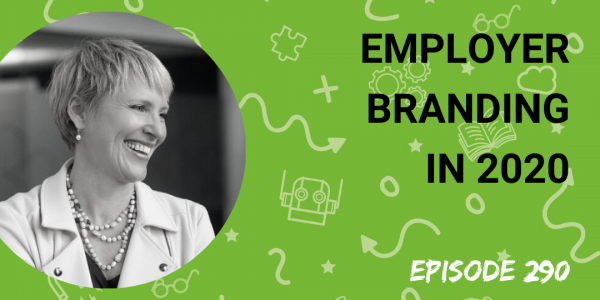
One of the topics we were talking about back in March was what effect the pandemic would have on the way employers have to think about employer brand.
It’s now the middle August and employer brand is something many employers having to consider carefully against a backdrop of mass layoffs and industries that may be changed forever by what is happening.
My guest this week is Kristen Weirick who, until very recently, was Global Head of Talent Acquisition and Chief Diversity Officer at United Airlines. The global airline industry has taken a hammering in the last few months, and Kristen shares her valuable insights into what employers should be doing during these challenging times.
In the interview, we discuss:
• The impact of COVID on the airline industry
• Re-imagining processes and capability building
• Why the way companies behave now will have employer brand implications for years to come.
• Making difficult decisions in a transparent way
• What should employers be doing to ensure their employer brand is in the best possible place
• Diversity and Inclusion at an inflection point
• What are the likely long term changes for talent acquisition and how will these affect the TA teams of the future
Subscribe to this podcast in Apple Podcasts
Transcript:
Matt Alder [00:00:00]:
Support for this podcast is provided by WorkMarket, an ADP company. Businesses that are looking to gain visibility, automation and security in managing their extended workforce use an end to end platform to efficiently and compliantly identify, onboard, organize, rate and pay their freelancers, independent contractors, or contingent workers. Check out workmarket.com to see how you can unlock the power of your extended workforce.
Matt Alder [00:00:54]:
Hi everyone, this is Matt Alder. Welcome to episode 290 of the Recruiting Future podcast. One of the topics we were talking about back in March was the effect the pandemic would have on the way employers have to think about employer brand. It’s now the middle of August, and employer brand is something many employers are having to consider carefully against a backdrop of mass layoffs and industries that may be changed forever by what’s happening. My guest this week is Kristen Weirick, who until very recently was Global Head of Talent Acquisition and Chief Diversity Officer at United Airlines. The global airline industry has taken a hammering in the last few months and Kristen shares her valuable insights into what employers should be doing during these challenging times. Hi, Kristen, and welcome to the podcast.
Kristen Weirick [00:01:52]:
Well, thank you. I’m really happy to be here.
Matt Alder [00:01:54]:
An absolute pleasure to have you on the show. Could you just introduce, introduce yourself and tell everyone what you do?
Kristen Weirick [00:01:59]:
Well, my name is Kristin Weirick. I’ve spent most of my career in the space of talent acquisition and diversity, equity and inclusion. My most recent role was the global Head of Talent Acquisition and Chief Diversity Officer at United Airlines. And then prior to that I was with AbbVie, a global biopharma company, and spent seven years with them leading talent acquisition DEI and also led their culture initiative. And I could go way back, but we probably don’t have enough time for that.
Matt Alder [00:02:34]:
Obviously, 2020 has been an extremely challenging year for everyone. It’s been an extremely challenging year for talent acquisition, but it’s also been an extremely challenging year for the airline industry. Tell us a little bit about the challenges that you’ve seen so far this year.
Kristen Weirick [00:02:50]:
Yeah, where to start? Because there is no shortage of challenges due to Covid and unfortunately, unfortunately, the airline industry has been pretty hard hit by Covid in terms of the business impact. I was kind of joking with someone saying that the only industry that I could have picked that probably would have fared worse is the cruise industry. But with that said, I did join United back in June of 2019 and at the time I Joined it was the understanding that we were in a very aggressive growth strategy, you know, more international routes than any other airline. I literally could not hire people fast enough and I needed to build a talent acquisition team and capability to deliver against that growth. That started slowing certainly at the global level in February and then, you know, by the beginning of March, it was like nothing I’ve ever experienced in my career. In talent acquisition we implemented a, what I call positively glacial hiring freeze. And I always joke that in the, you know, hiring freezes happen all over the place, but they’re never really freezes, they’re more like a frost because there’s always something that you’re hiring. But in the context of United Airlines, it came to a glacial halt. All hiring, internal movement, external hiring was completely cut. We went from over a thousand open roles to zero. So really hit hard. And so we very quickly had to determine what is this team going to focus on with absolutely no roles to recruit on. The good news is I said the silver lining for United in terms of talent acquisition and Covid was they had buckets of end to end process definition and capability building that needed to be done. And it gave the team the bandwidth to actually focus on that work so that when the airline does come back, it will come back with a completely refreshed recruiting process with defined roles and capabilities and SLAs. Lots of good stuff is going to come out when they do come back, but it has pretty much devastated the industry as we know it. They’re going from what was 93,000 employees to it looks like it’s going to be under 60,000. So big difference.
Matt Alder [00:05:28]:
I mean, that’s just incredible and not something that we could have ever predicted or even, even imagined really. I mean, tell us a little bit, a little bit more about that capability building. Was there, is there kind of any internal mobility going on amongst the people who are in the, in the business? How is it playing out?
Kristen Weirick [00:05:46]:
So they’re starting to open up a little bit in terms of moving people in the organization, but it is currently more about how are they staffing the new structure. Because as you can imagine taking that many people out of an organization, you have to define what the new organization looks like. Look at the kind of people you have left, because a lot of employees, including myself, took voluntary packages to leave the organization. And then so they look at who’s left, who can they slot into roles and then there is a competitive process to determine for those boxes, so to speak, that are left open, how are they going to fill those with the talent that’s left. And in some cases, if there’s not talent left, they’ll go externally and begin potentially contacting employees that had taken voluntary packages that were interested in coming back.
Matt Alder [00:06:42]:
It’s fairly clear at this point that the future that we’re, that we’re emerging to, or certainly the future that a lot of industries are emerging to, the airline industry in particular, is going to look very different. That said, and as you mentioned there, these organizations will, will still be hiring. They will hopefully go back into some kind of growth mode eventually, although maybe very much reimagined in terms of what their industries look like. What kind of effect does this have on an employer brand, not just of a company, but also of a whole industry?
Kristen Weirick [00:07:16]:
Yeah, it’s. I definitely spent some time thinking about that because we had just completed the work, our employer brand, you know, doing both and the real work, I mean, not just kind of saying what’s our recruitment advertising approach. It was truly about understanding, doing both the quantitative and qualitative research, you know, to kind of form what is really differentiated about United Airlines as an employer versus their competitors and why should people join us. And interestingly enough, one of the elements of that kind of employment value proposition was resilient. And before COVID hit, we had been kind of sharing the overall framework of the EVP with some senior leaders and they didn’t like the word resilient. And so we changed it to dynamic. And when Covid hit, we’re like, I’m not sure that’s the right pillar to stand on any longer. And so we were actually looking at changing it to determined, which I think is relevant both in good and bad times, because you can be determined in terms of your business objectives, you can be determined to succeed, be determined to continue to be the best airline in the world, even in the face of some incredible business and environmental challenges like a global pandemic. But as we all know about employer brands and employment value propositions, whatever tenants we define, how employees and employers behave during a challenge like this is going to speak volumes about who they are as an organization and what they will have to build upon in terms of why talent should join or stay with them in the future. And I’m sure that there are going to be a number of post mortems on, you know, the impacts of COVID to companies, employer brands, companies with iconic brands that maybe have not weathered or, or approached talent and employees and how they manage them in a way that is going to build that brand. So it’s going to Be interesting to see the outputs now. We’re probably not going to see it for at least I would say two, three, even up to five years post the pandemic.
Matt Alder [00:09:53]:
And what would your advice be to an organization going through these challenges right now? What can they do to make sure that their brand is in the best possible place coming out of this?
Kristen Weirick [00:10:08]:
Yeah, I mean, a really good thing is to think about your brand, think about the actions you’re going to be taking and they may be necessary actions to keep your business afloat. But always think through what are the implications to my people, to the talent that drives the business and make those decisions in the lens of that. Because sometimes you have to make difficult decisions that do negatively impact your team members, but making them in a way that is as transparent as possible and puts those employees in the best position as possible, given the current situations. And always to look at it through the lens of an employee and make those decisions with the utmost amount of respect and dignity that you can.
Matt Alder [00:11:02]:
So obviously this, this crisis is having a very big effect on talent acquisition as a whole. Companies are having to radically change their processes. The companies that are recruiting are in the main having to do that virtually through digital interviewing and digital onboarding and having to adapt sort of very, very quickly to the current situation. What do you think we’ll see in terms of long term changes to talent acquisition? Do you think that the things that are going on the moment are going to stick and evolve? We move back to some of the ways that we worked before? What do you anticipate happening?
Kristen Weirick [00:11:41]:
Yeah, it is an interesting time and I do believe that what we’ve experienced in terms of how we manage talent acquisition through Covid, it is going to have some long term and I think in many instances positive effects on the talent acquisition process. One of them, you know, as we have gotten smarter and better at, you know, video interviewing, leveraging whether it’s teams or Zooms or WebEx, I think everyone has gotten a much greater comfort level in managing interviews via your laptop. And my prediction is one of the things that is going to become a future tenant in terms of how we interview is first interviews are going to be done via your laptop. One of the other things that we’re seeing is a lot of people are accepting roles to new organizations without ever stepping foot in that, you know, that company environment and visiting the area. I don’t think that’s going to continue. I think those first interviews can happen virtually gives you. It saves candidates time, it saves, saves companies time and money to manage Videos in that way. Video interviewing in that way. But I think you’re going to see most people who are going to have to relocate are going to want to go and understand what’s this new community and corporate environment like. I do also think while, you know, it’s a pendulum that swings, you know, a lot of companies went to everybody can work remote and then you saw, I think Yahoo was the first one that pulled all those remote workers back because something was missed. And we might see that pendulum start swinging back again to more remote workers. And I think we’re going to find the right balance. One of the interesting things about how we work remotely that Covid has done is when everyone is working remotely, it’s, it does become a bit of an equalizer because you and I both know that the worst meeting is when there are four people in a conference room interacting face to face and you’re the individual on the phone. It’s hard not to feel disconnected. What’s going to be interesting is when everyone comes back to the office or has the ability to come back to the office, how do we continue to manage that? Some people are there and some people aren’t meeting environment.
Matt Alder [00:14:16]:
What do you think the TA team of the future is going to look like? Are we going to see more automation in recruiting?
Kristen Weirick [00:14:24]:
Well, you know, recruiting is one of those areas where I think technology can be a differentiator, but it is also a double edged sword. One of the kind of elements of talent acquisition that technology helps to manage is volume. And whenever there’s volume and technology together, you kind of miss that human factor and human touch. And I think a lot of talent acquisition organizations are trying to find the right balance between technology and where I leverage technology to manage volume communication, AI to help sort through potential candidates, and machine learning to making sure that candidates feel that they are not being managed by technology that they are being engaged with in a meaningful way. And that’s another place where we are going to continue to find the right balance between technology driving process efficiency and making sure that potential candidates feel they are part of an organization that is made up of humans that actually care about the experience that they have and how they might be a fit for any one organization that makes perfect sense.
Matt Alder [00:15:42]:
And do you feel that 2020 is also going to be the year that employers take diversity and inclusion as seriously as they should have done in the past?
Kristen Weirick [00:15:52]:
Yeah, that’s a great question. We are definitely at either a pivot or an inflection point around the space of diversity, equity and inclusion. And it Makes me a little bit nervous because in a good way. And then, you know, like everything, it’s a, it is a double edged sword when you try and drive things that may have unintended consequences. I embrace the renewed focus and efforts around diversity and inclusion. I see buckets of opportunities out there for chief diversity officers. I guess what makes me nervous about that is because it’s a pendulum that is reacting to something that’s happening in our external environment. You want to ensure that those CDO roles that they are creating actually have the right resources, support and buy in the teeth to get traction on a diversity, equity and inclusion agenda. I’m a much bigger fan of having that strategy, that agenda already in place and having this, you know, socioeconomic time with, you know, the unfortunate George Floyd’s of the word, giving a just a bigger push and focus on how do you drive that strategy and you know, how do you switch up and change what you’re doing to get deeper and more traction to drive the strategy. We are at a really unique and opportune time. I think what organizations need to consider is while having that DEI strategy is incredibly important, that what is the sustainability of it? If you’ve had one that you were driving, just doubling down, awesome. If this was something you had back burnered for whatever reason and you suddenly realized I need to pull this off the shelf, I need to drive it in a new and differentiated way, awesome. Think also through what is the sustainability of the effort because you can end up really creating some disenchantment, especially with your diverse populations. If you have a big kind of bang or a push, they invest in the hope and intent that something’s going to change. But then there’s no follow through on it. If there’s no follow through on it, that that can create a lot of disenchantment, disengagement and you may see more of your diverse talent leaving for those organizations that really are going to have a sustainable focus.
Matt Alder [00:18:35]:
Final question, what’s next for you? What are you focusing on and how can people find and connect with.
Kristen Weirick [00:18:42]:
Well, I am on LinkedIn, so come look for me on LinkedIn and you know, I am in a very, very fortunate position since I took that voluntary package. I haven’t had a summer off in a very long time and I am actually reveling in it. But I love work. I love the type of work that I do and I definitely love leading teams and developing others. So I’m in this fortunate position of having some time to really think through what is the type of organization and type of work that I really want to spend my time focusing on. So I am in conversations with a number of organizations and I’m looking forward to seeing what’s next. I know it will be something that is focused on talent. I love the talent space and we’ll look at how to leverage that passion that I have in overall talent, talent acquisition, certainly diversity, equity and inclusion to have a really significant and sustainable impact on the business and business performance. And of course always looking at how am I developing my team members to be the best, maximize their potential and be the best that they can be.
Matt Alder [00:19:53]:
Kristen, thank you very much for talking to me.
Kristen Weirick [00:19:55]:
I really enjoyed it. This has been fun.
Matt Alder [00:19:58]:
My thanks to Kristin Weirick. You can subscribe to this podcast in Apple Podcasts on Spotify or via your podcast podcasting app of choice. Please also follow us on Instagram. You can find the show by searching for Recruiting Future. You can search through all the past episodes@www.recruitingfuture.com on that site. You can also subscribe to the mailing list to get the inside track about everything that’s coming up on the show. Thanks very much for listening. I’ll be back next time and I hope you’ll join me.