
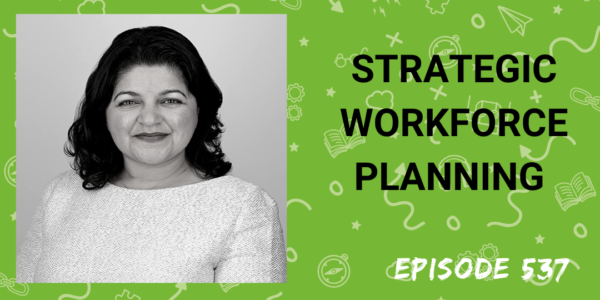
One of the key themes I’ve observed emerging over the last few years is the need for employers to think about talent holistically. To achieve this, progressive organisations are already breaking down the barriers between talent acquisition, talent management and L&D. The central tenet is Strategic Workforce Planning (SWP).
So what does effective SWP look like, how is AI changing thought processes, and what role does Talent Acquisition need to play?
My guest this week is Sadhana Bhide, Strategic Workforce Planning Subject Matter Expert at Faethm by Pearson. Sadhana has expert insights to share on the current state and future development of SWP, and this is a must-listen for TA leaders everywhere.
In the interview, we discuss:
• What is SWP, and why is it so important?
• Unique strategic advantages
• Engaged workforces
• The 6 Bs that underpin SWP
• The impact of AI on jobs
• What role should Talent Acquisition play in SWP?
• Common roadblocks and challenges
• Best practices to measure success
• Establishing a learning mindset and a culture of change readiness
• What does the future of HR look like?
Subscribe to this podcast in Apple Podcasts.
Transcript:
Matt Alder [00:00:00]:
Just before we start the show, I want to tell you about Wreckfest USA, an extraordinary event happening in Nashville on the 13th and 14th of September. Part festival, part conference, Wreckfest is a unique experience long established in the uk. I’ve attended most of them and I highly recommend you experience the incredible combination of content, networking and celebration of all that’s good in talent acquisition. Wreckfest is coming to America and I’ve got a mega discount code for you. Go to wreckfest.com USA and use the code RF50 to get 50% off your tickets. That’s wreckfest.com USA and the discount code is RF50.
Matt Alder [00:01:06]:
Hi there, this is Matt Alder. Welcome to episode 537 of the Recruiting Future podcast. One of the key themes emerging over the last few years is the need for employers to think about talent holistically. To achieve this, progressive organizations are already breaking down the barriers between talent acquisition, talent management and L and D. The central tenant is strategic workforce planning. So what does effective SWP look like? How is AI changing thought processes? And what role does talent acquisition need to play? My guest this week is Sadhana Bhide, Strategic workforce planning subject matter expert at Fathom by Pearson. Sadhana has expert insights to share on the current state and future development of swp and this conversation is a must listen for TA leaders everywhere.
Matt Alder [00:02:05]:
Hi Sadhana and welcome to the podcast.
Sadhana Bhide [00:02:08]:
Hi Matt, it’s great to be here.
Matt Alder [00:02:10]:
An absolute pleasure to have you on the show.
Matt Alder [00:02:12]:
Please could you introduce yourself and tell.
Matt Alder [00:02:15]:
Everyone what you do?
Sadhana Bhide [00:02:16]:
Certainly. Thank you Matt. My name is Sadhana Bhide. I am currently the strategic workforce planning subject matter expert at Fathom by Pearson. My role really is to work with clients and broader groups of people on their strategic workforce planning or SWP strategy.
Matt Alder [00:02:35]:
Fantastic stuff.
Matt Alder [00:02:36]:
Now, strategic workforce planning has come up a lot in conversations on the podcast, come up a lot in conversations about talent acquisition and I really wanted to talk to someone who was a specialist and an expert in this to really give everyone a sense of the details and why it’s so important. So talk us through. What is strategic workforce planning and why is it so important in 2023?
Sadhana Bhide [00:03:01]:
Absolutely. Fundamentally, strategic workforce planning is a set of activities that involve looking at an organization’s workforce today and looking at the impact of external factors around technology, as much planning as possible for unplanned, unforeseen world events, and also looking at how work will change and Thinking about the workforce of the future that will be required in to carry out that work in the future as well. We’re dealing with a huge period of change when we think about the world of work. We’ve got complex forces such as artificial intelligence, external events as we’re coming out of the COVID pandemic, impacting on how work is carried out, when and where through big changes such as moving to remote working, hybrid working, and also how are employees engaging and reacting with the world of work. So we often see trends on social media such as minimum Mondays, quiet quitting, people making big lifestyle changes as well. So for organizations, they all see and appreciate the need to act, but their starting point has to be understanding where they are today and from that being able to chart an effective path to the future of work.
Matt Alder [00:04:18]:
Absolutely. I mean, it is a very dynamic, disruptive time. There’s kind of, there’s so much going.
Matt Alder [00:04:23]:
On at the moment.
Matt Alder [00:04:24]:
Talk us through the sort of the unique advantages that a clear, effective, strategic workforce plan can bring to an organisation.
Sadhana Bhide [00:04:33]:
Absolutely. I think by having an SWP plan in place, it allows organisations to plan for the longer term future. We know we can’t plan for everything because we don’t know what’s coming down the line, but what we can do is build a foundation of readiness so that enables organisations to be able to react and respond quickly to events as and when they arise. From an employee’s perspective, by thinking about SWP and having a plan in place, it gives an employee the means and opportunities and support, learning and training to remain relevant for the future of work. That could be through upskilling and reskilling programs, but it keeps the employee relevant to the future of work, engaged and positive about the work they do and the organisation that they’re affiliated to. From an organization perspective, having an engaged workforce is absolutely key to success and productivity as well. Obviously you have then cost advantages by looking at that workforce and looking at how it can be recycled, reinvented, repurposed, reused for that work of the future.
Matt Alder [00:05:40]:
So many people listening will have some familiarity with SWP, but there are kind of six Bs that sort of underpin all of it. Could you walk us through those six Bs that help inform SWP?
Sadhana Bhide [00:05:54]:
Yes, absolutely. The six Bs is a phrase that’s used quite often when we think about SWP and it refers to a set of HR related, output focused actions that come from building a strategic workforce plan. I’ll run through what those six Bs are. We start off with bot and that refers to looking at the impact of technology on roles. Build is where the analysis of an organization’s workforce is completed to identify where you have a surplus or a deficit and from that what decisions can be taken. So with a surplus, would we look at redeployment? For example, if there’s a deficit, is there a need to reskill or upskill different pockets of the organisation to cover that gap? Borrow refers to where we’re looking at short term coverage for skills gaps. And it means a look across the organisation to look at where there are comparable or the same skills and where those roles could be moved to do that short term cover. Buy, as we would expect it to be, is buying in external resource. They’re normally ready to go with the relevant skills, knowledge and experience that are needed to come in and start actively doing the work that’s required. Bounce is where we refer to removing employees from the organisation and or the role that could be, either because performance is not where it needs to be or they’re a bigger organisation. Organisational decisions related to redundancy. In both cases the question should be asked to say is this an opportunity to look at where the individual or the division can go through reskilling or upskilling to move over into work that’s required today and will be relevant for the future as well? And as we’re going through this huge period of change within an organization bind is the loss of the 6Bs. And that refers to where we look at employees who are in what the organisation classes as a critical role and we look at how we can incentivise and motivate them to remain loyal and connected and focused to the organisation. I’d also say there’s a seventh B which is balance. What I mean by that is when we look across the six Bs, it’s important for every organisation to make sure that they are taking a considered and balanced view to those actions and outcomes and not leaning too heavily towards one or the other. So for example, if they know there’s a gap in the in skills or workforce, that’s needed not to jump to buy straight away as a solution, rather than looking at build or borrow. And on the other side, if there’s a surplus, not jumping straight to bounce is the option, but again, looking at build or borrow as the outcome as well.
Matt Alder [00:08:40]:
Lots of people listening to the podcast are talent acquisition professionals. What role should the acquisition function be playing in swp?
Sadhana Bhide [00:08:51]:
When I think about the most successful talent acquisition divisions that I’ve seen in my career, they all focus on a number of key areas which are around driving the attraction, retention and performance of critical talent. So all of those areas slot very nicely into a broader strategic workforce plan. In my view, the talent acquisition team should be front and center when it comes to starting the SWP journey of an organisation. The knowledge, insights and inputs they can share around the workforce and looking at how to manage that workforce for the longer term, to meet the challenges of the future of work is absolutely key.
Matt Alder [00:09:32]:
So talk us through the, I suppose, the most common roadblocks and the challenges that are getting in the way of building and implementing a successful swp.
Sadhana Bhide [00:09:43]:
There are a number of challenges and I would start off by saying that when the leadership of an organisation recognizes and knows that they need to act on future proofing their workforce, step one is getting the right data and insights. They need to make informed decisions. Step two is then also appreciating and understanding that this is a long term journey. They need to be looking at a three to five year horizon at least, and knowing that it will take that long to identify, implement and benefit from the changes that they’re making. And lastly, to know that looking at SWP is a continuous and iterative process. There needs to be regular check ins, reviews, refreshes, reflex, whatever you want to call it of that broader plan to make sure that it remains current and aligned to the future of work strategy.
Matt Alder [00:10:32]:
So when it comes to measuring all of this, what are some of the best practices that are used to measure the effectiveness of SWP and also ensure the process continues to set the organization up for success in the future?
Sadhana Bhide [00:10:47]:
Yeah, absolutely. Measurement is absolutely key to success of any SWP plan. How do you know what you’re doing has the right impact? I get this question a lot and what I would say is there is no one fixed set of KPIs that works across every organization, every geography, every industry. Step one is understanding what’s important to your organization and viewed as key to success. Now, it may be common across many organisations and we have identified a set of recommended KPIs, we can sort of bucket them into different areas and look at the impact on roles. From the SWP plan, we can look at what it means from a business productivity perspective. And I think also we look at actions and outcomes related to the 6Bs that I’ve just been through as well.
Matt Alder [00:11:40]:
So, final question, very dynamic, time of much change.
Matt Alder [00:11:45]:
What do you think the future looks like for hr?
Matt Alder [00:11:48]:
What role should it play? And how do you think technology is going to shape things moving forward?
Sadhana Bhide [00:11:54]:
I think HR has a critical role to play in the success of any organization. The impact of technology is happening at such a pace and with such dramatic changes that HR needs to be looking ahead continuously and thinking about what that workforce of the future looks like. One of the key areas that can really support the organization is looking at mindset and culture. How can HR work with the employees in the organization to build that learning mindset and the culture of change readiness as well, so that individuals in that organization are ready to adapt and change as work changes, not just where that work is carried out, but how it’s carried out and what the impact of technology is on individual roles. I would also say focusing on diversity, equality and inclusion is key to the success of any organisation as well. And that’s why HR also has a massive part to play. It’s looking at how that organisation can build a DE and I related mindset when it focuses on the employees in that organisation, how work is carried out, and also ensuring that the impact of technology does not have adverse impact on specific groups of individuals. Fundamentally, having that HR voice at the table means that organizations can be aware of their workforce, what the needs are today, what we’re looking for tomorrow, and what is the journey to achieve that workforce of the future.
Matt Alder [00:13:21]:
Sadhana, thank you very much for talking to me.
Sadhana Bhide [00:13:24]:
Thank you Matt. It was a pleasure.
Matt Alder [00:13:27]:
My thanks to Sadhana. You can subscribe to this podcast in Apple Podcasts, on Spotify or via your podcast app of choice. Please also follow the show on Instagram. You can find us by searching for Recruiting Future. You can search all the past episodes@recruitingfuture.com on that site. You can also subscribe to our monthly newsletter Recruiting Future Feast and get the inside track about everything that’s coming up on the show. Thanks very much for listening. I’ll be back next time and I hope you’ll join me.