
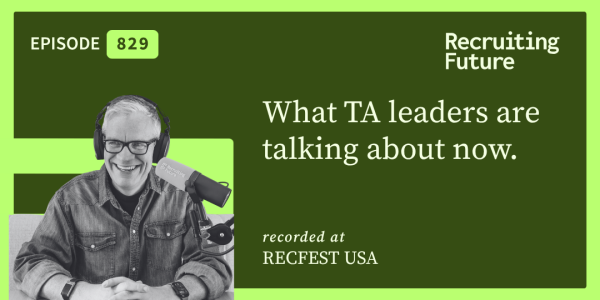
TA leaders have to keep delivering for the business while they use AI to transform how hiring works. At RecFest USA in Nashville, AI was the main topic of conversation, although the people I spoke to talked about much more than the technology. So where should TA leaders be focusing their attention?
I recorded seven short interviews at the event, and they fall into three themes. Those themes are the value that talent acquisition brings to the business, the risks that employers now have to manage, and what comes next for hiring.
My guests are Jamie Leonard, Founder of RecFest; Stef Nikitas, Director of Talent Acquisition at Ace Hardware; Julia Levy, a former Fortune 500 talent acquisition executive; Jim Stroud, Head of Market Strategy and Industry Engagement at ProvenBase; Lorna Erickson, Co-Founder of Expert Interviewers; Mark Chaffey, Co-Founder and CEO of hackajob, the company behind Archer; and Ben Russell, Co-Founder and CCO of SonicJobs. In our conversations, they discuss who should own quality of hire, how employers are responding to legal risk and candidate fraud, and how AI is changing the way candidates and employers find each other.
In the interview, we discuss:
- The growing conversation about how TA aligns with business goals
- Who should own quality of hire and how should it be measured?
- The compliance and legal pitfalls around AI and pay transparency
- How to check for candidate fraud without making the process harder for real candidates
- The lack of trust between candidates and recruiters
- How job seekers are using large language models to look for work
- What generative engine optimization means for employers
- Is agent-to-agent hiring the future of talent acquisition?
Follow this podcast on Apple Podcasts.
Follow this podcast on Spotify.
Key takeaways
- At RecFest USA, the prospect of AI taking on more of the hiring process was prompting more conversation about how talent acquisition aligns with business goals.
- Quality of hire has no single definition, and Ace Hardware treats it as a long-range measure of the impact a new hire makes on performance and on the wider organization.
- Legal and compliance issues around AI and pay transparency were among the challenges that talent acquisition leaders discussed at RecFest USA.
- Candidates and recruiters are both experiencing a lack of trust in the hiring process, and agent-to-agent hiring has the potential to work where it creates trust for both.
- In its own tests, SonicJobs found that content written for large language models was being cited in AI answers within weeks of being published.
Transcript
Matt Alder 0:00
I was recently at RecFest USA in Nashville, where, unsurprisingly, AI was the main topic of conversation. However, when I asked people what had stood out for them, they talked about much more than just technology. So what is on the minds of TA leaders right now? Keep listening to find out.
Advert 0:22
Support for this podcast comes from VONQ. VONQ’s talent attraction platform is now unified as Echo. One platform, six connected stages, a shortlist that you can explain. Instead of disconnected hiring tools, Echo brings together job content creation, distribution, attraction, screening, interviewing, and scoring in one continuous agentic workflow, delivering up to 70% faster time to hire and 75% fewer candidate drop-offs. Trusted by over 350 enterprise organisations, including Adecco, Danone, DHL, SoftwareOne and Randstad, and a five-time strategic leader in the Fosway 9 grid, Echo runs as a standalone platform or natively embedded into over 85 ATS and HCM platforms through VONQ’s hiring API. Stop managing hiring tools. Start running one workflow. You can learn more by going to vonq.com. And VONQ is spelt V-O-N-Q. That’s vonq.com.
Matt Alder 1:56
Hi, there. This is Recruiting Future with me, Matt Alder. TA leaders have to keep delivering for their business while they use AI to transform how hiring works. RecFest USA took place in Nashville at the end of September and it was a chance to hear how people across the industry are dealing with both of these demands. So where should TA leaders be focusing their attention? I recorded seven short interviews at the event and they fall into three main themes. Those themes are the value that talent acquisition brings the business, the risks that employers now have to manage, and what comes next for hiring. I’m starting with the first of those themes, and with Jamie Leonard, the founder of RecFest. I asked Jamie what he’d been hearing from the people at his own event. After Jamie, Steph Nikitas from Ace Hardware talks about quality of hire and the question of who should own it.
Matt Alder 2:51
Hi Jamie, how are you doing?
Jamie Leonard 2:53
I’m very good, Matt. How are you, sir?
Matt Alder 2:55
I’m very good. So congratulations on RecFest. How’s it gone?
Jamie Leonard 2:57
Thank you very much. Yeah, no, really, really good. I’m really pleased with the turnout. The talks have been really busy. Content’s been great. Weather’s held up, which is nice. And yeah, people are staying, which is fantastic. Always a good time. No, it’s still, what time is it now? It’s about one o’clock on the second day and it’s still busy.
Matt Alder 3:14
And what’s been the most interesting thing that you’ve heard people sort of talking about at this event? What topics, what’s really stood out for you?
Jamie Leonard 3:20
I think the conversation is still very much AI heavy, but I think there’s a lot more conversation at the moment about, and maybe this is born out of fear, it’s about how TA aligns with business goals. I think that there’s a fear that, you know, for years we’ve kind of just gone, oh, we have a process, we follow it, we bring people in. And now because we’ve got the robot coming along that might potentially take that away, people haven’t said, okay, well, we need to open head. Maybe we should start thinking about what the business needs and get a bit more attentive to that as well.
Matt Alder 3:45
Hi, Steph, how are you?
Steph Nikitas 3:46
I’m doing great. Good seeing you again, Matt.
Matt Alder 3:48
Just tell everyone who you are and what you do.
Steph Nikitas 3:50
I’m Steph Nikitas, and I’m the Director of Talent Acquisition with Ace Hardware Corporation.
Matt Alder 3:55
Now, this is not your first RecFest, is it?
Steph Nikitas 3:57
It’s not. I’m actually a rebound, second year.
Matt Alder 4:00
And what have you been doing? You’ve been talking on a couple of panels. Tell us about the panels.
Steph Nikitas 4:03
Yes, I overcommitted a little bit. I was hosting a workshop on Monday during the Recruiting Leaders Summit here at Geodis Park. And then yesterday I was on two panels. One was on The Funnel Isn’t Dead, It’s Missing the Point with my Shaker friends. And then later in the afternoon I talked on Quality of Hire, the metric everyone wants, but nobody wants to own.
Matt Alder 4:27
Awesome. Tell us a little bit about that. That’s interesting.
Steph Nikitas 4:30
Yeah, very lively conversations. We actually were in the morning with Shaker, a full women’s panel, and walked up to Dolly Parton 9 to 5, which was a nice homage to her especially being here in Nashville and had great conversation around what matters as far as attraction, conversion and metrics when it comes to the funnel and that the funnel itself isn’t the problem, it’s usually the people. And then on quality of hire we actually had a very colourful conversation because everybody of course has different opinions who should own it, what should it be, but I think at the end of the day the takeaway was it’s not a one-size-fits-all for everyone. It really depends on your organisational makeup and what you’re trying to measure. And that’s kind of what we all went with.
Matt Alder 5:15
What does it mean in your organisation?
Steph Nikitas 5:16
For us, it’s around, we look at it more like a long-range metric. Quality of hire for us is truly does the individual that you’re hiring into the organisation make an impact, not only on metrics, but from a performance standpoint, moving the organisation forward. Are they contributing in ways that will potentially move them up into a leader position, or further in the organisation to impact another team or the organisation as a whole. And measuring that is, for us, it’s important because it’s all about our mission to be the best hardware store in the world.
Matt Alder 5:45
Thanks, Steph.
Steph Nikitas 5:46
You’re so welcome. Good seeing you.
Matt Alder 5:49
The second theme is risk, and the next three interviews deal with two forms of it. One is the legal and compliance exposure that comes with using AI in hiring, and the other one is candidate fraud. You’ll hear first from Julia Levy, who was hosting one of the stages. She’s followed by Jim Stroud, whose panel on AI went very quiet when he mentioned a particular lawsuit. In the third interview, Lorna Erickson talks about how employers can check for fraud without making the process harder for real candidates.
Matt Alder 6:21
Hi, Julia, how’s it going?
Julia Levy 6:22
I’m having a fantastic day.
Matt Alder 6:24
Yeah, just tell everyone who you are and what you do.
Julia Levy 6:26
I’m Julia Levy. I say I’m a recovering talent acquisition executive, 25 years in TA, starting out as a recruiter, did some TA operations and then leading Fortune 500 global TA functions.
Matt Alder 6:40
And how many times have you been to RecFest?
Julia Levy 6:43
This is my fourth RecFest.
Matt Alder 6:46
The complete set?
Julia Levy 6:47
In the US. I have not had the opportunity to make it across the pond, but I plan to shortly.
Matt Alder 6:53
And how does this one measure up? What’s been going on today?
Julia Levy 6:57
I’m hosting the Unplugged stage today. So having a lot of fun hearing panel conversations around some of the big challenges that talent acquisition leaders are facing, having to do with workforce planning, AI, quality of hire, tool adoption, all the fun and sexy things.
Matt Alder 7:17
What’s the one that’s really stood out? The one that you thought that’s a really interesting problem, really interesting discussion?
Julia Levy 7:23
I’m really focused on compliance and legal pitfalls and things that organisations face. So there was a session around that that was really interesting to hear the different leaders’ perspectives on how they’re handling some of the legal compliance issues around AI and pay transparency and things like that.
Matt Alder 7:45
Hey, Jim, how are you?
Jim Stroud 7:47
I’m doing fine. How are you, sir?
Matt Alder 7:49
Yeah, I’m good. Quickly, tell everyone who you are and what you do.
Jim Stroud 7:49
I am Jim Stroud, and I do industry outreach and marketing strategy for ProvenBase. I also produce newsletters, The Recruiting Life and Career Intelligence Weekly, and I also have a podcast called The Jim Stroud Podcast. And when I’m not doing that, I am sleeping.
Matt Alder 8:00
Absolutely. I mean, you are a prestigious, prolific content creator and kind of always have been. And what are sort of big talking points? What have you noticed that people are talking about?
Jim Stroud 8:12
Well, you can’t get away from AI. You can’t get away from AI. Yeah, everybody’s talking about it in one way or another.
Matt Alder 8:17
I led a panel on AI’s impact on recruiting. And one of the questions that put a hush on the crowd was I mentioned the lawsuit with Mobley versus Workday. And how that lawsuit might impact the entire HR tech industry. And everybody was like, ooh, don’t talk about that. Don’t talk about that.
Jim Stroud 8:40
I put a slide up saying apparently AI is going to kill us in 10 years. So I went one step further.
Matt Alder 8:43
That’s what they say. Yeah. Thanks for talking to me, Jim.
Jim Stroud 8:48
Thank you, sir.
Matt Alder 8:49
Hi, Lorna. How are you doing?
Lorna Erickson 8:49
I’m doing so well. I’m so happy to see you.
Matt Alder 8:52
Great stuff. Could you introduce yourself and tell everyone what you do?
Lorna Erickson 8:54
Sure. I’m Lorna Erickson. I’m a co-founder of Expert Interviewers. We train hiring managers how to interview. And then we kind of accidentally became content creators in the HR space. That was by accident, just using our former recruiting trauma to create funny situations where hopefully people see themselves and want to change and be better hiring managers. So yeah, we are at Expert Interviewers and that is our other part of our business.
Matt Alder 9:18
What kind of topics are you hearing people talking about? What’s going on with TA leaders? What are they saying? What have you been hearing?
Lorna Erickson 9:25
You know what? One of the main conversations that I’ve noticed outside of the obvious AI is the candidate fraud component. And so we have been engaging in as much conversation as we can about how to identify candidate fraud and maintain a candidate experience for real people that are still going through those experiences.
Matt Alder 9:45
Yeah, I think it’s really interesting, actually, the fraud thing. People are obviously taking it much more seriously. I think there was a sense that this couldn’t happen to us, but it’s happening to everyone, isn’t it?
Lorna Erickson 9:54
It really is. And they’re creative. And I was like, who wants to pretend to be a candidate? Candidates, I mean, that sucks. But it’s a real threat for companies. And, of course, they have to have their ears open. But, you know, how can we also do that and create good processes that have a good friction to… Real people won’t notice this.
Matt Alder 10:13
And was there anything like an answer to that? What were people doing or what do you think?
Lorna Erickson 10:17
Yeah, you know, they actually, instead of doing stupid things, and I made a video about this because I couldn’t help myself, where I was being interviewed by somebody on camera and the somebody, also me, by the way, was saying like, Lorna, pick your nose. And I’m like, excuse me, what? Like, we have to make sure that you’re a real candidate. Pick your nose. You know, they have some, you know, they’re wiping their face or turning around in their chair, doing the hokey pokey. But instead of that, just seeing like after this conversation what’s a good phone number that I can reach you at, and oftentimes if it’s a fake candidate or like somebody who’s, you know, catfishing, it’s like they’re gonna have a tough time with that. So it’s like including simple questions that a real candidate wouldn’t even notice, but somebody who was fraudulent may have a tougher time coming up with that information right away.
Matt Alder 10:59
Thank you very much.
Lorna Erickson 11:01
Thank you.
Matt Alder 11:03
The final theme is what comes next for hiring. And that was the subject of the talk that I gave at RecFest. My argument on stage was that candidates and employers will increasingly be represented by AI agents, and that those agents will end up talking to each other. The last two conversations are with founders who are building technology in this area. And I wanted to know how much of the future they’re already seeing. First is Mark Chaffey, co-founder and CEO of Hackajob, the company behind an AI agent called Archer. After Mark, you’ll hear from Ben Russell of SonicJobs on what happens now that job seekers are using tools like ChatGPT to look for work.
Matt Alder 11:44
Hi Mark, how are you doing?
Mark Chaffey 11:45
Very well, thank you, sir. How are you?
Matt Alder 11:46
I’m very good. How has RecFest been for you?
Mark Chaffey 11:48
I may say this is my favourite RecFest US so far, actually. I think there’s obviously a lot happening in the world right now so the content’s genuinely innovative and interesting. You’re top of my list so big shout out for that. Are you going to share those slides publicly?
Matt Alder 12:01
Yeah, I will do. I’ll probably kind of also re-record it as a podcast or something like that because it’s kind of interesting content and obviously in the presentation I mentioned your Archer product and rebrand. Tell us a bit about that.
Mark Chaffey 12:15
Yeah, so a year ago we launched Archer. Archer is an AI agent that works for both sides of hiring. So job seekers sign up, have a 10-minute conversation with Archer and Archer will help them find their next role. And then on the employer side, companies will brief Archer on what they’re hiring for, Archer will go out, find talent, engage them, qualify them and then introduce them if it’s a good fit on both sides. And so yeah, we took the bold decision a couple of weeks ago to rebrand the company. Archer is now the both customer and candidate facing product. Hackajob exists as the company but there are no more Hackajob products.
Matt Alder 12:54
Well, you’re all looking resplendent in your pink T-shirts, which are very difficult to ignore. So in my presentation, I was talking about agent-to-agent hiring being the sort of future of TA, which is an interesting discussion. From the work you’re doing, is that true? Are you seeing the kind of results that would indicate that this is the way we’re going?
Mark Chaffey 13:10
I think the key thing for us is both sides, both recruiters and candidates are suffering from a lack of trust. On a candidate side, they apply for 100 jobs, don’t hear back, they apply for another 100. On the recruiter side they get 500 applications, two of which are relevant. And so where I think there is the potential for agent-to-agent hiring really working is you create an ecosystem of trust. When Archer recommends a candidate to a job, they are more likely to get an interview. And when Archer recommends a job to a candidate, they’re more likely to want to go forward. And the data that we have so far suggests that candidates that get introduced via Archer are five times more likely to get an interview than going direct to the career site. Why is that? Well, because the recruiters trust Archer’s recommendations. And so you end in this really nice cyclical motion. So that’s definitely our thesis and hypothesis. And I think we’re starting to see some really great data around it.
Matt Alder 13:58
Thanks very much.
Mark Chaffey 13:59
Cheers, Matt.
Ben Russell 14:00
Yeah, so I’m Ben Russell. I’m one of the co-founders at SonicJobs. Yeah, I’ve been with the company for about six years now and I live on the west coast outside of San Francisco.
Matt Alder 14:09
Now you work in the area that I’m kind of most interested in this sector at the moment, which is the kind of GEO, LLM optimisation. Tell us what that means. Tell people what it is.
Ben Russell 14:24
So we think about the GEO game being a data game, because if you optimise GEO without knowing the search data, how people are searching in natural language, how people are using ChatGPT, Claude, Gemini, without knowing how they’re searching, you don’t know what content to build in order to optimise. So we think it starts with data. And so we’ve built a new product, CareerGPT, which is a ChatGPT-like experience built by us, which is native beyond your career site. So it provides that beautiful ChatGPT, Claude, Gemini experience, but fundamentally it gives you all the data, all that search data, and what people care about and how they search. And that becomes the kind of bedrock of your GEO strategy.
Matt Alder 15:01
So I was talking on stage this morning about agent-to-agent, the future of agent-to-agent recruiting. And this discovery of job content and careers content by large language models was a key part of that. And lots of examples in other sectors of companies really kind of embracing this. Has hiring and recruiting caught up? Where are employers with this? Do people even know what it means?
Ben Russell 15:29
Yeah, I’m not sure. I guess there are some players, the guys who do get it are the same names. It’s like the Indeeds of the world. These guys who were really good 20 years ago now at identifying the biggest channel then, search and Google. They’re the ones really leaning in and understanding. So that presents kind of risk opportunity because clients now do want to, well, I guess they want to not be disintermediated. They want to disintermediate those players. So I think people are taking it seriously. I think everyone, this is the conference everyone’s talking about AI, GEO. But it’s hard to know where to start. So again, that’s why we try and anchor it back at like, the data seems like the logical place to start. But I think everyone, the good news is everyone’s thinking about this like really critically.
Matt Alder 16:18
And have you seen anyone sort of getting it right or getting some really good results from taking it seriously?
Ben Russell 16:25
I don’t know how much has been published. We’ve built some tools that also monitor visibility on the ChatGPTs so we can run it for clients, see how they’re kind of showing up. What we found interesting is we’ve been experimenting ourselves of, can you influence, can you really influence the LLMs, or is it stacked in the favour kind of like the SEO game where you need to have brand authority over, say, 20 years? Right. So we’ve been testing, like, can we, SonicJobs, show up for searches where really we have no right to show. We don’t have any sort of like historical credibility. So we started building like career intelligence pages about things like new grad nurses, lab technicians. Like we just identified a whole bunch of industries and we started building like LLM-optimised content on these sites. And what we found fascinating is like, it only took weeks to start seeing results and start seeing that we were showing up for answers of like, what’s the average salary for a lab technician? And, you know, we were cited as like the number one source ahead of like say a CVS or an Indeed. So it’s early days, but what is exciting about that is it doesn’t feel like, hey, do the work now and in 10 years’ time, there’s payoff. It feels like if you’re like taking it seriously and making moves, you can start seeing results really quickly, which is like, we all want results immediately.
Matt Alder 17:41
RecFest is held outdoors and feels more like a festival than a conference. I finished most of these conversations by asking why people should come. And the answers give a good sense of what it’s like to be there. Why should people come to RecFest?
Steph Nikitas 17:57
It’s a conference that’s different than any other conference you’ll ever attend. To start with, it’s outdoors in beautiful Nashville here. It’s kind of like a carnival without the scary clowns. It’s very laid back. The interaction with people that attend, with vendors really, it’s a completely different approach.
Julia Levy 18:19
RecFest is one of the most engaging conferences that I’ve been at but I think what makes it special is the people and maybe it’s because you’re not in a Vegas hall and so it’s just more relaxed. People are having more fun, open to conversations. And one of the things that we were doing on our stage is encouraging people to get up and meet someone.
Matt Alder 18:45
I saw that.
Julia Levy 18:46
And so that’s been a lot of fun watching people engage with each other and not just stick with the people that they know.
Jim Stroud 18:51
This is my first RecFest USA and my first RecFest period.
Matt Alder 18:55
And what do you make of it?
Jim Stroud 18:56
I think it is lovely. It is wonderful. I’m seeing so many people. I think what makes it just different for me is that people are having real conversations. It’s not just grab the swag and leave.
Lorna Erickson 19:07
Do you hear my voice today? It’s always raspy, always, but this is four octaves lower than normal because I’ve been laughing and yelling and having so many fun conversations. So that’s why you should come is because it’s fun and amazing and there’s wonderful people here.
Steph Nikitas 19:21
For my team, it’s been eye-opening. They don’t want to go to any other conference anymore. They just want to go to RecFest.
Matt Alder 19:25
I definitely will be back. I really, really will.
Jamie Leonard 19:29
Back in Nashville next year?
Matt Alder 19:29
Back in Nashville next year, we’ve rebooked the venue, so it’ll be our third year in the fairground. There’s plenty of space for us to grow, and Nashville’s a fun town. It certainly is.
Matt Alder 19:38
My thanks to Jamie, Steph, Julia, Jim, Lorna, Mark and Ben. You can follow this podcast on Apple Podcasts, on Spotify or wherever you listen to your podcasts. You can search all the past episodes at recruitingfuture.com. On that site, you can also subscribe to our weekly newsletter, Recruiting Future Feast, and get the inside track on everything that’s coming up on the show. Thanks very much for listening. I’ll be back next time and I hope you’ll join me.