
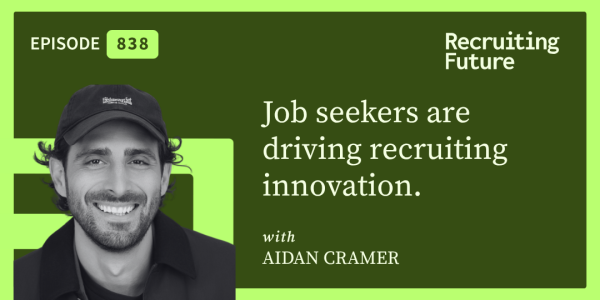
When employers talk about candidates using AI, the conversation is often about bulk applications, cheating or fraud. That conversation misses the sophistication of the technology being built for job seekers, some of which is changing how people find jobs and how they are matched to them. My own view is that the innovation in recruiting is being driven from the candidate side, and will continue to be, which is why TA leaders should know what is going on. So how do these tools work, and how should employers be thinking about them?
My guest this week is Aidan Cramer, Co-Founder and CEO of AIApply, a company building AI tools that help people find and apply for jobs. In our conversation, he explains how AI is being used to match people to roles, what the data shows about AI-assisted applications, where the line is between assistance and cheating, and what an agent to agent future means for employers and recruiters.
In the interview, we discuss:
- What are job seekers doing with AI and what is driving it?
- Bulk apply tools versus tools built around the quality of the match
- Why an AI agent needs to know when not to apply
- How job discovery is moving beyond keyword search to transferable skills
- What the data shows about interview rates for AI-assisted applications
- Does tailoring a resume to beat the ATS make any difference?
- How ATS providers are responding to applications from AI agents
- Where is the line between AI assistance and cheating?
- How sharing more context about a role filters out poor matches before anyone applies
- What does an agent to agent future look like and where does it leave recruiters?
Follow this podcast on Apple Podcasts.
Follow this podcast on Spotify.
Key takeaways
- AI tools for job seekers range from products that send applications in bulk to agents built around the quality of the match, where one of the most important decisions is when not to apply.
- AIApply’s data shows that applications submitted with AI assistance achieve better interview rates than applications its users submit manually.
- AIApply found that customizing a resume for a specific job made no difference to whether a candidate was interviewed or hired, while experience, credentials and how quickly someone applied mattered more.
- AI matching can draw on far more context than a keyword search, which allows it to identify transferable skills and suggest roles in adjacent sectors that a job seeker would not have searched for.
- The advice to employers is to share more context upfront about requirements, salary and what it takes to succeed in a role, so that poor matches are filtered out before anyone applies.
- AIApply expects job seekers to have AI agents that stay with them throughout their careers and employers to source candidates through those agents, leaving recruiters to focus on final interviews and understanding people.
Transcript
Matt Alder 0:00
The AI tools that are being built for job seekers are often seen simply as a way to apply for jobs in bulk. However, the market is much more sophisticated than that, and it’s changing the way job discovery and job matching work. I believe the candidate side is where the innovation in recruiting is coming from. So what’s going on that TA leaders should know about? Keep listening to find out.
Advert 0:26
Support for this podcast comes from Pinpoint. Your hiring needs aren’t one size fits all, so your ATS shouldn’t be either. Pinpoint is the ATS for multi-stream hiring. It brings every kind of hire, from frontline roles to executive search, into one flexible, easy-to-use platform. It adapts to how different teams recruit while giving you consistency and control across your organisation. And because more of your hiring happens in one place, Pinpoint captures the context that makes AI more useful. Your team can automate repetitive work, make more informed decisions, and spend more time on people. To find out more, go to PinpointHQ.com slash RecruitingFuture. That’s PinpointHQ.com slash RecruitingFuture.
Matt Alder 1:39
Welcome to episode 838 of Recruiting Future with me, Matt Alder. When employers talk about candidates using AI, the conversation is often about bulk applications, cheating or fraud. The conversation is missing the sophistication of the technology being built for job seekers, some of which is changing how people find jobs and how they’re matched to them. My own view is that the innovation in recruiting is being driven from the candidate side and will continue to be, which is why TA leaders should know what’s going on. So how do these tools work and how should employers be thinking about them? My guest this week is Aidan Cramer, co-founder and CEO of AI Apply, a company building AI tools to help people find and apply for jobs. In our conversation, he explains how AI is being used to match people to roles, what the data shows about AI-assisted applications, where the line is between assistance and cheating, and what an agent-to-agent future means for employers and recruiters.
Matt Alder 2:45
Hi Aidan, and welcome to the podcast.
Aidan Cramer 2:47
Hi Matt, great to be here.
Matt Alder 2:48
Absolute pleasure to have you on the show. Please could you just start by introducing yourself and tell everyone what you do?
Aidan Cramer 2:54
My name is Aidan Cramer, I’m the co-founder and CEO of a company called AI Apply. We are building candidate-side AI infrastructure in the modern job market. And practically that means we build tools to help people find and apply to jobs. And we’re building out more tools to help companies find and hire job seekers.
Matt Alder 3:12
Now, this is obviously a very big topic with employers, and it tends to sort of get bucketed together as candidates are using AI, which seems to sort of include, you know, a lot of different sort of strands of thinking. So it’s become a catchphrase for lots of different things. What are job seekers actually doing with AI at the moment and what’s driving it? What do you see from your customers?
Aidan Cramer 3:36
Like a high level, people want their job search to move forward without it consuming every moment of every day. So they’re using it primarily to just remove inefficiency. But there’s a whole range. So you have kind of some people that are using ChatGPT to update and write their resume. And some people that are building custom AI agents to mass apply to tens of thousands of jobs. And so there’s a really broad range within that of how people are using it. And then within that, you also have the tools available that also sit within that range. You have some tools that will send out thousands of applications on behalf of job seekers, kind of spray and pray. And then you have some tools that are more considered and focus much more on kind of high quality job matches and good submissions, which is the tools that we’re building.
Matt Alder 4:21
Tell us more about that, because again, I think everything sort of gets bucketed into one. I mean, from the employer’s perspective, there’s an absolute sort of surge of applications going on at the moment. Tell us about the tools that you’re building and what sort of separates them from those more generic bulk apply options that are out there.
Aidan Cramer 4:37
Yeah, so I mean, it comes down to application quality. So we are kind of building towards this vision where every job seeker has an agent in their corner and every company has kind of an agent working on their behalf to source. We have very high conviction that that is kind of the direction of travel in this market. And one of the most important decisions that an AI agent has to make on behalf of a job seeker is when not to apply. So a lot of our time and focus is spent on kind of building that feedback loop. So finding out what is working, what is not working and improving the job matching. And the initial job matching comes from context. So our agents can kind of take in more context than is humanly possible to ensure a job match is better than a human could have done themselves. So we’re pulling in millions of job listings, getting loads of context on the job seeker, their wants, needs, desires, and background, and then pulling in loads of context from companies. What has worked in the past, what hasn’t worked in the past, what actually makes this company tick. And we’re using all that to generate really good matches and ultimately good candidate submissions. Now that is hard. We have a large team of very talented engineers working on that and we have a lot of data from kind of lots of applications that are going out and outcomes from those applications, and that allows us to build kind of this virtuous loop of better matches over time. But starting out in this space the barrier to actually just submit applications is getting lower and some people are promising kind of the spray and pray approach, and that’s what’s kind of filling up the recruiters’ inboxes with spam ultimately. There’s also worth considering that, like, you know, the job market is really tough at the moment. There are, even without these tools, the disruption that’s been caused by the advent of AI in general is leading to more job seekers on the market than has been before, and we’re seeing that in the data just on the ratio of kind of people looking to listings available. So that’s kind of compounding this feeling of this kind of deluge of applications that are impossible to get through.
Matt Alder 6:44
It’s kind of the perfect storm, isn’t it? I think actually that is playing such a big part in it. And again, I think sometimes it doesn’t properly kind of get separated out in terms of really understanding what’s going on. I think that job discovery bit is really interesting, actually, because I think that there’s probably a perception amongst lots of people listening to the show that actually these tools are just all about applying. But you’re fundamentally sort of changing the way people find these jobs as well. Tell us a little bit more about that. What’s the candidate experience like there? How does the tool get that additional context about the candidate?
Aidan Cramer 7:17
So there’s one is just kind of the context and information gathering. There’s a lot of signals online about someone and their background that they might not consider to put in a resume or be able to put in a resume. So we do kind of a deep research to really understand what is available about a person. We then kind of gather more information through different interfaces like chat and voice, where people are more inclined to give more information. And then we actually look at what applications they’re applying to and declining, and that kind of feeds in this contextual picture. But kind of really interesting, like, you know, job search 1.0 or 2.0 was very much kind of keyword based, you know, someone, a hospitality manager, for example, who may have like super relevant training, scheduling ops experience, may start looking for jobs as hospitality manager in the traditional job search, and that’s all they’ll be kind of bucketed into. By using kind of these new tools or the things we’re building, we can identify those skills from their background and their experience that may be applicable across adjacent sectors, different types of roles, different types of jobs. So we’re doing a lot of surprising people. Once they’ve given us that context, surprising them with opportunities they might not have considered otherwise because typically they’d be going to LinkedIn and putting in a job title and seeing what’s available. And now we’re saying, actually, you know, you could be relevant to this. So the CV kind of tells us where someone’s been, but we also need to understand where someone’s going.
Matt Alder 8:48
I think that’s super interesting because I think from an employer perspective, that is something that the people are really thinking about, how AI can help them hire better. People are sort of working on as well. But I suppose there is a little bit of a legacy of employers maybe not recognising those kind of adjacent skills in quite the same way, unfortunately.
Matt Alder 9:11
You’re obviously processing a huge amount of job seekers and applications. What kind of data are you gathering? What can we sort of find out from that intelligence that you have?
Aidan Cramer 9:21
So on the applications that are kind of assisted or supported, we’re seeing actually like better application-to-interview rates than the cohort of users that are manually submitting applications. So actually the ability to go through like, you know, every job on the internet and find a match and submit it is much better for matching quality and outcomes than, you know, the human sitting, bouncing between job boards and going one application by the other, which was kind of our initial bet. But it’s good to see it actually come out in the data. Some surprising things that we didn’t consider. You know, we, before we kind of went into this world, we thought like tailoring a resume was really important to kind of job success. So we built a lot around kind of helping a candidate overcome the like ATS demons that were kind of not considering their real skills and experience. So we were using that context to kind of help build these resumes on behalf of candidates. Very important, I should say, like, you know, a lot of time to avoid any hallucination or making up any experience. This is just about kind of pulling in the things that are relevant to the job that the candidate has. But ultimately, we found that resume customisation had absolutely no impact on someone’s success, whether they got invited to an interview or ultimately got a job. And that’s kind of a bit of a misconception that if you’re kind of if you’re being successful, you know, honest and credible with someone’s background, just kind of stuffing in keywords to get through these filters just doesn’t make a difference. They’re actually quite sophisticated and they’re looking at real world experience and things like time to apply is more important and actual credentials, where you’ve worked, how long you’ve worked there and college, university experience.
Matt Alder 11:06
I think that’s such an important message because the amount of stuff that I see on LinkedIn with careers coaches telling people they have to beat the ATS and do all these kind of things. And they end up arguing with recruiters who are like, well, actually, that’s not the case. And it’s great to see that the data does prove that’s not the case. What else is kind of in there? Is there types of job board? What other sort of data have you got that could be sort of interesting to explore?
Aidan Cramer 11:30
It’s interesting the openness that kind of the ATS and some of the job providers have to receiving these types of applications. Initially, kind of the perception was that this was, you know, it was low quality. We’ve got to find ways to block these types of candidates that aren’t like taking time to apply themselves. And the actual self-apply seemed to be this kind of filter for quality and that the whole industry thought was very important. And we’re finding that actually now we’re kind of proving that these, you know, interview rates are higher, hire rates are higher, the candidate quality is improving because of better matching and better search and better context, that the actual application is much less important. Forcing someone to go through the effort of submission is much less important. And yeah, there’s just a massive openness from the job providers, the ATSs, to build credible pipelines between good agentic tools and good agents and find ways to work together to block out the bad agents.
Matt Alder 12:32
I think, again, that’s interesting because there’s a whole perception about is AI cheating and all this sort of stuff. And I think that the data, the evidence that you’re kind of presenting there is really actually these AI-assisted applications are good for everyone. They’re good for the employer. They’re good for the job seeker. What about AI use kind of elsewhere in the process? Because that level of authenticity is sort of really important. And what about things like the interview itself? Where is this line between AI assisting someone in an application and cheating in an application or misrepresenting someone in an application? Where does that sit?
Aidan Cramer 13:08
Yeah, I think we’re all still figuring that out, is the truth. And I don’t think it’s changed massively from the past. Some people are willing to put some fake experience on their resume to get their foot in the door or make things up during the interview. And sometimes they get through, but often the interview is there to flag and get those people out of the process. The tools are becoming more sophisticated to allow those willing and interested in cheating to be able to do so more efficiently. But I think also like it’s just a very small percentage of the overall job seeking population. Job seekers as a whole do not want jobs that they are not qualified for. They’re not prepared to kind of lie and cheat their way to get into a role. So it’s a very small percentage of people that are misusing tools to get through. And to the level of state-sponsored attacks really is where the headlines go. That said, you know, I think job seekers are desperate in a very difficult job market at the moment. And we have seen people willing to, you know, make things up or try harder to get their foot in the door. And I think that’s where the company needs to come in and just really draw a line and say, you know, very openly, if you’re conducting an interview, what are the fair use policies of AI during this interview? In your job, what are the policies where you can and can’t use AI? Like, is this an open book exam or a closed book exam? And there just needs to be some adaptation on both sides.
Matt Alder 14:42
The problem is, I think, is that the fraud thing is a very different issue and it’s getting lumped in with AI-assisted applications and all these kind of things, but it’s a different issue with a different solution and I think it’s important that you flag that up because it is something that people perhaps aren’t thinking about as clearly as they should. What would your sort of advice be to employers on a couple of things? I mean, the first one, just how should they be thinking about these type of tools? Is there a way that they can be working better with products like yours rather than seeing them as the enemy that are causing all these issues?
Aidan Cramer 15:18
I think like when it comes to actual, you know, putting job ads out and trying to source, context is now becoming like really relevant and very important. Tools like ours are built like in the interest of the job seeker to help them get relevant interviews and get hired. Like that’s where our incentive is and in order to do that we want to pull in as much context from the company and the job as possible. So I think we’re going to see a world move away from human readable job descriptions to machine readable prompts and just more context available on what the recruiter wants, what the hiring manager wants, like what are the needs for kind of experience and background, the kind of things that a HR manager would tell a recruiter over the phone. They’re the things that should be kind of flagged earlier on in the process so that the filtering happens upstream when the candidate or the candidate’s agent is doing the job matching rather than downstream after there’s kind of these applications that are not relevant. So yeah, really clear on requirements. I think we’re still going to have to get more open on, you know, salary and must-haves and, you know, what it really takes to succeed in this role. So we definitely want to see that change. And yeah, it’s all going to be about how can employers and candidates establish this mutual interest before the application is even submitted. That’s what’s going to be much more important. So yeah, context upfront, very clear on requirements, more information, more transparent, the better. And that will help kind of the upstream matching, which will solve the downstream problem. In the short term and then longer term, you know, the adoption of sourcing tools and sourcing agents for companies so they can tap into these agentic talent pools, that’s going to make the process a lot more efficient as well.
Matt Alder 17:10
And what about how employers think about talent and how they hire? I suppose alluding back to what we were talking about earlier about you’re finding those transferable skills, you’re helping people find jobs that they wouldn’t have thought of. What can employers learn from that aspect or what should employers be thinking about when it comes to talent?
Aidan Cramer 17:28
I’m probably biased but I think kind of willingness and openness to be at the forefront and learning about what’s going on in the world of AI is going to be critical in the next like, yeah, 18, 24 months and going forward. And I think we’re seeing that across like every level from entry level to like the most experienced hires. So it’s still the topic of conversation. I don’t think it’s going anywhere anytime soon. And yeah, being able to screen and test for that native understanding of using this new software is going to be critical.
Matt Alder 18:05
Final question. Where’s this heading? You spoke earlier about that you felt that the future very much looked like an agent-to-agent setup. And I really agree with that. What’s your vision for that? How do you think we’ll be recruiting in a few years’ time in that agent-to-agent world that seems to be being built at the moment?
Aidan Cramer 18:19
So yeah, we believe that candidates will have a job seeker agent that learns about them, goes with them through their career, that understands them very deeply, and is constantly scanning for the best possible opportunities on their behalf. And that will create this active talent pool of candidate agents that are constantly interested in what’s going on, signals in the job market. And then on the employer side, yeah, again, it’s going to be this like passive sourcing through candidate agents. And these conversations will be happening constantly in the background. So we’re trying to build the rails, the infrastructure that kind of connects those two. And at the moment, it’s kind of building these candidate-side agents. We have millions of them at the moment and they’re connecting directly with jobs. The next stage of the evolution is going to be able to like build these deeply integrated sourcing tools that are constantly scanning the market and finding these matches that are going to ultimately improve the efficiency of the labour market.
Matt Alder 19:21
And where does that leave humans in the process? Where do you think the role of a human recruiter is in this kind of vision of the future?
Aidan Cramer 19:26
So recruiters are brilliant at our final stage. You know, they also don’t want to be doing kind of the admin of sifting through CVs that have come through or the inefficiency. And ultimately, a lot of them, I believe, truly are brilliant at understanding what makes someone tick and what makes someone human. And it’s going to be a long time before kind of AI can really understand that. Is this person going to do well in this company? Is this human going to thrive in this role? And is it going to benefit them going forward? So I think, yeah, recruiters are going to be able to do more of the things that they are great at and enjoy doing, really understanding people, really trying to figure out like the skills gaps from the person and the company, and yeah, work with these agents as sourcing tools for themselves, but ultimately to spend time kind of doing those final interviews and understanding like, yeah, how to build brilliant teams.
Matt Alder 20:20
Aidan, thank you very much for talking to me.
Aidan Cramer 20:22
Pleasure, thank you so much for having me.
Matt Alder 20:24
My thanks to Aidan. You can follow this podcast on Apple Podcasts, on Spotify or wherever you listen to your podcasts. You can search all the past episodes at RecruitingFuture.com. On that site, you can subscribe to our weekly newsletter, Recruiting Future Feast, and get the inside track on everything that’s coming up on the show. Thanks very much for listening. I’ll be back next time and I hope you’ll join me.