
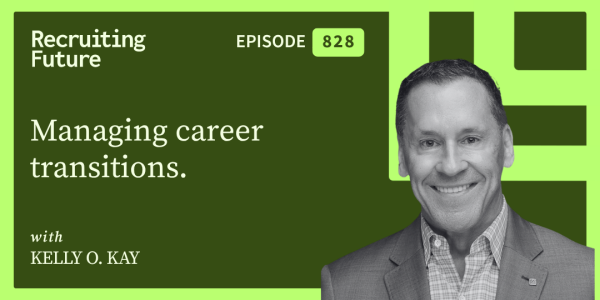
The world of work is changing quickly, and the way people move between roles is changing with it. Hiring for senior positions looks very different from the way it did even five years ago, while many people still approach their own careers with instincts shaped by a market that no longer exists. What does it mean to manage a career well in this environment, and how do the people who navigate transitions successfully approach them differently? My guest this week is Kelly O. Kay, Global Managing Partner of the Enterprise Software and AI Practice at Heidrick & Struggles. Kelly has spent more than twenty years in executive search, and together with his longtime colleague Jeff Sanders he has just published Show Up to Win, a Harvard Business Review Press book on how leaders should manage their careers and navigate transitions. In our conversation, he explains how hiring at the top has changed, why career management needs to be a continuous and strategic activity, where AI does and doesn’t fit into the process, and what people misunderstand about the way search firms work.
In the interview, we discuss:
- How hiring at the most senior level has changed
- What the best leaders do to get the best roles
- Career management as a continuous process, not a response to wanting to move
- Quality of company, quality of role, quality of offer
- Showing them how you think via executive dialogue rather than question and answer
- What people misunderstand about how search firms work
- Using AI as an interview coach
- What does the future of leadership careers look like?
https://www.linkedin.com/in/kokay/
Follow this podcast on Apple Podcasts.
Follow this podcast on Spotify.
Key takeaways
- Career management should be a continuous, strategic activity rather than something that begins the moment someone decides to change jobs.
- Turning down an approach without thought is a common mistake; even an unwanted role can be a route to a relationship with a CEO, a board, an investor or a specialist recruiter.
- Evaluating the quality of the company, the role and the offer separately helps take emotion out of career decisions.
- Interviews for senior roles have become a dialogue about how a candidate thinks, not a question and answer session about what they have done.
- Search firms have less influence over the final hiring decision than candidates assume, and their aim is to give the client a strong set of options to choose from.
- Skipping references because of familiarity with a candidate is a recurring cause of failed senior hires.
Transcript
Matt Alder 0:00
Senior hiring has changed a great deal in the last few years, with more diligence, more scrutiny, and far more focus on how a leader actually thinks. The way most leaders manage their own careers has barely changed at all. What does it take to navigate a career transition in a market like this? Keep listening to find out.
Advert 0:22
Support for this podcast comes from Jack and Jill. Jack and Jill are two AI agents changing how people find jobs and companies find great people. Jack gets to know what professionals want from their careers. Jill gets to know exactly who a company needs to hire. Together, they make warm introductions at the scale of the internet, matching people on far more than keywords and skipping the application altogether. Find your next great hire or your next great job at jackandjill.ai, that’s jackandjill.ai.
Matt Alder 1:17
Hi there, welcome to episode 828 of Recruiting Future with me, Matt Alder. The world of work is changing quickly, and the way people move between roles is changing with it. Hiring for senior positions looks very different from the way it did even five years ago, while many people still approach their own careers with instincts shaped by a market that no longer exists. What does it mean to manage a career well in this environment, and how do the people who navigate career transitions successfully approach them differently? My guest this week is Kelly O’Kay, Global Managing Partner of the Enterprise Software and AI Practice at Heidrick & Struggles. Kelly has spent more than 20 years in executive search, and together with his longtime colleague Jeff Sanders, he’s just published Show Up to Win, a Harvard Business Review Press book on how leaders should manage their career and navigate transitions. In our conversation, Kelly explains how hiring at the top has changed, why career management needs to be a continuous and strategic activity, where AI does and doesn’t fit into the process, and what people misunderstand about the way search firms work.
Matt Alder 2:31
Hi, Kelly, and welcome to the podcast.
Kelly O’Kay 2:33
Thank you, Matt. It’s great to be here.
Matt Alder 2:35
A pleasure to have you on the show. Please, could you introduce yourself and tell everyone what you do?
Kelly O’Kay 2:41
Sure. I’m Kelly O’Kay. I’m a partner here at Heidrick & Struggles. I’ve been here for 20 plus years and lead the AI practice and enterprise software practice. So nice to be invited on your podcast.
Matt Alder 2:54
You’ve been in executive search for over two decades now. We’re living through very interesting times when it comes to the world of work and technology at the moment. What’s happening in the market for senior leadership talent and how is hiring at that level changing?
Kelly O’Kay 3:14
Yeah, as you know, Matt, the market that Heidrick serves is really the kind of the executive market, sort of VP level and above. It’s incredibly competitive. It’s incredibly complex. It’s changed dramatically over the last five or ten years, the amount of due diligence that goes into hiring at this level. And it’s just a, especially with AI now, it’s just a much different process now. I would think that many of your listeners that have gone through this process recently would know exactly what that means, simply because you’re given case studies. You’re given lots of opportunities to show how you think in a process, not just what you say in an interview.
Matt Alder 4:04
You’ve also just co-authored a book. Tell us a little bit about the book and why you wrote it.
Kelly O’Kay 4:09
Yeah, well, congratulations on your books. You have a couple of books out as well. Let’s see, my co-author, Jeff Sanders, and I decided to write this book during COVID. And what happened was he and I, and colleagues of not only ours at Heidrick, but around the industry during that time, remember, people were getting hired without ever having met anybody. And it was the most uncomfortable, unfamiliar process for everybody in the entire world. And so the questions that were coming in fairly frequently were, you know, the obvious questions. What do I do? Should I leave? How do I negotiate? It’s just like all the standard questions that you get, but in the context of COVID where you couldn’t meet anybody. And we’ve been watching, Jeff and I have worked together as colleagues and friends for the entire time I’ve been here, 20 plus years, and paid attention closely to what the best leaders do to win these competitive jobs and what are leaders doing that they don’t win these competitive jobs. And as one leader I spoke with said, the graveyard of opportunities that they didn’t get. And so we decided to write the book because when you step back, there’s really nothing that’s ever been written on the end-to-end process of a career transition. It’s not just about interviewing. And so when we thought about not only what we see in the market every day of best practices and worst practices, it became very clear. There’s really nowhere for leaders to go to get advice other than from people that are doing what Jeff and I do. And so to make it available and democratise that advice is really the purpose, but in a very practical way. So it’s not a bunch of platitudes.
Matt Alder 6:02
Let’s dig into it a little bit more around the transition thing, because obviously you work with highly accomplished leaders, people who are brilliant at running businesses, the best in the world at what they do, but they’re still getting their own career moves and their own career transitions wrong. And I know that everyone listening has probably the same issues with career transitions. What is it that people get wrong and why is that? And how do they need to think differently?
Kelly O’Kay 6:30
Yeah, here’s the couple things that we see often. And there’s a long list, by the way, so I’ll give a couple examples, but in the book we talk about lots of them. Career transitions, well, career management, let’s just sort of zoom out even further. Career management is typically thought of the minute somebody wants to change jobs. That’s typically the way people think of career management versus thinking about it proactively, strategically throughout their entire career, whether they’re happily employed or actually in a mindset that they want to start to look. So just thinking more broadly about the best practice of managing your career, not just when you need a new job or want to change jobs. But the things that we see often that they get wrong is they say no to opportunities. If somebody’s very heads down in a role in a company, they get a call from someone like Jeff or I or colleagues or others in the industry. And the response we hear most often, Matt, is I don’t want that company, I don’t want that job, or I don’t want to waste anybody’s time. I mean, that’s really what the majority of people say. What Jeff and I lay out is an argument that that’s actually not the right way to think of it. At this level, the right way to think of it is really much more strategically. Can I build a relationship with somebody, the CEO perhaps, or someone on the board, or maybe the venture firm that’s invested in it or the private equity firm that’s invested in it? There’s so many other ways. Or is it a recruiter that specialises in your talent, in your sector, in your geography that you haven’t met? That’s a great way to get acquainted with that recruiter. And so thinking of the decision to say yes is a much more strategic decision. We see the answer of no as sort of one of the early steps in the funnel, if you will. The other thing that we see, again, there’s a long list, but I would highlight one other area, which is letting emotion play too big a part in the decision. And we talk a lot about this when we offer a bunch of frameworks in the book, Matt, as you know, you’ve seen the book, you’ve read the book, that we’ve tried to just simplify some of the concepts that we’ve introduced. And one of them is the concept of the quality of the company, the quality of the role, and the quality of the offer and a framework to evaluate each of those, which we hope will help take out some of the emotion. Oftentimes, let’s face it, senior leaders are the ones usually seducing, going after somebody, recruiting. But when the tables are turned and that recruiter all of a sudden is being recruited, and being desired and wanted and needed, and it’s just emotion sometimes plays too big of a role, and they don’t often — sometimes when Jeff and I get to the end of a process that someone’s been recruited, and we’ll say, do you actually want the job? And they’re like, I don’t know if I actually even want it, but it felt I wanted to win. And so getting the emotion out of this decision process and making sure that for an executive it’s actually what you want to do is a big part. It sounds maybe obvious. Be shocked how often it happens.
Matt Alder 10:10
I think both of those points are really interesting in the context of what you were saying about the market being so competitive, because what I see quite a lot is senior leaders going into the career market, maybe they’re forced to in some way or they’re looking for a new opportunity, and just being amazed that it’s not like it was ten years ago or five years ago or fifteen years ago. Do you find that very often? Are people confused by how things are now compared to how they used to be?
Kelly O’Kay 10:36
Yeah, very much so, Matt. It’s changed pretty radically, pretty quickly. And that’s the part that, you know, if you think about from a demographic standpoint, folks at the senior peak of their career, they’ve probably been working for 30, maybe 40, I don’t know, 20, 30, maybe 40 years. And they’ve been doing it the way they’ve been doing it for a long time. If they haven’t interviewed in a little while, they come into a market like this and they revert back to their traditional view of interviewing, which is, Matt, you ask the questions and I answer them. That is absolutely not the way it works anymore. At this level, this is all about an executive dialogue. I think in the book, we cite one of the quotes I think I like most for this to highlight this insight, which is Fidji Simo talks about the way to show up. And the way to show up, she describes, is be clear about who you are, what you believe and how you plan to contribute. Bring ideas, show them how you think. That is a fantastic way for people to think about how to navigate this process, because it’s not just about, let me regurgitate what I did at the last few companies. It’s all about tailoring this discussion for this opportunity in this moment, but showing how you think.
Matt Alder 12:14
I know a lot of people listening will feel that they’re familiar with what search firms do, but I’m just really interested if you can give us a little bit of a view from the inside around executive search. I mean, where are the big misconceptions? What do you think people misunderstand the most about the way that you work and what you do?
Kelly O’Kay 12:34
Most people think that we may have a bigger voice than we do in the hire. I think most people will think that we have a vested interest in the outcome, in terms of it’s our candidate versus your candidate. I mean, the reality is what we want is what’s best for the company. As I tell every client that I ever work for, I mean, at the end of the day, we want to get you the best possible leader in the shortest amount of time. And it’s literally the best as defined by you, Mr. and Mrs. Client, not by us. So our job is to make sure that we provide lots of great options. So you, at the end of the day, have great options to choose from.
Matt Alder 13:25
We’re talking about AI changing all kinds of different aspects of hiring. What’s happening at this level? Is it having any influence on how people assess talent or how candidates show up? What impact is it having, if any?
Kelly O’Kay 13:40
I think it’s different at the senior level than it is at earlier in career. At the senior level, it’s being used in lots of ways to prepare. I mean, the obvious way, the way everybody probably does it today is research on the company, research on the executive, etc. I still continue to give advice, and we talk about it in the book, use it as an interview coach. And what I mean by that is, you know, put the job description that you’re being asked to be considered for, the company, as much data about the company, as much data about the person you’re going to be speaking with, your own bio, put it into whatever LLM you use, and then toggle back and forth between asking your interview coach, what questions would this company, this person, this company ask this individual about this role? What’s the most concise way to answer those questions? And again, it’s not meant to give you the answer of how to answer it. It’s just meant to give you some preparation and some practice because let’s face it, the folks that have too much practice interviewing, that’s not good either. That’s a whole different issue. So that’s one way it’s being used at the senior level in advance. We just announced, I mean, one of the things I’ll just shamelessly plug, one of the products that we just came out with called Heidrick Immersive. And what it is, it’s an experiential sort of assessment in the process itself, to really explain and show how leaders think, how they think with real-time situations, under pressure, etc. So it’s another way to provide some judgement to our clients in this process. And then afterwards, it’s being used lots of different ways post-process. But at the end of, it hasn’t been able to actually shorten the amount of time that it takes to hire an executive. Because if you think about at the senior level, these bets, and you know this, Matt, these bets are so big. I mean, one of the, Ryan Green in the book at Francisco Partners talks about these are billion-dollar bets that companies are making when they hire a senior executive. So they still need to run through the process, references, case studies, in-person meetings, however many interviews. And so it’s being used throughout the process. I mean, I think the one area where at least I keep seeing earlier in career, because your audience, I understand, is going to be the full spectrum, earlier, mid, and senior. But obviously, the earlier in career, it’s being used much greater, much greater percentage in a much more inclusive way by identifying candidates, qualifying candidates, assessing them through AI. So that is all happening as people listening in your audience are probably aware of and have done. But at the senior level, the in-person meetings are incredibly important.
Matt Alder 17:02
And I suppose on that process point, what is it that employers could be improving or doing better around the processes that they run around this type of hiring? What would your advice be in terms of improving it to really get the results they’re looking for?
Kelly O’Kay 17:18
I think at the end of the day, the best thing that companies can do and continue to do. So it’s not like they’re missing steps. Every company does it a little bit differently. Referencing what we’ve seen, one of the things that we’ve seen that’s changed a great deal is just the quality and quantity of references that are being done. And so if that step is skipped, we typically see issues, even when, I mean, recently I saw a situation where somebody had worked with, a leader had worked with a leader at a company years ago. They knew each other. The leader that was at the future company hired this leader who they had some familiarity with at a previous company. Because of the proximity, the familiarity, etc., they skipped the reference step. And then that person was fired a year later, because at the end of the day, the familiarity that they worked together at the previous company was a big company. The company that the leader went to that was hiring was at a much smaller company. And they just skipped the whole, they relied too much on relationship, too much on past, and not really, didn’t put up enough effort to validating and vetting this person for this new opportunity.
Matt Alder 18:45
As a final question for you, as we said sort of all the way through the conversation, things are changing very, very fast at the moment. What do you think the future might look like in terms of how executive search works, but also how leadership careers might be different in, say, two to three years’ time?
Kelly O’Kay 19:05
So this may sound a little self-serving, Matt, so I apologise if it comes across this way. But honestly, my focus and Jeff’s focus and Tom Monahan and Tom Murray, our CEO and president, who have been fantastic supporters of the book. I think what we’re hoping is that the book will help leaders navigate their career management and career transitions much more effectively, much more productively. If that happens and if people, I mean, at the end of the day, Jeff and I, we have kids earlier in career that are early in, you know, right out of college, earlier in their career. Our hope is that this book, again, this is the self-serving part. But you’ll hear in a second, we hope that this book resonates with the next generation of leaders, because if you think about it that way, it literally can change the world if people who didn’t have access to this advice, and by definition, they don’t, unless they have a parent like you or Jeff or me or one of our colleagues who… If they could make, instead of having a graveyard, as I mentioned earlier, of missed opportunities, maybe they used the best practices from this book. If you think about it, between Jeff and I, it’s 50 years of pattern recognition and experience put into 180 pages. And if that happens, that could change the world. If people literally start their careers by being given advice that they’ve never been given before. Because let’s face it, if senior leaders aren’t getting this right and they have access to the best network that they’ve developed over a lifetime, boy, the earlier in career, next generation leaders surely could use it. So from a future hope standpoint, which is the question, we hope that lots of people around the world read the book. It changes the world. It may be a little bit too idealistic, but I do think it’s possible.
Matt Alder 21:18
And it’s a great book, and I would recommend that everyone listening reads it. Kelly, thank you very much for talking to me.
Kelly O’Kay 21:25
Matt, it’s been a pleasure. Thanks for the opportunity.
Matt Alder 21:28
My thanks to Kelly. You can follow this podcast on Apple Podcasts, on Spotify, or wherever you listen to your podcasts. You can search all the past episodes at recruitingfuture.com. On that site you can also subscribe to our weekly newsletter, Recruiting Future Feast, and get the inside track on everything that’s coming up on the show. Thanks very much for listening. I’ll be back next time and I hope you’ll join me.