
The way people look for work is changing fast. A growing number of job seekers now begin by using tools like ChatGPT, asking questions in plain language about roles, salaries, and what it’s actually like to work for a company. It is a very different starting point from typing a job title into a search box and scrolling through pages of aggregator links.
At a time when employers are drowning in low-intent applications, something interesting is happening at the other end. Candidates who find roles through AI search arrive with real context about the company, the role, and why it fits their life.
So how can employers make the most of this new world of job search?
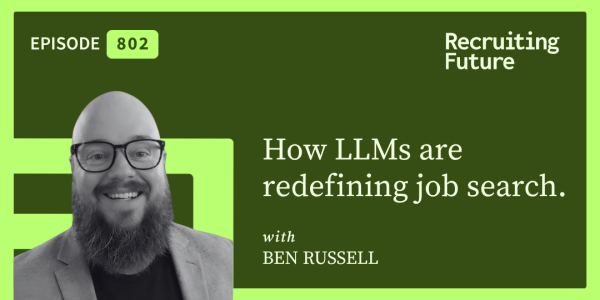
My guest this week is Ben Russell, Co-founder at SonicJobs. In our conversation, Ben explains how AI-driven job search is developing, what it means for candidate intent, and why he thinks this moment could rebuild trust between employers and job seekers.
In the interview, we discuss:
• The role LLMs are now playing in the job search.
• Changes in job seeker behaviour
• Lessons from the rise of Google
• Building apps in ChatGPT
• Implicit and explicit discovery
• The implications of conversational search
• Delivering well-informed, high-intent applicants
• How employers can own their own brand
• What does the future of the job search look like?
Follow this podcast on Apple Podcasts.
Follow this podcast on Spotify.
00:00
Matt Alder
The rise of large language models is changing the way that people look for jobs. Search is being redefined. Candidates are arriving better informed and the rules for reaching them are shifting. So what does this mean for employers? Keep listening to find out.
00:34
Matt Alder
Hi there. Welcome to episode 802 of Recruiting Future with me, Matt Alder. The way that people look for work is changing fast. A growing number of job seekers now begin in tools like ChatGPT, asking questions in plain language about roles, salaries and what a company is actually like to work for. It’s a very different starting point from typing a job title into a search box and scrolling through pages and pages of aggregator links. At a time when employers are drowning in low intent applications, candidates who find roles through LLMs are arriving with real context about the company, the role and where it fits into their life. So how can employers make the most of this new trend? My guest this week is Ben Russell, co founder at Sonic Jobs.
01:26
Matt Alder
In our conversation, Ben explains how AI driven job search is developing, what it means for candidate intent and why he thinks this moment could rebuild the trust between employers and job seekers.
01:39
Matt Alder
Hi Ben and welcome to the podcast.
01:41
Ben Russell
Hey Matt, how are we doing?
01:43
Matt Alder
Doing very well, thank you and it is an absolute pleasure to have you on the show.
01:48
Matt Alder
Please could you introduce yourself and tell everyone what you do.
01:51
Ben Russell
Wonderful, thanks Matt. Thanks for the invitation. Yes. So my name is Ben Russell, I’m one of the co founders at Sonic Jobs. Originally from the uk, I now live in the US with my family in the Bay Area.
02:02
Matt Alder
Fantastic. And tell us a little bit about Sonic Jobs.
02:06
Ben Russell
So We’ve been building Sonic Jobs, been building technology in the US now for the last four years really focused on using AI and specifically AI agents even before they had then you name to really improve the discoverability and the appliability the way that candidates apply for jobs.
02:27
Matt Alder
And you’ve got a particularly interesting relationship with OpenAI. Tell us about that.
02:32
Ben Russell
We’ve been partnering with OpenAI for the last couple of years now. Yeah, two or three years. We share some investors in common which is helpful and also we’re part of their startup program we which essentially means that we get advanced access to the latest models which obviously we then use and embed in our technology and also some of the new product initiatives as well. So we’ve been at the last couple of dev days, we’ve done little bits of PR together in the past and so, yeah, it just gives us, I guess, advanced access, but also just advance support to some of these initiatives and figuring out how we can bring them to market in recruitment and in TA.
03:14
Matt Alder
Let’s just talk about LLMs and what’s going on with them because they’re growing so quickly, they’re dominating the conversation. I mean, what is the growth like?
03:23
Ben Russell
They’re already such a meaningful channel. I mean, gone is the debate around what is this new channel, is it going to be meaningful, how to engage? So now they are so dominant in most of our lives. So ChatGPT specifically, which still has the biggest market share in the U.S. also globally, but in the U.S. i think it’s now 65% of the market share they’re seeing. I think it’s now 900 million weekly users. The thick end of 20 billion weekly prompts. Again, I mentioned about, I think 40% of this usage is estimated to be us. And what’s really meaningful for all of us closer to home in the TA in recruiting field is estimated that around 1 in 5, 1 in 6 of these prompts already relate somehow to pay to salaries, to careers, you know, to improving life through work.
04:15
Ben Russell
And that’s the full spectrum showing the influence of these LLMs from, you know, research, discoverability, about companies, about individual roles, about salaries, about building a resume, about interview prep, about how to ask for a raise or how to, you know, upskill in certain areas. It’s a real cross spectrum, but clearly it’s the place where the job seekers are already starting their search but also really using to benefit like I guess that career quite holistically across, you know, all stages of search strategy, employment, onboarding, offboarding and everything in between.
04:53
Matt Alder
It’s really interesting because I was actually listening to a podcast the other day where they were talking about life before Google. So that short period of time where we had the Internet but we didn’t have Google. And I know that lots of people probably don’t remember a time when Google didn’t exist, but some of the older listeners out there, myself included, can remember what the Google revolution was like and how that developed. How does this compare to what was going on with Google all those years ago?
05:21
Ben Russell
That’s a great question. We all remember Google and we speak a lot about Google and this new wave, of this new wave, you know, GEO, AEO, SEO 2.0. It’s a new way, but it’s called SEO 2.0 because we’re comparing, you know, obviously to those Google days. And everyone remember early days of Google, early 2000s, everyone remember performing, you know, any job based search and seeing five pages of, you know, likely indeed URLs. Everyone also remembers and companies that we speak to directly remember that being very frustrating, but also what almost felt more frustrating. Even when you search for specific companies, those companies themselves might be buried on page two or three in the results.
06:07
Ben Russell
You know, jobs at careers, at Coca Cola might actually be on page two behind again, a whole bunch of aggregator, you know, job board and again, often, typically, indeed, URL. So when we speak to companies about this time, it’s tinged with a level of kind of annoyance and so worth maybe spending a minute to dive into that, you know, this feeling that job boards got there first. I guess it feels that’s not really in debate of did they get there first? They did, but maybe. Why? A short answer that we give is that, you know, indeed in these other aggregators, they just meaningfully engage in this new channel. So even before Google was Google, they could see that consumer behavior was changing and figured out early it’s essential that we get involved. That’s a theme, obviously, that’s very relevant today.
06:59
Ben Russell
How did they get involved? They really understood what Google was looking for. So you know, if you remember the first versions of these aggregator sites, they mirrored exactly what Google looked and how it performed. I mean, at one point I actually think, indeed actually had a little tagline of like it’s Google for jobs or something like that. It was thousands upon thousands, millions upon millions of pages. You know, every job title and every location. All these pages were structurally consistent, easy to crawl. They figured out scraping so that they could aggregate supply, really kind of turbocharges, flywheel, even more pages, even more search results, even more indexing. And they figured out linking effective backlinking strategies in order to impact, positive impact, domain authority. So I guess, short answer, they understood what Google was looking for. Google was and is a search engine.
07:55
Ben Russell
And so what does a search engine need? It needs search results. If you can position yourself as an entity with loads of search results and Google’s going to love you, why is it important that Google loves you? Because Google was the channel growing, you know, quicker than anything else. And we talk about growth, you know, chatgpt as impressive as 900 million weekly users is, what I think is more impressive is it’s growing five and a half times quicker than Google did in these early days. So, you know, you sort of blink and you sort of forget. It seemed like out of nowhere Google came and kind of took over all of our lives from a search perspective, ChatGPT is actually doing that five and a half times quicker. So at this rate, you know, they’ll be of comparable size really before we know it.
08:35
Matt Alder
Yeah.
08:35
Ben Russell
And so we get asked this question around, okay, you know, in some ways, not how is it different from Google, but some of these seems to feel quite similar. Platform changing, consumer behavior growing quicker than anything else. How do we engage? We talked about the incentive point and Google’s incentives were and are different. We believe that because again, if you think about Google’s model, even now, but especially in those early days, it made its money from ads. So it was a search engine, it needed search results and it was going to charge companies to be the top of the results pre IPO financial support this theory, I think it’s something like 98% of revenue came from its AdWords product.
09:17
Matt Alder
It was interesting because it solved a problem because at the time no one knew how to make money out of adverts on the Internet. So it kind of created a business model. And it’s funny now, you thinking back, you kind of forget that, but, but it did.
09:30
Ben Russell
Absolutely. And so again, it all kind of made sense. And maybe these companies, maybe these aggregators would just naturally a better fit for that kind of model where give me links, give me search results, make it a very buoyant search engine, and then I’m just going to charge companies to be the top. So anyway, it worked beautifully. Well, I guess for those companies involved, we speak to a lot of enterprise companies actually feel like a high level of frustration. I really felt they spent, you know, years, if not decades, almost like winning that sort of, you know, candidate traffic back, which, you know, when you’re using your own company name, feels kind of like it’s rightfully yours. So comparing that now to ChatGPT data from last year, the vast majority, I think it’s 75% of revenue from ChatGPT comes from subscriptions.
10:18
Ben Russell
So that’s coming from individuals who Pay to use ChatGPT more because it’s a really useful tool. So very different to Google’s making money from ads. You know, I need results that I’m going to charge you to be the top result and then send you on your merry way. ChatGPT is making money by keeping people inside ChatGPT, which is a very significant difference and I think a really exciting opportunity for those companies that want to build, you know, into ChatGPT to make it an even more useful ecosystem. More useful means the candidates and users rather want to spend more time in there. And one of the ways they’re doing that, and they announced that their dev day last year is with this new app product. And apps essentially are ways for third parties to natively build inside of ChatGPT.
11:10
Ben Russell
And the stated goal, which I think is interesting, the stated goal from OpenAI on this product is for these apps, these third party tools, to live natively and fit naturally in the conversation. I fit naturally inside ChatGPT and can be called and are discoverable in two key ways. So they are explicitly discoverable. You know, you exist as an app in an app store, not vastly different to the apps from an Apple kind of app store framework. So now if you’re going to try to be t, you can see neatly on the left there’s an apps icon about four down from, you know, its tools. So you can search for your favorite apps, call them explicitly and use them to perform the task.
11:49
Ben Russell
And, and also, which is maybe more exciting and more impactful, OpenAI’s commitment to suggesting these tools based on a generic prompt, based on the context of a user’s prompt, which ChatGPT deems, hey, this tool, this app, this third party integration is the best answer for this query. So you’re sort of getting, yeah, a pincer approach where it’s an explicit, you can find it, you can advertise it, but also ChatGPT is going to recommend it as well. So it seems a really exciting new product to influence and get your in our world, jobs and career side content inside ChatGPT which, you know, again is the goal for OpenAI. They want to make ChatGPT as useful as possible, to keep you in there for as long as possible and get you coming back as often as possible.
12:40
Matt Alder
And just to clarify, how does that work? If someone says, I’m looking for a job or where can I find a job in a particular place? Then ChatGPT suggests apps that connect to jobs that are going to help that.
12:53
Ben Russell
Yes, absolutely. So the discoverable in two key ways. So what you’re talking about, Matt, is what OpenAI refers to as an implicit. So implicit discovery when you haven’t tagged your favorite tool to perform a task, you’re looking for answer still. So in a TA world that could be, hey, I’m looking for a nursing job in this area that pays this amount of salary. So at the moment, you know, ChatGPT is trying to figure out the best answer for that prompt and these apps become almost like answer type to these queries. And interestingly, you can see on Claude, they’ve actually sort of taken a step ahead in terms of how they’re thinking about implicit. And now if you go to Claude perform something fairly generic, non branded in a jobs context, it starts suggesting what they call connectors. Right.
13:47
Ben Russell
But it’s fundamentally the same sort of infrastructure where it’s suggesting these tools of, hey, I think what you want lives in here and it doesn’t just live in jobs. Obviously Expedia and some of these other big companies have been building for quite a while and Expedia is already starting to see a lot of this implicit search volume come to them without any prior knowledge of the brand.
14:08
Matt Alder
And how are you working with these apps? What is it that you’re doing that’s different? What’s the opportunity to change recruiting here?
14:16
Ben Russell
We’re building individual apps for enterprise clients, for enterprise employers. So we’re actually building, as opposed to us building say a Sonic Jobs app in a similar way to say Indeed has built an Indeed app, we’re building individual employer apps. So it allows individual companies a way to integrate, you know, all of their jobs. There’s no paper, performance budgeting cpc, CPA element here. It’s all jobs all the time in your own dedicated app that again lives natively in ChatGPT. So we’re working with companies directly to build these apps on their behalf.
15:00
Matt Alder
What’s the job seeker experience like? If I was looking for a job, how would that work?
15:05
Ben Russell
I think the job seeker experience is probably in some ways the thing that’s coolest and most different because the thing that OpenAI showed us is a different way to search. And I think now we all do. We all got really used to how to speak to Google. So it was very keyword based. You almost didn’t want to have kind of too much noise. It was, you know, I’m looking for a job title in a location. The most common search is like, you know, jobs near me and things like that. What ChatGPT has shown us is natural language is a much better method of searching. It’s why humans speak in natural language. And if you were speaking to a recruiter and they said, you know, hey, what kind of job are you looking for?
15:56
Ben Russell
I don’t imagine people would apply to a recruiter and say, nurse near me. They would say, I’m a nurse with 12 years of experience, I live in this area, I have access to travel, I have a car, or I don’t. This is my family situation, this is what I like to do. My personal life, you know, you would provide criteria which are really kind of broad about you as a person. And then the individual go, okay, cool. When you say that maybe, you know, you’re a single parent or you’re thinking about starting a family, you know, the implications for that, and you start thinking immediately, okay, you probably need, like, a fixed working pattern. Like, you probably don’t want variable shifts. You probably don’t want a night shift if you’re a single parent.
16:41
Ben Russell
If you don’t have access to a car and you’re based in a certain location, you’re looking for those in public transport areas, you’re looking for those. And maybe you can walk or cycle to work. If you talk about maybe your health and, you know, desire to, say, get fitter. This year in 2026, you know, it’s looking at jobs which might have access to a gym. And so that’s. That’s exactly what the search on these tools allows you to do. And I would really welcome anyone and everyone to, you know, connect with one of these tools. We recently, last week, launched the Johns Hopkins Career App. And seeing how you can search, it’s so much different from, you know, keyword, job title, location. And you can say things like, you know, I’m experienced in this area. Here’s my resume. You know, these are the.
17:26
Ben Russell
These are the aspects of a job I like and don’t like. And seeing how search now works with, in natural language, I think, is honestly really incredible. I think it’s a really significant step forward in terms of kind of job search and discoverability. So, yeah, I could talk about it forever, but really, I encourage everyone to go and, I mean, have a play with one of these tools because I think it’s really amazing. And we’re always kind of amazed as well by the results, because we’re joking the other day when we’re on Airbnb and you are looking for this sort of experience, and my colleague was joking that, you know, she just wants somebody she can play pickleball. So whether there’s, like a court nearby or maybe there’s space or whatever it is, and it just couldn’t figure out what to do with that.
18:06
Ben Russell
We now do the same search on, you know, with a job, hey, I’m a nurse and I like to play pickleball. And seeing the results is super cool. Like, it says, hey, like, you probably need to make sure you got enough time off. This hospital has a gym facility. They might play pickleball there. You know, it’s. Yeah, it feels as a really significant step forward now, which we are really excited about.
18:27
Matt Alder
And I Think for an employer perspective, it’s interesting as well, because one of the issues that employers have at the moment is they’re getting thousands of applications. AI is kind of being used to apply quickly and all those sort of things. But often there’s very, very little intent behind them. So sometimes they’re dealing with seekers who don’t even know they’ve applied to that particular job. But through this kind of channel, it sounds to me that you’re going to be getting job seekers with a kind of a real sort of high intent to want to work for that particular company.
19:00
Ben Russell
That’s what we’re seeing. We’re just seeing that the discoverability part, even like before you’re ready to apply, is so much richer. Like candidates are researching more about the company because again, they can really easily. You don’t now need to go and read five different websites, read, you know, 10 different blogs. You can do all of that inside a ChatGPT or a Claude or you know, where else you’re performing your searches. So yeah, we’re absolutely seeing just a much more meaningful engagement which again is leading to just better outcomes, like more excited, relevant candidates that are really excited about this job knowing that it, you know, suits what they’re looking for. Job sees absolutely what, you know, employers are looking for. They don’t want to be wasting their time with irrelevant applications.
19:45
Ben Russell
They certainly don’t want to be wasting their time with like almost, you know, auto apply, not even being conscious of the applications.
19:54
Matt Alder
Exactly.
19:55
Ben Russell
They want this really meaningful. And so I do think, and OpenAI has talked a little bit about this as well. I think this technology really allows that kind of headhunter, recruiter relationship, but for just the full jobs market. I mean, if you think about really, you know, senior exec level roles, I wouldn’t know, but I’m sure being a CEO of a Fortune thousand companies, not the hardest thing. When you’re in between jobs, there’s a whole market dedicated for helping very senior high paying individuals into other, you know, great jobs. But like lower down in the market, you know, for the rest of us, there isn’t that kind of level of support. A lot of it is you have to do all of the heavy lifting yourself, the research, the understanding about the jobs, the understanding about the companies.
20:44
Ben Russell
You know, I think this is like a really meaningful step for essentially, you know, a kind of head hunter or a recruiter agent for, you know, every job seeker in the world, which I think is just a really exciting shift that AIs enabled where previously economically it wouldn’t make sense to help an individual into a better hospitality job, but now with technology you absolutely can do that and you can have this technology really working on your behalf to really meaningfully improve your life. So yeah, I think it’s super exciting.
21:18
Matt Alder
You mentioned indeed a few times and they’re doing things in ChatGPT as well. How does this differ from what indeed are doing?
21:28
Ben Russell
Indeed are amazing at a lot of things. I’d say the thing that they’ve proven themselves to be the maybe the best at is identifying job seeker trends. I mean how indeed figured out in the early days how to work with Google. My opinion, you know, made indeed without that they might have not even been a meaningful business at all. And so the fact that indeed is really, you know, aggressively building into the ecosystem I think is a great validation point that there’s a reason why they’re doing that. They can see this as being the next wave of consumer behavior and job seeker behavior and they want to position themselves with right at the top of the funnel exactly like they what they did for Google.
22:20
Ben Russell
I also think when we spoke to to companies that’s also serves as much as a bit of a warning because do you want as a brand to be continually eternally disintermediated from the like the source kind of truth and really the source of candidates and have to work and have to get all these candidates through these other job boards. Now’s the time that you can build yourself and speed always works in new marketplaces. You know, early integrations in all aspects in all platforms, you know, become those default answers especially in organic discoverability channel. So it’s a really exciting time to really ask yourself hey, do you want to be reliant on the likes of and indeed for the next 10, 20 years as well. And if you do then that’s fine. When we speak to companies, 9 out of 10 say no we don’t.
23:19
Ben Russell
And again building in this way is a really meaningful way to really kind of disintermediate yourself to divest some of that spend and actually invest in your own brand versus being reliant on someone else’s.
23:32
Matt Alder
We’ve almost exclusively been talking about ChatGPT and OpenAI. Does your approach work with some of the other LLMs that are out there?
23:41
Ben Russell
Yes. Yeah, absolutely. We’re trying to build, we’re positioning this product as you know, one integration on behalf of an employer. The integration itself was mentioning is very light on the employer side. So you know, we need some logos, we need a feed of jobs just to make sure that, you know, the actual data is as up to date and as relevant as possible. But that’s it really. We do all the heavy lifting. And so to start with, we’re building into ChatGPT and OpenAI because that marketplace is more mature and also again, it is still the market leader by some significant ways. It just makes sense to build there first. But no, we’re already in conversations and actively building with the likes of a Claude with a Gemini and with these other platforms that are kind of figuring out they’re sort of a similar approach.
24:26
Ben Russell
The good thing in some ways have been this kind of AI arms race between these platforms is any good idea that any of them has. The others look quite quickly and think we should do something similar. So the fact that when OpenAI came out with this apps product again a few months ago now I think it was only September last year, Claude immediately started working on their version. I mentioned they actually took a little step forward in terms of how they’re thinking about explicit and now you can already see that on their site, which then incentivize OpenAI to do the same. Gemini has fallen a little bit behind, but obviously, you know, has the power of Google behind it. So yeah, we’re working with all of these platforms and again from an integration, from our perspective, it’s a one to many approach.
25:07
Ben Russell
So it’s one product, one integration you’re building with us and then our goal is to get your jobs across all the LLMs in all ways. You can be across all these LLMs as well. So we really try to forward future proof, you know, your LLM discovery strategy.
25:26
Matt Alder
Final question for you. It sort of hinted at this a little bit, but what do you think the future looks like? How is this going to change recruiting? What’s the vision for where this is all going?
25:37
Ben Russell
Yeah, that’s a tough question. Probably always a tough question. But now it feels more so than ever. I think in times of like real change, it’s possibly helpful. I think it was a Jeff Bezos quote about it’s looking at what maybe won’t change at the time of high change, what kind of won’t change. And I think with that lens there are some things that I don’t believe will change quickly. Job seekers will always want to find, you know, better, more meaningful work. I think there was a stat of the Labor Department statistics referencing as many as like 100 million Americans are looking for another job like looking for that kind of better job. So you’re always going to find candidates that are looking for better, more fulfilling work.
26:29
Ben Russell
And you’re always going to hopefully have companies that are looking to hire, you know, bright and amazing talent. And so what’s interesting is on both sides of the marketplace you’ve got a willing buyer and a willing kind of consumer, but in some ways almost the industry kind of gets in the way. And I think unfortunately right now we live in a moment where trust actually between both parties is like an all time low. Like if you speak to candidates, they are complaining about, you know, fake jobs, about being ghosted, about AI, maybe not being used in a way to help them find like, you know, better, more fulfilling work. And the same thing on the employer side, talking about, you know, auto apply, talking about bot apply, talking about, you know, all of this.
27:22
Ben Russell
And so it sort of seems amazing that we are at a point where we have amazing technology, better the capabilities we’ve ever had, but really both sides probably are the lowest trust from each other. So, so what? I think the future will hold. I, I’m massively optimistic. I think, you know, working for a startup and leading stuff, you have to be. But I’m massively optimistic for a few different things. I think we will look back at this period of time as being one of great innovation in our industry. I think now the things, the tools, the products that you can build and the speed that you can build iterate demo is higher than any time in our history. So I do, I am optimistic that we will look back at this period of a period of like really immense innovation.
28:13
Ben Russell
I’m also optimistic that we can use AI to improve a number of things. I think we can use it to improve trust. I don’t, maybe in the short term things might get kind of worse maybe before they get better, but we absolutely can. I believe there are companies working to really improve, genuinely improve the experience for both parties, not just kind of improve ways you can make more money out of the existing system. So I do feel optimistic that AI will prove to be a tool that we can improve trust on both sides. I also remain optimistic that this AI wave will break some of the monopolies that are forming and have formed in our industry. And from a sonic jobs perspective, I remain really optimistic that we will play a meaningful part, you know, in this revolution and in this next phase.
29:11
Matt Alder
Fantastic. Ben, thank you very much for talking to me.
29:14
Ben Russell
Wonderful. Thank you Matt.
29:17
Matt Alder
My thanks to Ben. You can follow this podcast on Apple Podcasts on Spotify or wherever you listen to your podcasts. You can search all the past episodes at recruitingfuture.com on that site. You can also subscribe to our weekly newsletter, Recruiting Future Feast, and get the inside track on everything that’s coming up on the show. Thanks very much for listening. I’ll be back next time and I hope you’ll join me.