
When organizations hire thousands of frontline workers, delivering a personal candidate experience becomes almost impossible. Recruiters spend all of their time answering calls, responding to messages, and running through the same screening questions over and over. There is little time left for the conversations that actually matter. Meanwhile, candidates want speed, flexibility, and a process that respects their time, including outside business hours.
So how can AI solve this?
My guests this week are Jeroen Klerkx, People Operations Leader at Picnic, and Bill Fischer, CTO at VONQ. In our conversation, recorded live at HR Tech Europe, they share what happened when Picnic gave candidates the choice of a human or AI screening call, the surprising feedback they received, and how they built 10 years of recruiting knowledge into an AI agent that frees up time for their recruiters to have more valuable conversations.
In the interview, we discuss:
• Picnic’s unique approach to candidate experience
• The current market challenges
• Building an AI recruiter
• Closely monitoring candidate sentiment and responding to their feedback.
• Overcoming the considerable technical challenges
• How recruiters responded to automation and how their role is developing
• Managing candidate expectations around AI
• What does the future look like for AI in TA
Follow this podcast on Apple Podcasts.
Follow this podcast on Spotify.
00:00
Matt Alder
High volume hiring normally means trade offs, speed versus quality, technology versus the personal touch. But what if AI meant you didn’t have to choose? Keep listening to find out more.
00:14
Matt Alder
Support for this podcast comes from Vonq. Vonq is transforming recruitment advertising with a results driven platform that helps employers attract, vet and shortlist top quality candidates. Efficiently trusted by global leaders like Danone, Bayer, Randstadt and PwC, Vonq combines AI powered technology, deep ATS integrations and recruitment expertise to streamline hiring workflows, enhance employer branding and deliver measurable outcomes. With Vonq, you can streamline your recruitment process, improve ROI and build diverse high performing teams. Hire smarter, faster.
01:16
Matt Alder
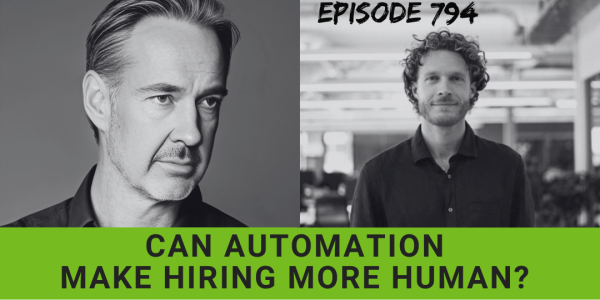
Hi there. Welcome to episode 794 of Recruiting Future with me, Matt Alder. When organizations hire thousands of frontline workers, delivering a personal candidate experience becomes almost impossible. Recruiters spend all of their time answering calls, responding to messages, and running through the same screening questions over and over. There’s very little time left for the conversations that actually matter. Meanwhile, candidates want speed, flexibility, and a process that respects their time, including outside of business hours. So how can AI solve this? My guests this week are Jeroen Klerkx, People Operations Leader at Picnic, and Bill Fischer, CTO at Vonq.
02:02
Matt Alder
In our conversation, which was recorded live at HR Tech Europe, they share what happened when Picnic gave candidates the choice of a human or an AI screening call, the surprising feedback they received, and how they built 10 years of recruiting knowledge into an AI agent that frees up time for their recruiters and to have more valuable conversations.
02:22
Matt Alder
Hi Jeroen, Hi Bill.
02:24
Matt Alder
Welcome to the podcast. Absolute pleasure to be talking to both of you. We’re here on the Expo floor at HR Tech Europe on the Vonq stand. Let’s just start off with can you just introduce yourselves and tell everyone what you do?
02:38
Jeroen Klerkx
So my name is Jeroen. I’m in charge of several people domains within Picnic, including High Volume recruitment and currently we are testing AI calls together with Vonq. So therefore also Bill is here.
02:48
Bill Fischer
Hey Matt. So yeah, I think we’re just here to talk a little bit about what we’re doing in conversational AI with Picnic. So it’s a new product for us. We’re really excited about it and so I run the product and engineering function at Vonq. It’s good to be here.
03:03
Matt Alder
So let’s start off by talking about Picnic. So you’re on stage later today talking about some of the challenges that you’ve had and the solutions that you’ve developed to solve them. Tell us about the main challenge that you’re going to be talking about today.
03:17
Jeroen Klerkx
Yes, so we do high volume recruitment and it’s a very interesting paradox because the more automation we add to the process, the more we can be human. And what we do a lot also last year is we speak a lot to our applicants, to our recruiters, we look into our data and we actually see huge opportunity to bring some automation and technology in to further optimize applicant experiences.
03:40
Matt Alder
What is it that’s kind of special about your applicant experience? What makes it different from other organizations who might do the similar things?
03:48
Jeroen Klerkx
Yes, that’s a very good question. So in the past we had a one size fits all process. Actually, like a lot of companies, they still have it. But if we speak to a lot of applicants, employees, we find out that they all have different expectations of the process. And I think we need to have that. We need to offer different flows based on the needs of the candidates.
04:10
Matt Alder
Tell us more about the solution that you put together. So you’ve looked at technology as a way of solving these kind of issues. Bill, just to bring you in here, what was unique about the solution that Picnic were looking for?
04:24
Bill Fischer
So I think what excited me most about the project was that we’ve done a lot of work over the last couple years building a synthetic recruiter. So, and using an agentic process that we could, you could just present this AI agent recruiter with any job description and they could look at it and know, okay, so we’re going to do this interview in French. It’s a high volume role, these are the requirements for it. But we just would present it with the job description and the agent would just figure out a way to do it. So we’ve worked really hard to kind of build these agents that can just, again, you just give it a job description and they would just figure out how to do it again. High volume, high skilled, low volume.
05:09
Bill Fischer
What was fun about Picnic is that they had a very, they had many years of learnings on best practices on how they wanted to run their screening process. And so what they wanted was for us to build kind of a synthetic Picnic screener. And so we had to take all of those learnings and best practices and knowledge that the recruiters had accrued over the last 10 years and build that into the agent. So when our agent was speaking with the Picnic candidates, they brought all of those best practices into the process.
05:44
Matt Alder
Let’s just zoom in on that for A second here. So what is it about the screening process that’s different or what was it that you absolutely kind of had to maintain through the automation?
05:54
Jeroen Klerkx
Yes. So when an applicant applies, we need to get some data from this applicant to assess if there’s a fit. For example, availability, if they live close to the fce, motivation, language skills. There are several examples. That’s one case. But also applicants, when they come to our landing page, have a lot of questions. And nowadays they were just calling us, which of course costs a lot of time for the recruiter. But we’re also only working during business hours while an agent is 24, seven available. So we start actually doing our first test. And in this test we took one fulfillment center. It was in Beckleronereijs in the west of the Netherlands. But what we did there is we offered the applicants the option to choose a screening call with a real recruiter and a screening call with our AI recruiter.
06:43
Jeroen Klerkx
And we did around 400 calls. And we found out that around 20% selected the AI call and 20%. I was already quite surprised because it feels quite a lot because here on the event we see a lot about AI and automation. But what is actually the status of adoption of AI right nowadays? So it was a really nice case to just test it. And what’s also very interesting in that, in those calls we can also measure the sentiments. Is it positive, neutral? And actually we learned that only 1%, so 4 out of 400 had a bit of negative sentiment. Subsequently, we also learned that the recruiter immediately needs to know that negative sentiment. So we can give a follow up call to fix that, of course, but overall, very positive results.
07:24
Matt Alder
And how about the rollout with the recruiters? How the recruiters kind of respond to the automation? How do you kind of make sure it’s adopted and that it works? What did you kind of learn from that kind of implementation?
07:35
Jeroen Klerkx
From a change management perspective, that of course can be quite tough. So first of all, what we did, we speak a lot to them to understand their experiences, their frustrations. And we knew that they felt we are just too busy with answering calls, answering WhatsApp messages. Secondly, when we start designing the new process together with Vonq, we also involve them. So we have a Slack channel together with Vonq, with recruiters, where after every call they can also share feedback. They see the scorecards of the candidates in the dashboard. And what they also do is that especially in the first stage of testing, each recruiter would call an applicant that had an AI call to Ask for their experiences and also share that feedback with the phone team. So we really made the recruiters part of the project.
08:21
Jeroen Klerkx
And nowadays you really like it because they are tailoring like automation brings a lot to the process because we have way more time for a real conversation, less time pressure, a more diverse job.
08:32
Matt Alder
And Bill, did this present any particular technical issues with what you were building?
08:37
Bill Fischer
So for this deployment, we’re doing phone screening, which introduces a whole new set of challenges in conversational AI because the sentiment, we wanted it to be great, so we wanted the applicants to have a really good experience. But when you think about the phone, sometimes audibility can be difficult. So the pronunciations have to be spot on. We were doing these in Dutch. The large language models that support Dutch do not have as much training data as they exist in other languages. So sometimes the pronunciation would be a smidge off. And so we had to do kind of some reprompting to work around some of that. So, like, for example, I think it was like juiced and juiced, which again, sounded the same to me. Well, like, I meant, like two totally different things.
09:29
Bill Fischer
And so it took a while to kind of prompt around that. But also, phone calls, like, life happens when somebody’s on the phone. And we needed the AI agents so that if somebody. You didn’t hear something correctly and maybe answered something that wasn’t asked, they would understand the context or re ask the question, or if the call got dropped. That challenge you have in a phone call, like, oh, do I call you back? Or do you call me back? So you have that. So you need to reconnect. But then when the agent picks up the call, they have to know what was discussed before so they don’t start from scratch. Which, again, all these things sound simple, but in aggregate, you know, they. They. Yeah, they’re pretty difficult. Yeah. I think another interesting thing was the location.
10:13
Bill Fischer
So because what’s important when you’re estimating a commute time for an employee to get to a location is also the time of day and the mode of transport. So when were trying to assess is this candidate a strong fit from that requirement around location, we had to do a lookup on how would they likely be traveling, what time of day would they be traveling, and what is that commute time at that time on that route. So we built some tooling around that as well.
10:40
Matt Alder
I think that’s just really interesting detail because at an event like this, you get lots of people standing on stage talking about AI strategy and all this kind of stuff. But without this level of detail, it’s just never going to work, is it? So I think that’s kind of really, a really interesting perspective coming back to just talk about the recruiters because as you said, they’ve kind of got more time, better quality conversations. How do you see the role of recruiters developing as we get sort of more automation appearing in the hiring process?
11:11
Jeroen Klerkx
So we do high volume recruitment and we need to do a lot of pre screening and answering questions, which is something which can be easily automated. And so currently how our process looks like, an applicant comes on our landing page, they can still apply via form, they can apply via AI call. In the past we already tested WhatsApp apply, which was also very interesting because you see that the threshold to start interacting with us was way lower compared to the form and what we do. So we collected a lot of data about this applicant and then we have a predictive model that gives a likelihood score to an applicant. And that also becomes quite interesting because if you have the perfect applicant, we send them immediately to a location to have an on site interview or tour.
11:55
Jeroen Klerkx
But if we have any doubt, we can use the AI or the real recruiter to ask a bit more questions, in depth questions. And I think it’s also very important to mention that at the end the recruiter is on control, but automation, especially on Frontline, is supporting the recruiter.
12:10
Matt Alder
Has it sort of changed the way that you look at all the applications that you get? So I was listening to someone sort of talking earlier and they were talking about similar sort of system and they said that, you know, they were getting 3,000 applications for one particular role in the past they wouldn’t have been able to look at all of them. They’d have to have made some kind of decision. But it kind of allows you to sort of look at everything that comes in now.
12:31
Jeroen Klerkx
Yes, and this is of course a very interesting trade off. But already in the past in high volume recruitment for US applicants, experiences, which means quality of the process and time to hire, which is very short, it’s around seven days was already top priority. So already every applicant that applied for picnic had the opportunity to speak with a real recruiter within one hour during business hours. So that’s already quite unique. So we always made the trade off to have enough recruiters. So I think it’s also more now we bring in more automation, we can improve applicant experience for a lot of people, we improve the experience of our recruiters and we become way more efficient.
13:09
Matt Alder
Final couple of questions, what’s next? Where Are you taking things next? What are you, what’s the next challenge that you’re going to solve?
13:16
Jeroen Klerkx
Evaluated the first pilot and in terms of applicant experiences, they were very surprised by already the quality of the AI call. Some people, I also spoke to some people and they just said, well, it’s insane how good it actually is, right? But on the other hand we also see that especially the expectation management is very difficult because people don’t know what they can expect from an AI call. So some people said, I had no clue that it was possible to ask a question, right? Or I had no clue that I could have a real conversation. So also expectation management on our end is very important. What we will do next. To answer your question, we will scale the volume of calls in the Netherlands to test more, to measure, to learn, iterate at full speed. That’s the highest priority.
13:56
Jeroen Klerkx
And we’ll also start testing in Germany and later on in France because of course it’s a different culture. We need to learn about adoption of AI and if they are ready, if we need to do things differently. And I also feel, and I think Bill agrees, that only way to find out is start testing and measuring it by combining qualitative and quantitative data.
14:13
Matt Alder
Just to drill into one thing you said there, because I think it’s really important, which is about candidate expectations. Because one of the things I see time and time again in the media is people complaining about AI application systems. Oh, it’s not here I want to talk to a human. Computer says no, all these kind of things, but obviously getting great feedback from candidates, it’s improving the process. How are you managing those expectations? How are you making sure that people are aware that the AI route could be a better route maybe for them in some cases than talking to a human at that first stage.
14:47
Jeroen Klerkx
So we discussed that a lot in the last weeks and first of all, I believe that we should still give people option because my mom, she doesn’t like to speak to an AI agent for sure. Secondly, we measure the sentiment and if it’s negative, we immediately act. And I also believe that if someone is in a call and is stuck, they should have immediately the opportunity to speak to a real recruiter and managing that part. And because at the end we can talk about efficiency and it’s all about applicant experiences. They should be spot on, best in class, time to hire should best in class.
15:21
Jeroen Klerkx
And then you win this game in high volume recruiting because people apply for several jobs so you immediately need to engage them, you need to act fast and if there are any negative experiences, we should first of all avoid them and if it’s there, we should act.
15:33
Matt Alder
Fantastic. And finally, Bill, what’s possible in the future with all of this? I know you’re kind of very much at the cutting edge. Where do you think things might move in a couple of years time?
15:43
Bill Fischer
At some point a person has to speak to a person. So at some point that has to happen. So I don’t see that going away. I think it’s where it happens in the process will change. So I definitely see a world where a candidate will use something like an agent or a claw that’ll do the discovery of the jobs and then might even ask a few questions of an agent on the employer side just to gather a little more information. So maternity cover, child care, commute culture, work culture, like those types of questions. So I see that process being handled more in an agentic, you know, world and then just bring in kind of like the a candidate who is qualified for the job, is excited about the job.
16:36
Bill Fischer
So with recruiter has enough information to go like this is someone that seems very promising, we’re very interested into and then have those people talk. So I think it’s kind of that collapsing of all of that work that happens in the middle. So you can just have, you know, three great quality candidates, you’re talking to your recruiter and you not have to cover bookkeeping, transactional stuff.
17:02
Matt Alder
You’re in. Bill, thank you very much for talking to me.
17:05
Matt Alder
My thanks to Jeroen and Bill. You can follow this podcast on Apple, Podcasts on Spotify or wherever you listen to your podcasts. You can search all the past episodes at recruitingfuture.com or on that site. You can also subscribe to our weekly newsletter, Recruiting Future Feast and get the inside track on everything that’s coming up on the show. Thanks very much for listening. I’ll be back next time and I hope you’ll join me.