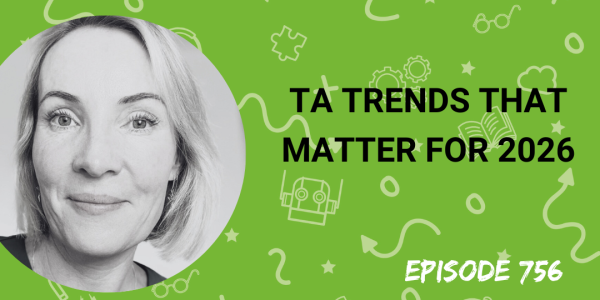
Making sense of talent acquisition right now feels impossible. Every week brings new technology announcements, shifting economic signals, and conflicting advice about what comes next. It’s tempting to chase the latest headline or follow gut instinct, but reactive decision-making rarely ends well.
Understanding key patterns helps separate signal from noise, and this is where genuine trend analysis grounded in real data becomes invaluable.
So what trends are shaping TA heading into 2026, and how should leaders respond?
My guest this week is Susan De La Vega, SVP Global Tech and Client Experience at Korn Ferry. Korn Ferry has just published their 12th annual TA trends report, built from interviews with over 1,600 global talent leaders, and Susan shares what the research reveals about where talent acquisition is heading.
In the interview, we discuss
• The biggest TA challenges we have seen this year
• Methodology behind Korn Ferry’s TA Trends Report
• Changing attitudes and approaches to AI
• Why your next hire might not be human
• The importance of mapping tasks
• Investing in future talent
• Can TA get a seat at the table?
• Breaking the silos in the talent function
• Advice to TA Leaders on strategies for 2026
• What does the future look like in 3 years’ time?
Follow this podcast on Apple Podcasts.
Follow this podcast on Spotify.
Transcript:
Matt Alder 00:00
It’s been a disruptive year for talent acquisition, and we can certainly expect more of the same in 2026 everyone has predictions about what might happen, but what are the actual trends that will set the talent acquisition agenda for the next 12 months? Keep listening to find out
Matt Alder 00:21
Support for this podcast comes from smart recruiters. Are you looking to supercharge your hiring? Meet Winston. Smart recruiters. Ai powered companion. I’ve had a demo of Winston. The capabilities are extremely powerful, and it’s been crafted to elevate hiring to a whole new level. This AI sidekick goes beyond the usual assistant handling all the time consuming admin work, so you can focus on connecting with top talent and making better hiring decisions, from screening candidates to scheduling interviews, Winston manages it all with AI precision, keeping the hiring process fast, smart and effective. Head over to smart recruiters.com and see how Winston can deliver super human results.
Matt Alder 01:25
Hi there. Welcome to Episode 756, of recruiting future with me. Matt Alder, recruiting future helps talent acquisition teams drive measurable impact by developing strategic capability in foresight, influence, talent and technology. This episode is all about foresight, making sense of talent acquisition right now seems impossible. Every week brings new technology announcements, shifting economic signals and conflicting advice about what comes next. It’s very tempting to chase the latest headline or follow gut instinct, but reactive decision making rarely ends well. Understanding key patterns helps separate noise from signal, and this is where genuine trends analysis, grounded in real data becomes invaluable. So what trends are shaping talent acquisition heading into 2026 and how should leaders be responding? My guest this week is Susan de la Vega, SVP, global tech and client experience at Korn Ferry. Korn Ferry has just published their 12th annual ta Trends report, built from interviews with over 1600 global talent leaders, and Susan shares what the research reveals about where talent acquisition is heading. Hi Susan, and welcome to the podcast.
Susan De La Vega 02:52
Hey Matt, thanks so much for having me.
Matt Alder 02:54
An absolute pleasure to have you on the show. Please. Could you introduce yourself and tell everyone what you do?
Susan De La Vega 03:00
Sure. So Hi everyone. I’m Susan de la Vega. I actually work for Korn Ferry in our RPO solution, and essentially I lead all of our technology based RPOs around the world. So pretty, pretty interesting scope, and get to talk to a lot of interesting people, as you can imagine, fantastic.
Matt Alder 03:19
We’re going to be talking about trends in talent acquisition in just a second. But before we do what have you sort of seen as the biggest challenges in talent acquisition this year?
Susan De La Vega 03:30
So Matt, I would say the conversation I’m having right now with existing and new clients, sometimes three or four times a week, is, how do they flex and scale when they don’t know what’s coming next. So essentially, everyone’s trying to figure out how to adjust and move quicker than we ever have done before, because none of us really know what our organizations are doing. I think it’s relevant in a lot of different industries, but I think especially in the technology industry, it’s kind of unprecedented, and all we’re doing is talking about ways that we can use technology, people adapting processes. You know, the good old AI conversation comes up on the daily basis, you can imagine, but that’s certainly the one that we are looking to solve with our clients, literally daily.
Matt Alder 04:16
Yeah, I can imagine. And just things moving so quickly, it’s just probably very difficult to very difficult to address.
Susan De La Vega 04:22
Well, it makes it interesting, right? Like I would say five years ago, it was very much, hey, we need an RPO, and it’s end to end, and this is what it looks like. And now it’s, you know, we don’t know what’s coming. We don’t know where we need help. It could be in this country. It could be over here. How do we move, you know? How do we get people ready to start recruiting for us in two days versus two months. So it definitely keeps us on our toes.
Matt Alder 04:44
Let’s talk trends. So corn, very just released your annual ta Trends Report. Tell us a little bit about the process in terms of identifying those trends, and really, what were the sort of the most surprising findings for you for this year. So there’s a
Susan De La Vega 04:59
secret source as to. We go about identifying these trends, as you can imagine, but I think overarchingly, we have access to a lot of data, given how much we work right across the entire talent landscape, so not just in terms of RPO and in recruiting, but all of the other information and assessments that we have access to. But we also talk to over 1600 global talent leaders, which is really interesting. So they’re all interviewed, give us a ton of data, what they’re seeing. And then we have over 200 people within Korn Ferry that we also talk to assess. And then we look at all of the the trends and pull those together. You also asked what is most interesting about what I what we’re seeing today is, I think AI has been on the top of the list for the last three years. And what was interesting is, year one of that it was AI is coming. Oh my god, get excited. This is going to be amazing. The next year was, hey, we thought AI was coming, and it hasn’t come as quickly as we thought it would. And this year, really, what I’m seeing a lot of is, how do we marry AI and human beings and get everybody to work alongside each other? I think a lot of the kind of panic around we’re going to, you know, reduce our workforce, and hundreds of people are going to lose their jobs, is changing a little bit to more around. How do we use people for high value activities, and how do we make people faster and, you know, take away a lot of those monotonous tasks? So I think the tone is changing there, and I’ve just it’s been interesting for me to to watch it over the last three years, especially. Let’s dig
Matt Alder 06:34
into that a little bit more, because I want to sort of talk about two or three of the trends that have been kind of picked out. And that first one is your next hire might not be human. Talk us through what that actually means in practice and how organizations are starting to think about that relationship between AI, robots, humans, all that kind of stuff.
Susan De La Vega 06:54
You know, AI is definitely the buzzword. What I would say to anyone that’s listening to this is, you know, after often it’s automation versus AI. And I think AI, though, is something that, you know is cool for people to talk about. And we may not be using AI and everything, but we’re using a lot more automation as we move forward. What I think we’re seeing in practice is that the way that we’re thinking about dividing up somebody’s workload is changing a lot. So we actually did this within our RPO team just recently, and we started to pull apart and said, Okay, so what does a recruiter do day to day? What could be done by AI? What could we give this person in addition to what they’re doing on a day to day basis? That would be higher pay off a better experience for our candidates and our hiring managers, and we’re almost splitting up what somebody does, and we’re not reducing our numbers, right? We’re just expecting a different output, a different level of service and quality from those individuals, and we’re actually just taking away some of the boring stuff and making the boring stuff faster and more automated. So I think we’re definitely seeing that people are starting to almost take a job, pull it apart, into what could be automated, or an AI and what could be done by a person. The second one that I’m seeing, which I thought was really interesting, and we’re seeing it more and more often, is most of our leaders and most of our hiring managers don’t actually, even they’re not AI experts working in the tech space. As you can imagine, we’re often recruiting for a lot of AI skills. The managers who are actually hiring for these individuals, they’re not experts in this space. They’re hiring because they need to build expertise within their own organization. So one of the things that we’ve been talking a lot about is, how do you get somebody, a leader, ready for the AI world? So how do we make sure they even know what it’s you, what it’s used for, how they can use it more effectively? What does this mean? How can it help them with their teams? And how do they how do they hire and recruit people with this type of skill set? So we’re seeing that as well, which I also thought was like an interesting trend that’s kind of popped up in the last probably four or five months.
Matt Alder 09:07
The second one that I wanted to pick out was entry level cuts today equals pipeline crisis tomorrow. This has obviously been a big, you know, a big thing that’s been going on this year in terms of entry level jobs, you know, being cut. What’s the trend that you’re seeing, and why is it important to understand the implications of that?
Susan De La Vega 09:27
When we think of AI, we typically think of lower level roles, right? So we think of, how do we reduce or eliminate lower level roles? And I think that was everybody’s thinking, you know, a couple of years ago, that was going to happen. And so because of that, we saw a reduction there, as we’ve seen many organizations as well. There’s a lot of uncertainty at the moment around the world, and so we’ve seen a lot of organizations kind of pull in the purse strings and not spend as much in terms of recruiting. And I would say the organizations that are making good decisions that will help them with the future. Year are still keeping their internships, they’re keeping their graduate programs. They’re, in fact, investing more on their graduate programs, which is, you know, in my opinion, anyway, absolutely where the investment needs to continue with, because it will help us with that pipeline issue down the track. But I think what we saw is, initially, everyone was pulling back and saying, Oh, look, look for who gets paid the least, and let’s reduce there. It’s not necessarily going to pay off, I think, in the long term. And organizations that we see that are actually investigating investing in grads and graduate programs, I think will have the pipeline of the future. So if I was going to say, one thing to take away from it is definitely keep your grad programs, keep your internships. Maybe you change the the content of the program, maybe you look at more leadership programs versus engineering programs, for example, but keep those and that should prevent some of the pipeline crisis that that we do believe is coming.
Matt Alder 11:01
Do you think that the companies that have stopped investing in as much in kind of entry level? Is that specifically because of AI, or is it that it’s an easy target in an uncertain economic time?
Susan De La Vega 11:13
I think it’s a great question, Matt, and it goes back to my comments around AI is the buzzword, right? And I think it’s used as in a lot of ways and places that it shouldn’t be. And I do think you’re right. There’s, there’s absolutely a component of it is weird Economic Times globally, and where you’re trying to, you know, nobody really knows what’s coming. And so it’s an easy scapegoat. I would say, you know, it’s considered kind of non essential, which isn’t smart, but you know, it’s considered non essential. So I do think there’s absolutely truth in in what you’re saying.
Matt Alder 11:51
The other trend that I wanted to pick out from the report was, it’s time ta got a bigger seat at the table. Now, this is something that has obviously been kicking around as a as a discussion for years and years and years, what’s different now, and perhaps even more importantly than that, how can ta actually make this happen?
Susan De La Vega 12:10
Yeah, one of the things that I’ve seen, certainly over the last year, and maybe maybe as I’m thinking back, it’s over, been over the last two years, we’re seeing TA and TM so talent management, combining more and more, and I think with a lot of the tools, if you’re looking at AI specifically, right, there’s a lot of tools that you could be using there that would span, you know, what you want to do for your external market you would also want to do for your internal market. So I think it’s a smart play, and I think that has given ta a better seat at the table. I think there’s still work to be done. Honestly, it’s it’s more around. I’m always shocked that ta seems to be the last to know when there’s, you know, changes in the organization and peaks in hiring and things like that. And I think we can all do a better job of putting in front of senior leadership. Hey, look, here’s the implications of not having ta at that table, right? So you can decide to go and move to this other country and you think it’s great and it’s going to save a ton of money, and blah, blah, blah, were you even aware that there wasn’t the talent pool in that country that you needed? Did you understand what you were going to pay there. So it’s, I would say it’s, it’s broadening. It’s not just about filling roles anymore, right? It’s about what’s the best decisions to make, what’s the strategy does align to reality within the market. And I think that a lot of organizations are starting to realize that, but we’ve still got to continue to push that, but we have to add value to get a seat at the table. We can’t just be sitting there saying, Oh, we’ve got great time to offer, except today, you know, we’ve got to be able to show what we can do that’s, you know, valuable to the business,
Matt Alder 13:53
yeah, no. 100% I suppose, following on from that, but really, kind of applying to everything is what advice would you give ta leaders going into 2026 in terms of, know what to think about, what to focus on, how to kind of really roll with some of the trends that you’ve identified.
Susan De La Vega 14:11
The one thing I would give is be holistic about your strategy. And by that I mean, at the moment, a lot of people are saying, Hey, I must have technology use technology thoughtfully, right? It doesn’t need to be blanket. Hey, I put in 17 different types of tech, and I’m done, right? You’d need to make process tweaks. You need to think about the people that sit in behind that. What do you have your people actually spending their time on? I’d say, Look at the way that you model like, one of the things that I’ve been talking to a lot of clients about recently is all roles are almost created equal in most organizations today. So sometimes it’s Hey, if you pay more for this role, you get a different level of service. So you need a different recruiter, or, you know, you might get some extra, you know, bells and whistles that that sit around filling that. Role. But actually what I would say is moving to a more critical role model I think is going to be essential in the future. And by that, I mean it’s not just saying, hey, this this person is paid most and so that role is most important. It’s about saying, hey, these may be more lower level roles within our organization, and they’re not paid as much, but they they interface with our clients every day, and we can’t deliver our service without having these individuals. They are critical. So I’d say it’s think about how you structure your organization from multiple different ways, versus just saying, I’ve got to put in a CRM and all my you know, my problems are going to be solved. It’s just not the case. You’ll get incremental gains from doing all of these things which will lead to success. It just can’t be a don’t just throw in some tech and think our job is done. If we
Matt Alder 15:52
were to look a little bit further out the next year and how ta might evolve in the longer term. What do you think we will be talking about in two years time? We’re having this conversation again. What trends do you think we might be discussing then?
Susan De La Vega 16:06
I hope we’re not still talking about AI, but I fear that we may be. I would say that if I think two years out, I would I would hope that we would be talking about recruiting models that are agile and scalable and have a component of technology and that we’re not continuing to just talk about, hey, I need I need more sourcing. My sourcing is broken, right? I would hope we’d be having those conversations. I would also hope that we be thinking realistically. I think a lot of organizations that I work with, they’ll, they may come back to me and say, right, we need to hire all of you know, Google’s engineers, right? I’m saying, Okay, why would a Google engineer want to come and work for for your organization? Right? So I would say, I hope that we’re talking about how to be realistic in the market, how to pay people where we need them to be, how to make jobs more interesting, to attract the right talent. I hope the conversation will be, you know, versus again, I’m just going to put in a piece of tech, and my job is done, that we would be talking, you know, more holistically about we’re a realistic organization looking in the market. We have the right pay and benefits. We have the right infrastructure in place. And yeah, I hope we’re not talking about AI, but I think we might be
Matt Alder 17:34
absolutely and where can people get hold of the trends report if they want to dive into it and a little bit more detail,
Susan De La Vega 17:42
yeah, for sure. I mean, we have it on our website, we so we can definitely share out. We can share that link out as well. It’s our 12th annual one. So I think I’ve been at Korn Ferry for 13, almost 14 years now, so I feel like this is the 12th one that I’ve seen. But we absolutely had that on our website. And go in and grab it, and would love to hear your comments as well, right? Fantastic.
Matt Alder 18:04
I’ll put a link to that in the show notes. Susan, thank you very much for talking to me. No problem anytime. My thanks to Susan. You can follow this podcast in Apple podcasts on Spotify, or wherever you listen to your podcasts, you can search all the past episodes at recruiting future.com on that site. You can also subscribe to our newsletter recruiting future feast and get the inside track on everything that’s coming up on the show. Thanks very much for listening. I’ll be back next time, and I hope You’ll join me.