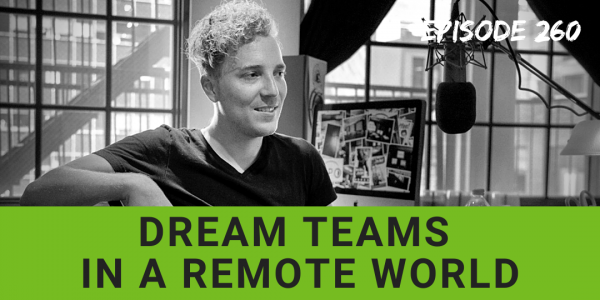
One of the best business books I’ve read in the last few years is Dream Teams by Shane Snow. In the book, he analyses how the best teams become more than the sum of their parts, illustrating this with evidence from history, neuroscience, psychology, and business. I interviewed Shane on the podcast in 2018, and I’m delighted to have him back again. In our conversation, we talk about the concepts of Dream Teams (many of which he has researched further since the book was published) and how they can be applied to building and leading teams in our current challenging times, particularly when people are working remotely.
Here are some of the topics we discuss:
- Why everything we do is teamwork
- What makes a team more than the sum of its parts
- Intellectual humility and its importance in teamwork
- Cognitive friction from a diversity of thinking
- Hidden dysfunctions in teams
- The importance of boundaries
- Building trust in teams
- Ensuring inclusion
- What will work look like in the future
Subscribe to this podcast in Apple Podcasts

Transcript:
Matt Alder [00:00:00]:
Support for this podcast comes from Meet and Engage. Meet and Engage is an award winning candidate experience technology provider with three products, A Chatbot Solution Timeline, which is an onboarding technology and a live chat messaging platform. Meet and Engage provides the tools you need to digitally engage with candidates 24. 7 in any location, on any device to deliver the best candidate experience trusted by the likes of Arup, Amazon and Diageo. Meet and Engage improves the candidate experience for clients worldwide, helping them to engage candidates throughout the recruitment journey. Find out more by visiting www.meetandengage.com and requesting an online demo today. That’s www.meetandengage.Com.
Matt Alder [00:01:07]:
Hi everyone, this is Matt Alder. Welcome to episode 260 of the Recruiting Future podcast. One of the best business books I’ve read in the last few years is Dream Teams by Shane Snow. In the book, he analyzes how the best teams become more than the sum of their parts, illustrating this with evidence from history, neuroscience, psychology, and business. I interviewed Shane on the podcast in 2018 and I’m delighted to have him back again. In our conversation we talk about the concepts of dream teams, many of which Shane’s researched further since the book was published, and how they can be applied to building and leading teams in our current challenging times, particularly when people are working remotely. I know you’re going to enjoy this interview. Hi Shane, and welcome back to the podcast.
Shane Snow [00:02:08]:
Matt, it’s great to be back.
Matt Alder [00:02:10]:
A pleasure to have you back on the show. Could you, to start with, for people who may not know you, could you just introduce yourself and tell us what you do?
Shane Snow [00:02:17]:
Sure. My name is Shane Snow. I’m a journalist. I write about science and business, mostly about human behavior and psychology and how it can help us to work better together. And that’s primarily what I focus on. Over my career, I’ve gone back and forth between journalism and running startup companies, and both of those things have sort of informed the other side of the work that I do now.
Matt Alder [00:02:43]:
You were last on the podcast in 2018 and we were principally talking about business storytelling, and I think you’d just written your Dream Teams book, but we didn’t really talk about it. So could you tell us about Dream Teams, the book, and what it’s about?
Shane Snow [00:02:59]:
So the premise of the book book is that everything we do is teamwork. We don’t often think of our families as teams, but that’s what they are Our neighborhoods, our teams. And of course, in business, everything revolves around the idea that people working together can be better than just an individual. The thing that I wanted to explore with Dream Teams was the fact that most of the time, when you get groups of people working together, you get more like strength in numbers than this sort of super additive dream of, oh, we’ll be smarter together and we’ll have synergy and two heads are better than one. Usually that doesn’t happen, but big groups of people can build buildings and businesses and all of that. So what I wanted to do is explore what are the circumstances and what are the habits among teams that do actually add up to more, that can solve problems that none of the individuals could have done on their own. And yet together, their brains add up to something more. So that’s what Dream Teams is about. It’s an exploration of that and it digs into the psychology of human collaboration. And then I go into the history of fun and incredible stories of groups of people pulling off seemingly impossible things together and how those stories illustrate the underlying psychology.
Matt Alder [00:04:15]:
We’re going to talk about teamwork and the relevance of that to the current situation with most of the office workers of the world being forced to work from home at the moment. Before we go into that, tell us a little bit about the reception that Dream Teams got and what you’ve been working on since then.
Shane Snow [00:04:32]:
So Dream Teams has been a hit in the business and management community. And anyone who’s like a chief of staff, you know, whether we’re talking about it at a company or even in politics, not everyone, but a lot of those types of folks have really loved the book and shared it, which is absolutely wonderful as an author. So it’s done very well in the business community. It was the number one bestseller in business for the month that it came out, and it’s continued to sell. That’s great. What I wanted to do with the book is dig into the underlying principles of breakthrough collaboration. And since then, after spending all this time working on those principles and really trying to understand what’s under the surface, now I’ve been working for the last couple of years on writing about the applications of those principles in different settings. Lots of people have studied team frameworks and had their own ideas of this is the right way to set up a team for this kind of challenge. And truly different challenges require different types of team configurations. But I’ve been looking at which of those team frameworks that are common in the business world actually do map to the underlying principles that work and which are kind of best practices that are just there because people copy each other. And then four different scenarios, such as a lot of people are working from home right now. How do you apply the principles of dream teams to a situation where you are not face to face anymore, where you don’t have all the social cues and the organic interactions that often do help teams to trust each other and to, you know, to collaborate without having to spell things out. So those are the kinds of things I’ve been working on. In particular, I focused a lot on two areas. One is intellectual humility, which is I go into in dream teams, but it’s the ability to change your mind when it’s hard and knowing when not to. So it’s recognizing that you’re not right about everything and that things can change and so you need to change. Turns out this is incredibly important for teamwork. And so I’ve been studying how does that come into play in different types of scenarios. And then the other is what I call cognitive friction. That is basically productive conflict. How does the conflict between our different ideas or the things we have to say or the way we see things, how can that add up to, to progress rather than turn into something that stalls us? And how does that play out, say, in a jury that’s deliberating or in a group of people trying to brainstorm, or in a, you know, an army that’s, you know, that’s facing, you know, challenges and the plan goes out the window and they have to improvise that sort of thing. So those have been the primary things that I’ve been following up on, is these kinds of applications of those underlying principles.
Matt Alder [00:07:28]:
Let’s talk about the underlying principles and the, and the key themes in the context of remote working, because as we said, this is the big topic in terms of work at the moment. We probably, through the initial sort of stage of shock and logistics, where companies were having to set their entire workforces where they could up remotely in a few days. And obviously a lot of the content and the advice that was, that was circulating well three short weeks ago, three very long weeks ago, it was all about logistics and practicalities, but kind of moving that conversation on to be, to be more strategic. What do you see as the unique challenges of remote working and having a remote workforce?
Shane Snow [00:08:11]:
I think I’d start by saying you can, if we’re talking about remote work on your own versus remote work as a team, some things that you can do on your own obviously help you to be a better team member. But where I focus is on the difference between good teams and bad teams. And I think you can sort of break down all teams into three buckets. There’s teams that are dysfunctional, which means that they don’t get work done like they intend to. There’s teams that are functional, which means that they do get work done. And then there’s teams that are synergistic, which means that they make breakthroughs together, that they get more work done together than they possibly could if they were just working on their own and added up their work together. So whether you’re working remotely or not, your team is going to fall into one of those buckets. Moving to remote work actually makes it more likely that the habits and norms that you have before are going to make you less functional, maybe even put you into the dysfunctional bucket. So I think the challenge is to address the things that. That likely add to dysfunction so that you can be functional and then from there to apply, you know, these dream teams principles to actually make your team do better together. And I think remote work gives an opportunity to do a couple of things that are actually. It’s good timing. One is because it’s hard to change your habits when you’re doing the same thing over and over again, right? Like business as usual, work is going on. We gotta get stuff done. It’s hard to do things like set boundaries and, you know, and change the way that you share information. However, if you’re making a shift to something else like remote work, in this liminal space of transition, it’s a lot easier to. To do some things differently. So that’s an opportunity for just changing some of the dysfunctions that a lot of companies have. And then in that there are a lot of things that remote. Remote work forces you to do that can actually be helpful from that synergistic standpoint. So I can share some examples, and maybe we can just start with the dysfunction part. There are several, I think, hidden dysfunctions that a lot of teams have. And it’s because basically when things are going well, when you’re accomplishing things, you don’t necessarily address the minor things that are bumps in the road, the bad habits or. Or whatever. It’s like that classic thing. If a salesperson is making lots of sales, it kind of is easy to let them be a jerk and get away with it because, hey, they’re making sales. However, if they’re not making sales, them being a jerk suddenly, you realize, is a huge problem. So that’s an example of bad habits that don’t necessarily prevent Us from being functional when we move to remote work or when things get a little bit tougher, those bad habits actually do reveal themselves as being, you know, as aiding, adding to dysfunction. So there’s a few, you know, one is the boundaries thing that having poor boundaries between work and life becomes very obvious when you’re working from home. So this is, you know, if you’re working from your kitchen table and you’re also eating at your kitchen table and you’re also, you know, yelling at your kids from the same spot and you know, you’re, you’re still thinking about work as you’re going to bed, that is not good. It aids burnout. It leads to overwork, which is actually a more common problem with remote work than under work. But it turns out that when you look at it, we have that same problem even when we’re not working remotely at the office. We are eating where we work, we’re eating our lunches at our desk like the vast majority of information workers and white collar workers do that. We come home and we’re answering emails all the way up to when we’re going to bed. We’re supposed to be hanging out with our families and our kids and we’re checking our email or we’re responding to notifications. Rather than having those work for us, we work for them, the notifications and other people’s communication. So that boundary issue I think is really key. And this speaks to, I think that the simple solution, it’s not easy, but it’s simple, is that whether you’re working from home or you’re working in an office, you need to carve out space and time for, for you to get traction on the things that you want to accomplish. And so this means there’s a spot in your house where all you do there is work. If you’re going to eat, if you’re going to hang out, you go somewhere else, but you have a spot that’s part of your ritual for work. You have visual cues for the people who live with you to know when you’re in heads down and focus mode and when you’re not. Then the equivalent of this digitally is setting your status on your team chat or letting your colleagues know what are the hours when you need to do heads down work, when it’s not appropriate to ask you questions or interrupt you, or when you simply will not respond until you’re done with these blocks. There’s a lot of practical things you can get into. Sharing calendars and being very transparent about the times when you’re working and you’re not and having mechanism for, if it is an emergency, then contact me this way and I promise I will respond. Those kinds of agreements, but that’s the nature of boundaries is having agreements with yourself and with the people who you collaborate with of what, what you will do and, and what you won’t do and sort of if, then statements. If you contact me this way, I will always respond because I’ll assume it’s emergency. If I have my status on heads down or the calendar block says, you know, that I’m busy, then I will not respond. If you, you know, if you sort of infringe on that, then I, you know, I’m not going to humor that. And this is in the service of the team. That kind of stuff can be hard. But those boundaries become really important for just being functional, getting work done. The other thing on the sort of functional side is the nature of trust. It’s very common for teams to have a lack of trust in each other’s intentions and this. If things are still going well, then you kind of ignore it and you, you deal with the politics. But if things aren’t going well or if things change and they get harder, then that lack of trust becomes a very obvious source of pain. So if you don’t trust that people are always doing things for the right reasons or they’re looking out for the team rather than just themselves, or they have ulterior motives, then you’ll behave a little bit differently. You will not. You’ll be more careful about how you share information. You’ll be more careful about who you say things to. You’ll be more careful about only speaking up if you’re right, you know, not putting yourself out on a limb, even if it would be helpful to a conversation because you don’t trust how people will use that information. When you switch to working remotely, working from home, if people are having the tendency of wanting to check up on you, you know, the boss wants to know what’s on your screen or are you working? Are you there? Do I need to surprise you and make sure that things are going the way that I want them to. That indicates that they don’t trust you and that they don’t trust that your priority is to get work done. And, you know, I would hate if I, you know, I could work 12 hours and, you know, not take any breaks and be super productive, then I would still hate if my boss could see my screen. Something extremely icky about that and it’s because it shows a lack of trust. So the getting things to a functional place. And I think it starts with trust and boundaries and there’s other things as well, just bad habits, not using meetings as a way to force yourself to find time to think about things, but actually scheduling time to think about things before you waste other people’s time, that sort of thing. But once you get to that point where you’re functional and you can get the work you need to done and you can take that long term view of helping the team out, then the question becomes how can you actually use your skills and talents and your team dynamic to achieve more, to make breakthroughs happen? And how can remote work be a hindrance or an opportunity? And like I said before, just the fact that you’re switching to a different way of working means that you have a chance of making it easier to try some new things out without having to do as much change management. Things are already changing. But the principles. So you asked about the underlying principles that I study. The principle is that for a group of people to see further together or to add up to more than the sum of their parts, they need to have different ingredients. They need to have different ways of thinking, different perspectives. And not just that, they can’t just have the ingredients and not mix them together, they need to have productive conflict between different ways of thinking. So it’s not, we all agree here, great, you’re never going to see more than the person who sees furthest that way. That’s also not. Well, we all agree to disagree, so we’re not going to get into it. It’s actually combining our different perspectives. And this is tricky. And the other thing on top of that is the principle of intellectual humility, which I talked about. It’s not just being willing to have debates and willing to explore things, but actually being willing to change your mind to admit that you’re wrong, to admit that a new way is a better way. And with remote work, I think there’s a really cool opportunity in that so much of our communication becomes asynchronous when we’re working remotely. So someone asks a question and you it’s usually going to be over chat or over email so you have time to think before you respond. And it means that the number one thing that gets in the way of healthy productive exchange of different ideas and healthy conflict, the number one thing that gets in the way is easier to deal with. That thing is our ego. And when we make ideas personal or take conversations about ideas personally. So if you and I are having a debate about the best Way to solve a problem. I might propose my hypothesis, my idea, and if you shoot it down, it’s really easy for me to take that personally. To feel like I’m stupid, or to feel like you think I’m stupid. And notice the wording there. I feel like someone thinks something like that itself is irrational. But that’s what we do. We conflate how we feel with reality and with what we think. However, when you’re working remotely and you’re typing to each other and chatting with each other, it gives you a little bit of a chance to pause, to take a breath and to think through how am I feeling? To assess your reaction to things, then to respond. Now it’s easy to just react and to just type out your response, but it gives us the chance to put some distance between action and reaction. Working on the habit of stepping back, taking perspective, and assessing situations before we respond becomes really good. In an office setting, if someone walks up to you and wants to have a hard conversation with you, or you’re invited to a meeting to have a hard conversation, or someone just asks you for something, it’s really easy in the moment to get defensive or to get worried. Be afraid that if you don’t have the right answer, it’s going to be bad, so you give a safe answer. It’s a lot harder to say, I don’t know, I need time to think. But when you’re asked a question over chat, then you can take time to think. And also if you need to have a real time conversation, which is often super important, you need to look people in the eyes and really have something out, you can schedule the time to do that so that you can schedule time to think about it and prepare beforehand rather than someone tapping you on the shoulder and taking you to a conference room to have a conversation. That is the foundation, I think, to actually having productive conflict or cognitive friction. Beyond that, I think it really is this information diversity issue, which is that a group of people that have the same information and think the same are have less potential than a group of people that have a broad range of perspectives and information. So you’re working on your own and you’re collaborating with a team. Taking more time to explore different points of view and to build your own brain trust and to kind of do that thinking and research and go wide in your thinking process before you bring something to a group and then have that healthy conversation is a really productive way for even a fairly non diverse group to add some cognitive diversity. That extra homework of going out and Searching and seeking. And that brings up, I think, the underlying principle, which is that you never know where the perspective that helps you break through will come from. So the more you can increase your chances that you can explore perspectives that might be helpful, whether that’s from a recruiting standpoint, bringing in people who likely have different perspectives, or from a just a personal homework standpoint, seeking out perspectives to aid your own thinking process. And I think that working on your own, in isolation, despite all the downsides, actually lends itself to that kind of process.
Matt Alder [00:21:29]:
So many things I want to ask you more about. I suppose the one thing that stands out the most for me, because it’s something that’s come up in a number of conversations I’ve had in the last few weeks, is, is that issue of trust. Trusting workers, trusting teams, building trust within teams. From a leadership perspective, what can leaders do to make sure that they have that trust within a team, particularly within a remote setting?
Shane Snow [00:21:59]:
It’s such an important question. I think the foundational question to avoid dysfunction, the way that most people operate with people who they. They don’t know, haven’t had a consistent experience with, or they don’t know enough to, you know, to be able to turn their back on them and fully trust them, is we wait for people to earn our trust before we give our trust. You know, someone has to prove themselves first. Yet that’s not the way that trust really works. From a psychology standpoint, trust is built through consistency, but it’s built by showing trust. So as a manager or as a leader, if you’re waiting for people to earn your trust, especially, you know, you’re working from home, you got to earn my trust that you’re working and not watching YouTube. That is a suboptimal way to gain trust and to get people to trust you. Turns out that if you show trust first, people will tend to immediately in their brains mirror trust back, but they will also behave in ways that help you to increase that trust. So that’s the first starting point is as hard as it is, you have to, as a leader, accept that if these are the people on my team and I have been given them or I have picked them, I need to show trust first if I’m going to possibly increase the trust on this team. And modeling that trust is helpful for people to trust each other as well. And how this manifests is not just in saying I trust you, it’s in actually walking the walk. So it’s not doing surveillance. It’s focusing on deliverables rather than on process so saying and actually living the idea that I don’t care how you work, as long as you do your best and you do what you can to work in your best way, as long as you get me what I need and what the team needs, I’m not going to manage your process. If you want advice, if you want help, come to me. I’m happy to be helpful. But what I’m going to focus on is what you’re going to deliver. And I think a lot of leaders and managers in particular are very focused on shepherding the process because they are smart and successful and they know best or whatever it is, but really because they don’t quite trust that people will have a good process. So actually showing that trust in people’s ability to figure things out and offering extending the help to help them figure things out as the backup plan rather than as plan A, I think is really important. Second thing I would say is that when people talk about trust from a psychology standpoint, really what trust is, is the ability to be vulnerable. It’s being able to turn your back on someone believing that they won’t stab you in the back. And so what’s the office worker version of this? It’s admitting that you could be wrong about things, which there’s vulnerability there. Like, oh, if I could be wrong, that means I could be seen as incompetent and lose my job or whatever. Whatever it is, people could use something against me. And if that’s the case, that being wrong can be used against you, that that’s a cultural problem. But this is where, again, leaders can really help making it okay to be wrong by saying, I could be wrong. And admitting when you’ve changed your mind and modeling that behavior of, you know, of not being right about everything is extremely helpful for building trust. Because if you do that, then people will feel okay with putting themselves out on a limb with pushing conversations forward, even if they don’t know the answers, and with saying, I don’t know the answers and taking the time to think, being able to, I think, as an employee, say, I don’t know that I have a satisfying answer for that yet. Let me take some time to get back to you. That is really hard, but so impressive. If you’re a manager and someone says that to you, that’s super impressive, especially if they come back to you having thought it through and wanting to talk about it. But you have to do this first. As a manager, you can’t pretend like you have all the answers. If you don’t, you can’t show that the way to succeed is to be right and to be full of yourself. You have to show that the way to succeed is to be open to learning and changing. So that, I think is really core to building trust. And I think once again, the remote work thing gives the opportunity to let the leash out a little bit to say, you know what, we’re going to throw some of these rules out the window. You know, we don’t have a work from home policy anymore because everyone’s working from home. So great. I’m not going to check up on how many days you’re working from home and what hours you’re working. You let me know what you need in order to get your best work done. And I’m going to follow up on whether you’re getting the work done. And if you’re not, then I’m going to help. And by the way, I’m struggling with figuring out how to do my best work, too. So I may ask you for help. And that’s the final thing I would say, especially with teammates that you’re having a hard time connecting with or building trust with because maybe they’re not as open or they’re a little more shy or they’re a little more guarded or reserved. One of the best things you can do as a leader is to ask them for their advice or ask them for their help, to say, hey, I’m struggling with this thing, or hey, I’m thinking through this thing. I would love your input. I would love your advice. That showing vulnerability and showing that you’re not omniscient and not invincible and it opens the door for them to do the same and for you to really start to have human conversations with them about how they’re doing, which makes it easier to resolve problems when they arise.
Matt Alder [00:27:41]:
Leading on from that, what about building a culture, but also specifically making sure everyone’s included in the kind of the challenging times we find ourselves in.
Shane Snow [00:27:50]:
Yeah, the inclusion thing is really interesting. I’d say on the one hand, this is giving us a really good look at how different people really are beneath the surface. Our different work from home situations are, you know, they’re not the same or we’re up against different things. And I think this gives us a chance to learn about what our teammates are up against at home and therefore how they are truly different than us, even if we wouldn’t think it because we look similar or we come from the same schools or whatever it might be. So I think that’s a really good silver lining to this is starting to understand that we are all different in our ways and that that’s okay and important. But to get to the question around culture and inclusion, it’s really easy to feel isolated and to be isolated when you’re working from home. It’s really easy to go crazy and to feel like you’re out of the loop. So I think a key priority of a manager with a remote team is to, with all that time you’re saving by not doing surveillance and dictating process and just, you know, helping people and you know, tracking deliverables, use that time to help smooth the road for people and you know, and this ties into what I was just talking about. But also use that time to connect one on one with people to make sure that a day doesn’t go by without every member of your team knowing that you are there for them, that you care about them and that you, you know, you’re all in this together. And this doesn’t have to be a meeting. It can be, you know, a chat message every day or a couple times a day, how are you doing? You know, what’s, or even just sharing things like, hey, I found this that might be helpful. You know, here’s an article that I think is really great and it made me think of you or what do you think of this? Those touch points that are informal really help. One bit of advice that I really like that comes from, from a couple of places that do remote work as a matter of course. So Basecamp and WordPress parent company automatic both subscribe to this idea of a daily dispatch, which I really like, which is basically not a report, but a sort of how I’m doing check in that you send to your team and or your boss every day. Again, it’s not a report, but it’s a, you know, at the end of the day, here’s what happened today, here’s how I’m feeling, here’s what’s on my mind. And having it either be a thread on Microsoft Teams or Slack, that’s like the daily dispatch that everyone chimes in on every day. Or maybe it’s an email thread that gets started every week. I think the group chat is a little bit easier to make it less formal. But just that little touch point of today was a hard day, but I’m still working on Project X or today was great, I feel like I really got a lot done, whatever. But it’s not a time to formally set the status of things. It’s just a time to say how you’re doing and give a little clue about what you’re doing. And if you do that, it creates a paper trail so you can see every day we kind of know what each other are doing and what we’re about. But it also creates a starting point for conversations that are real and organic. And that is where culture comes from. The norms and the camaraderie and the rituals that you develop as a team that are yours have to feel natural and organic. And so a simple mechanism like that that starts conversations around how each other are doing and allows you to connect is fantastic. I think as soon as you make it a, like a form that you fill out where you rate your day on a one to five and you say exactly what you did from hours A to B, then it’s no longer a culture thing, it’s like a surveillance thing or, you know, or some sort of clodgy management thing. But the organic interactions every day, that’s really help you to see how people are doing and to let them know that you care about, about knowing how they’re doing. That’s the foundation of culture. And then on top of that, you can do fun things. But I think that the two dimensions to summarize, one is that anyone with a direct report check in one on one with everyone every day informally, in a friendly way to offer help or to just to be, be a friend. And then the other dimension is let the team share how they’re doing, what they’re up to every day and make that a ritual that’s informal so that they can feel like they’re in it together and they can understand each other.
Matt Alder [00:32:39]:
Obviously it’s impossible to make predictions about. Well, it’s always impossible to make accurate predictions about the future, but I think it’s particularly difficult to make predictions about the future right now. But what would your best guess be in terms of the long term impact on what work looks like in the future, the long term impact of what we’re going through right now?
Shane Snow [00:33:01]:
Well, I would hope that people will learn that working from home is not so scary and that the nightmare scenario of people just watching Netflix all day instead of working is actually a really rare edge case that if people are going to slack off, they can slack off at work and get away with it. So if people are working from home, they can work from home. So I would hope that we collectively develop more comfort around this so that when someone has a sick kid and they want to stay home and work from home, we don’t, you know, we don’t question it. We Just say, okay. And we know that we can be comfortable with it and we can trust them. I think that would be wonderful. And I do think that’s going to happen in a lot of organizations. I think it will also open up the possibility for more, you know, regular, even permanent or semi permanent remote work possibilities. You know, I, I have many friends who are full time remote workers. I have a friend who spends most of his time in Latin America, even though he’s from Connecticut and he works for a company in South Carolina. And it works great because they have good habits and good process around it. And someone like him who may be the best person for the job to add his skills and his perspectives to a team, maybe the best thing for them is to work from Mexico City rather than from your office in South Carolina. And so I think this shift in recognition that, hey, we can have the best people for the job no matter where they are, as long as we’re comfortable with how to work with them. And now we are more comfortable, I think that opens up a lot of possibilities and I hope we’ll see more of that in the future.
Matt Alder [00:34:37]:
Final question. Where can people find out more about you and your work?
Shane Snow [00:34:42]:
My main website is shanesnow.com, it’s just my name, the remote work stuff in particular. I’m doing a lot on my online academy. So if you go to shanesnow.com and click on Academy, it’ll take you to where I have courses on remote work and teamwork and all of that. And there are a lot of articles there. If you click on the LinkedIn button from my homepage, every article for the last few weeks is about teamwork in this time of crisis. So I’d love for anyone who’s listening to check any of that out.
Matt Alder [00:35:14]:
Shane, thank you very much for talking to me.
Shane Snow [00:35:15]:
Thank you so much.
Matt Alder [00:35:17]:
My thanks to Shane Snow. You can subscribe to this podcast in Apple Podcasts or via your podcasting app of choice. Please also follow us on Instagram. You can find the show by searching for recruiting future. You can also listen and subscribe to the show on Spotify. You can find all the past episodes@www.rfpodcast.com on that site you can subscribe to the mailing list and find out more about working with me. Thanks very much for listening. I’ll be back next time and I hope you you’ll join me.