
Trust in the hiring process has been eroding for some time. Poor candidate experience, a lack of transparency about how hiring decisions are made, a difficult job market and the belief that AI is rejecting applications without a human reading them have all left many candidates skeptical of the process. So what can employers do to start rebuilding trust in the process?
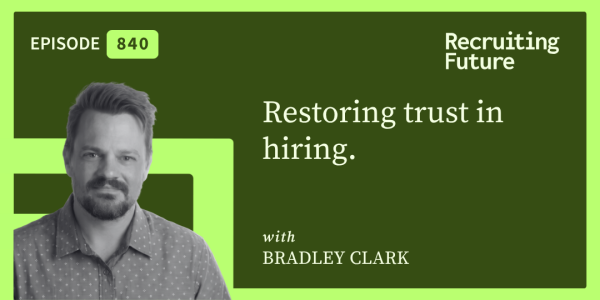
My guest this week is Bradley Clark, Head of Talent Acquisition at Article. In our conversation, Bradley shares the practical steps Article is taking to rebuild trust, including how it is being transparent with candidates about its use of AI and what it expects from them in return. He also discusses how employers can get ahead of regulation and the role technology vendors need to play in building trust with candidates.
In the interview, we discuss:
- How trust between employers and candidates broke down
- Why candidates assume AI has rejected them, even when it hasn’t
- Separating the reality of candidate fraud from the hype
- Being transparent with candidates about AI at every stage of the hiring process
- Setting clear expectations for how candidates can use AI
- Going further than compliance and getting ahead of regulation
- What should employers expect from their technology vendors?
- Moving interviews from question-and-answer sessions to working sessions
- What does the future look like?
Follow this podcast on Apple Podcasts.
Follow this podcast on Spotify.
Key takeaways
- Trust between employers and candidates has broken down on both sides, with many candidates assuming AI is rejecting them and many employers doubting how much of an application is the candidate’s own work.
- Hiring decisions at the furniture brand Article are made by people rather than AI, yet a growing number of its candidates say no human looked at their resume.
- Article sets out how it uses AI and what it expects from candidates on a single career site page, and links to that page from job postings, confirmation emails, each interview stage and rejection messages.
- Article tells candidates that using AI in an application is acceptable, provided they can speak to everything on their resume.
- Article’s Head of Talent Acquisition argues that saying nothing to candidates about AI is a bigger risk for employers than explaining how it is used.
- Technology vendors should be able to explain how their AI tools work, but employers still need to audit and test those tools themselves.
Transcript
Matt Alder 0:00
There’s been a huge breakdown of trust on both sides of the hiring process. Many candidates believe that AI is rejecting their applications without a human reading them, while many employers are unsure whether the applications they receive are even genuine. So what’s causing this and what does it look like when an employer takes practical steps to fix it? Keep listening to find out.
Advert 0:27
Support for this podcast comes from Pinpoint. Your hiring needs aren’t one size fits all, so your ATS shouldn’t be either. Pinpoint is the ATS for multi-stream hiring. It brings every kind of hire, from frontline roles to executive search, into one flexible, easy-to-use platform. It adapts to how different teams recruit, while giving you consistency and control across your organisation. And because more of your hiring happens in one place, Pinpoint captures the context that makes AI more useful. Your team can automate repetitive work, make more informed decisions and spend more time on people. To find out more, go to PinpointHQ.com slash Recruiting Future. That’s PinpointHQ.com slash Recruiting Future.
Matt Alder 1:40
Hi there, welcome to episode 840 of Recruiting Future with me, Matt Alder. Trust in the hiring process has been eroding for quite some time. Poor candidate experience, a lack of transparency about how decisions are made, a difficult job market and the belief that AI is rejecting applicants without a human reading them at all has left many candidates sceptical of the process. So what can employers do to start rebuilding trust? My guest this week is Bradley Clark, Head of Talent Acquisition at Article. In our conversation, Bradley shares the practical steps Article is taking to rebuild trust, including how it’s being transparent with candidates about its use of AI and what it expects from them in return. He also discusses how employers can get ahead of regulation and the role that technology vendors need to play in building trust with candidates.
Matt Alder 2:35
Hi, Brad, and welcome to the podcast.
Bradley Clark 2:38
Hey, Matt. Good to see you.
Matt Alder 2:39
A pleasure to finally get you on the show. Can you just start off by introducing yourself and telling everyone what you do?
Bradley Clark 2:46
So I’m Bradley Clark. I am currently the Head of Talent Acquisition for Article. We’re a D2C furniture brand which sells in North America. We hire in the United States, in Canada, Mexico, and in Vietnam. In addition to this, I co-founded a startup which is called Kiora. That’s an HR tech startup, which is run by my co-founder, Brian Thompson. I’m in an advisory role. And then because I’m not busy enough, I also sit on Kyle & Co’s human-centric AI council. So do some stuff there too.
Matt Alder 3:18
Fantastic. And over the last few years, me and you have had some great sort of face-to-face conversations about AI and its implications and everything that’s going on in talent acquisition. But I thought we’d record this because we were having a conversation about trust. And this to me is just such a big thing at the moment. And I wanted to get your thoughts on it as a practitioner, because we seem to be in this situation caused by AI. I mean, who knows, you’ve probably got an opinion on it. Trust between employers and candidates seems sort of broken in both directions. So you have candidates assuming that they’ve been rejected by some kind of algorithm or AI, and you have employers who have expectations that every single application they get is generated from AI. From the position that you’ve got, what do you see happening? And how did we get to where we are?
Bradley Clark 4:09
I think you summarised it really well. I mean, it is definitely, it’s almost like that Spider-Man meme where they’re both pointing at each other, saying you’re both fake or you’re both using AI. And so where I came from this and where I started seeing it as a practitioner was, so we handle about 20, 25,000 applications a year. We have more, we shut down. So we’d actually probably get more than that. We shut our jobs down quite quickly. And after you apply, you go through the process. If you’re hired or rejected, everyone gets a survey. And what we found was we’re sort of seeing this pattern where people are saying, hey, a human being looked at my resume, accusing us of using AI. And in the past, we just didn’t see this. And I thought, okay, we’re actually not using AI. Humans are making these decisions on our team. We keep seeing this and it keeps increasing in volume. And so for us, I did some more digging in this because there’s about a 40% overlay between our target applicants and our customers. And so talent acquisition for us also impacts our brand, impacts our revenue. And so we’re going, holy cow, this is, you know, we can’t be the only ones who do this. And so I started kind of diving into this. And I thought, oh, you know, of course, well, this makes sense. There’s so much going on and it’s this confluence of things. And I looked at it and go, we’re getting reports on our side of Gartner saying a quarter of applications are going to be fake by this stage. Tons of hype on candidate fraud, which I know is real, but I don’t think it’s real to the extent that the HR tech companies are trying to pump it up to. I think Darren Bush did a great post recently on like data worthwhile checking out where he talks about like the level of AI fraud. But still as a hiring team, you have your back against the wall saying, hey, all these resumes looking better and better and they all look great. And so it’s harder for us to get through this. And same time, we also have this, this huge, all these HR tools are saying, hey, we can solve your hiring problems and we have AI and then it’s AI sprinkling, and everyone’s claiming to be agentic. I mean, I think there’s a lot of agent washing going on. I don’t know the term yet, but it feels that way. It feels like everything is an agent. I look at it. It’s not really an agent. You’re just calling this or you’re a wrapper over an LLM at best. So we’re seeing all these things and the candidate side, I mean, they’re seeing like the Workday versus Mobley case and they’re seeing, I mean, they’ve got to apply to four times as many applications to get responses. They did. So, I mean, so we have this perfect storm. We’ve got LLMs are easy and accessible and the sluggish labour market. And I know like the unemployment numbers aren’t telling the whole picture of this on the candidate side, because it’s the same people have been unemployed longer. And so they’re frustrated. And so it’s really easy to point the finger at this AI monster instead of saying, hey, I was outcompeted. And that sucks to hear. And that’s the, but that’s the unfortunate reality. And so it’s like, oh, the ATS monster might have done this. And then people are taking advantage of it. We’re seeing this where we see career coaches saying, beat the AI bot, beat the AI machine. I’ve got a secret, make your resume AI compliant or ATS compliant. And so we’re just in a very strange case where we have this standoff going on between candidates basically saying, I don’t know what’s going on. I’m just getting rejected. I’m applying to way more jobs than I have ever had in the past. And they don’t understand how that works. Employers are seeing these perfect resumes and this fear of North Korean people coming in and stealing secrets and this kind of thing. And then you have on the employer side, like again, these perfect resumes. And so it’s this three-way confluence of AI finger pointing going on. And so this, what let me say is there’s something here and trust is fundamentally broken. No one is trusting each other. And really to, I mean, to get past this, we need to get to transparency. We need to find a way. That’s something really why I think we can’t be the Wizard of Oz here. We need to see behind the curtain.
Matt Alder 7:48
Yeah, absolutely. And what does that look like in practice? So I suppose there’s two parts to this, aren’t there? What should employers be telling candidates about how they’re using AI? And what should they be saying to candidates about how they expect them to use it or not use it?
Bradley Clark 8:00
I think even before that, there’s another part to this. And that is, I think employers need to make a decision. And AI can assist. A human decides and they’ve got to be really clear with that and that line is blurry and then that’s a blurry line so they’ve got to figure out what that looks like. I’m old and so that was learning the thing more about this. I was diving in, I saw this one, this IBM memo, it’s like literally a screen, like a photo of a memo which came out in 1979 and it said a computer can never be held accountable, therefore a computer can never make a mandatory decision. So it came out in 1979, which is the year I was born, which so you can say a long time ago, this is old. And hiring is the ultimate management decision. This is what it comes down to. And so for me, I think the line in the sand is a human needs to decide hiring decisions. And you need to be really clear about that. I really think you’re going to be in a world of trouble. I think there’s a bunch of compliance and legal stuff later on, which is probably going to kick in, which will also make that probably hard to do. But I think have that line in the sand. And then from there, really for an employer side of it, it is getting into how many times you need to be very clear about this. So you need to find a way to inform candidates. And I think most people are doing zero. Most companies are just saying, I’m not saying anything. I’m worried about this. And I think there’s a bigger threat to not saying something than there is to just saying something. Yeah. And I think this is one of the things, but it can be. So I think like, if I was going to look at it from a maturity lens, like a level zero is not saying anything. I think most companies are at that stage. Some companies, it may be on a career site. It might have like a one liner saying, hey, we use AI to help us hire. And I mean, I don’t think that’s enough. I mean, I think most candidates are applying through a job board. They’re applying to hundreds of applications. They’re not going to remember where it took place. And so it needs to be multiple touch points during that journey. And so like, I guess from Article, yeah, we have our job, we have our career site, which I think most people go to after they apply. I don’t think people go to your career site first. I think it’s more like if you get an interview, you go. So it’s our career site. Our job posting is mentioned. There’s an application question where we actually place there. It’s a multiple choice question for most of our jobs where we say, did you use AI? And basically allows you to say how you used it. We’re saying it’s okay to use AI, but we’re setting the tone on that. Then it’s after you apply, you get an email confirmation with such a normal, like, hey, thanks for applying. Here’s what you expect. Also saying that, hey, here’s where we use AI and it links back to that career site page, which is our single source of truth. So all these things link back to this page and that becomes a single source of truth. So you get email confirmation and then each stage in the interview process, you also get expectations and we lay them out really clear. I think that’s where, again, if we suspect or catch you using an LLM during the interview process, we warn you once. If we have to say it again, the interview is over. Our hiring manager says, we make it really clear. And so you know ahead of time. And so we also say like anything in your resume needs to be defensible. You need to be able to speak to it. If it’s not, again, we’re not going to proceed. When it comes to technical interviews, we use Claude Code. We use, and we tell people, we encourage you to use these tools. We use these tools, use these tools during these coding tests. Like you need to explain how you use it. And so, but it’s just transparent. It’s the transparency piece. So each stage of the interview is very transparent instructions. And then on the rejection side, we remind people again that, hey, this decision was made by, so if they get rejected, then this was made by a human and also links back. So we have this one career page. So you go to our career site at Article, you can see it just lists out what we expect. And then also, and then, but also there’s the tools we use. So I think that’s the other side of it. So one is like, here’s our expectations. We make this and they change. We change these all the time. We documented it. We put version control behind it. The other side of it is here’s how we use AI. I think we’re okay with this. I think we’re getting better. I want to get this even more granular so everyone can see and just have this super clear. But this is a journey. I’m not at the final stage. So I’m not preaching from the choir saying, hey, I’ve got this perfect. I’m saying this is a problem and we’re trying to advance this problem. That’s where we’re at right now.
Matt Alder 12:00
I think that’s fantastic because transparency is just so important here because I think there are huge and necessary debates to be had about AI on both sides of the hiring fence, as it were, but we can’t really get anywhere when there’s so much disinformation about how it’s being used or not being used. And I think that there is just an enormous responsibility on the employers to explain because without that, there’s just a void of information where people make assumptions, where they see stories in the media, or, as you say, careers coaches are selling them solutions to problems that don’t really exist. So it’s so incredibly important. One of the things that will drive people to do this is compliance and legal. And we can talk a little bit more about some of the laws around this a bit later on. But there’s really a case for going further than just whatever the regulation tells you to do, isn’t there? And what’s the sort of return on doing that?
Bradley Clark 12:55
I think you’re right. I mean, there’s a lot of laws on pay transparency. So that doesn’t mean companies are going to pay fairly. Right, and so like just because you do the thing doesn’t mean you’re doing the right thing. And for me, I look at trust. I mean, I think some key things I want to trust, like when it comes like my doctor, my dentist or health and that kind of stuff, I need to be able to trust. I talked about like my partner or my family, my friends, I need to trust them. And my employer is probably the third one. These are like the biggest buckets of trust. And so it goes beyond just compliance and compliance means like yeah, I’m checking a box and legal team is going to be happy that we did the right thing. And I think that’s the baseline here. And the just doing that from a, yeah, here’s the tools we use and we audit them, we make sure they work the way they work and everyone needs to do this. But really I look at this is how do you eliminate fear, how do you eliminate fear and that’s that transparency side. And so going in, people we know, like, hey, this is, they’re making the right decisions, they’re being honest about, or they’re trying to best make the right decisions. I don’t know, again, because I think some of these lines are fuzzy there, but at least they are putting their best way forward saying here’s how we’re doing, here’s our approaches. That’s really important to start a relationship off. Like this is a really big deal. Your employment relationship is really big. I think it’s also, I mean, it’s your consumer brand if you’re a consumer brand. It goes beyond compliance. Like this is, you’re creating trust because these potential ones can be your customers and you treat them equally the same way and you wouldn’t treat your customer as poorly as a lot of companies treat their candidates. Right, and that’s the way I look at these things. And also just defensibility. Like just if you are, I mean, I think this world is shifting. I think we’re going to see a lot more compliance coming together and forcing this. And I think the compliance side of it is coming down to saying, we’re going to probably see it in more blue states. We’re going to see it in a bit more of the kind of progressive areas, but it’s going to probably become standardised pretty soon. And so my thoughts are, get ahead of it. You know, so like there’s a lot of compliance, compliance is coming, get ahead of it, be transparent. And I think, again, if something does go wrong, at least this is going to put you in a better stance to be legally defensible. Here, here’s what we audit. Here’s what we do. Again, here’s behind that Wizard of Oz curtain, I guess.
Matt Alder 15:02
I mean, how do you manage that process across different countries and different states and different regions where everything is slightly different at the moment? How do you manage that as an organisation?
Bradley Clark 15:11
The fun part is, AI is really good at gathering information, distilling it. That’s the nice thing here is like, so I can, I’m constantly using AI to research about AI laws. I mean, I look at the big things I care about for, as far as legality, is pay transparency. That’s a big one. That’s for shifting things. Like a lot of stuff has been set in stone for a while. So I look at pay transparency. I look at background checks. That’s a huge one, especially in the United States and what we need to do around that. And then AI. And so I’m constantly using AI to do my research for me. But typically what I do is I find the hardest place and I make that my baseline. Just to make it easy. I run a lean team. We’re not a huge company. We’re not a huge team. And so I just go, if I can pass the hardest, that’s my bar across everywhere. And that makes it easier rather than having to have multiple levels. Or like, well, in this state, I can get away with this, or I can do this here. What’s the hardest level? And I think that makes life easiest. That’s really where I look at this. But I mean, like the laws themselves, everything is converging on a few things. It’s disclosure, it’s keeping human in the loop, it’s auditability. And also the other one, and this is going to be the interesting one, is providing an alternative route. It’s kind of like when you go grocery shopping and you can go pay by yourself and go to the automatic checkout, but there’s also the human option. And I think that’s going to be really interesting to figure out how as practitioners, we figure out how we could have these two lines. And I don’t think, I don’t know if the tooling is ready for this yet.
Matt Alder 16:34
All of these software products are provided by vendors, other than in some exceptional cases they’re not being built by the employers themselves. So what do you expect from vendors? What do they need to do to help build trust with candidates in this part of the process? Because I think it’s very easy for a software provider to say, well, actually, you’re my customer, not the candidate. How do you kind of bridge that gap? What do you expect? What part do you expect them to play in this?
Bradley Clark 17:01
I don’t think they’re playing enough of a part and I think often when I go to big HR events and I talk to vendors, right? And a lot of them, you’ll ask and you ask these questions and you’d be like, okay, how are you training your models? Are these your models? Are they other people’s models? Your body? And everyone just says big smiles. Like, oh, it’s all proprietary. It’s all ours. And you go, really? Like this is, there’s a lot of stuff which is just wrappers over LLMs. The data piece of it and sub-processors, a lot of people can’t speak to that well enough. For me, a lot of tooling I like, I like when it’s GDPR compliant. The requirements of Europe are higher than North America, more standardised at this stage to more transparency. And so again, my thoughts are, go to the hardest place. If it can be this, then I feel more confident that I’ll be fine with it. So when I see a tool which isn’t that, the other part is, I can’t also outsource the audit side of it. Like they have to be responsible saying how they do it, but I need to own the auditing. I need to test these tools and make sure they work and make sure they’re doing what they say they do, how they do it. You know, you’ve got a lot of responsibility to actually not just have blind faith. And I think this was again where, I mean, it’s going to be interesting. Again, it’s this Mobley versus Workday case. I think it’s really interesting. And it’s something, this is really where, what’s that line in the sand? How much of this kind of finger point at the tool and say, hey, your problem, or is it to me because I just didn’t do my diligence and I’m not actually doing the audit?
Matt Alder 18:30
I think that’s a really interesting point because I’m just sort of struck by when we bought software in the past, we look at things like penetration testing and the employer would have lots and lots of criteria that they would go through, that they would test to make sure this is the software for them. And that doesn’t seem to quite exist in the same way with AI at the moment.
Bradley Clark 18:44
You’ll get like a SOC 2 test and you go, oh, this is great. They pass the SOC 2. But even that, I mean, that world has changed. I mean, look at that PHP issue we had like a week ago, because in the past, I mean, if you were in cybersecurity, like you hammer a tool, but a normal penetration test. But now you can just have this thing run infinitely and the vulnerabilities of these things. So, I mean, like it’s a wild world we’re getting into. The bias side of things is a real issue. I think sub-processors are things which people are intentionally very like, I don’t know, like it’s not obfuscation at all. Maybe it is obfuscation. Like they’re intentionally not because I think everyone wants to claim they own it. It’s proprietary. And I think there’s a lot of tools which don’t actually say under the curtains, here’s how it runs. And this is a layer on top of a bunch of other technology, which is how all technology is made for the most part. But I think people are really scared just to say that and show their sub-processors and the stack they sit on. Right.
Matt Alder 19:37
Yeah. It’s kind of a bit like, you know, it’s 25 years ago and I’m claiming to have my own proprietary internet that I’ve invented.
Bradley Clark 19:45
Yeah, a little bit, right? And you go, it’s not realistic. Is my data being used to train models? How do you protect personal information? These are really, I mean, hiring has so much, again, like just things that can go wrong. And this is data you do not want leaked. And we see so much where customer data is leaked. And this is what I’m really curious about is, as a consumer, I get an email, I swear, once a month where it’s like, your data was leaked and this hack happened. And I go, oh, that really sucks because I buy stuff online a lot. It’s like, I hate real life shopping, but I’m wondering what that looks like on the candidate side now. Hey, by the way, this was hacked and your data was leaked and what that looks like and what the penalties look like. I mean, I think we’re going to be in a space pretty soon where this is going to be a reality where people are. And that feeds into that candidate fraud side of things where they’re going to be stealing identities, stealing resumes, stealing profiles. And why wouldn’t they?
Matt Alder 20:37
There’s lots to think about. There’s lots to think about.
Bradley Clark 20:39
It’s a wild world. It’s a really wild world.
Matt Alder 20:39
It is. And so I suppose on that lots to think about note, from the candidate trust perspective, what advice would you give to the TA leaders listening? Where should they start with this? How should they think about this from the candidate’s perspective? What can they do to build that trust?
Bradley Clark 20:56
That’s a great point. So kind of bringing this back together here is start with a single point of truth. Have, again, whether it’s a page, I know not everyone has control of their career site easy, but I mean, this could be a Google doc, it could be a SharePoint link. Document what your expectations are and have this as your single point of truth. And so what you expect and what you do from using AI. So I think that’s number one. And then multi-thread this, that’s at multiple touch points. Link that into all the stages and so map out your candidate journey, all the touch points, and include that link. That’s your, and then from there, keep this thing alive. And so you’re going to keep changing, keep learning. I think the line in the sand for what candidates can and can’t use is going to continue advancing. Stuff which we thought was, spell check a lifetime ago was seen as like cheating and like a super, like, and you look at this and go, what are you talking about? Calculators and other things. And this has been the same thing where the line is going to continue to move. And so you have to keep this document alive. And so I think mapping the touch points, have that single point of contact and continue updating that, that’s going to be really important. And then also like who you need to involve, like legal and compliance probably need part of this conversation, your HR tech, IT security, part of the conversation and letting hiring managers know, hey, what to expect? What happens when you catch someone cheating? You’re in an interview, catch how you handle it. What signs are you looking for? In addition to this, I think one of the other big ones is going to be, and this is something we’ve done, is shifting interviews away from question answers into working sessions. Demonstrate you can do the thing because the resume looks perfect. Yeah. Right. And the answers can be prepared. The interview acting can happen. But this is, I think, going back to the original question, as a TA leader, this has to be really important on your list. And it’s not just like a checkbox. It’s an ongoing piece of work where you try to continue advancing.
Matt Alder 22:41
And I think you just make a really important point there. There are bits about this, kind of this legacy process, this old way of doing things that we’re not going to be able to fix, that AI has permanently changed. And actually, what a great opportunity to evolve and do things that are more effective. And I suppose on that note, as a final question, where do you think this might go? Or what do you hope the future might look like? What’s the relationship between employers and candidates like in a few years’ time, if we get this right?
Bradley Clark 23:11
If we, okay. I think just, so I don’t know if we’re going to get it right. And this is where I feel for AI in general. I live in this like dual state of incredible excitement and joy and immense fear. And so I live in these two states at the same time. So I don’t know if we’re going to get it right. I hope we get it right. I think this is, we’re going to be beyond resumes. And I know the resume’s stood for a long time, but I think that we’re going to have to figure what this actually looks like. It’d be moving now. I don’t know if you like the Jack and Jill style having agents talk to agents. I don’t know if that’s going to be real or anything different. But that might be part of it. But I think from a hiring standpoint is shifting over to demonstrating you can do the work, finding ways to demonstrate that, having that be the bar, not can I answer questions. You’re looking back, I think we’re going to see the bar move so hard. I think when I talk about that line in the sand changing, we’ll look back, say two, three years from now, go, oh, remember that time when it was like, this was seen as a faux pas, but now, like, again, your agent applies for you. And yeah, it’s just, you know, I think ATS can become headless almost in a sense. Like, I mean, we’re doing a ton of work with MCP and I don’t know if we need to even, I think all the tools will be orchestrated on their own. I think that’s going to be a major difference. I think one of the things which I’m amazed at, back to the first part, is I’ve always disliked career site bots, you know, those little chatbots on your career site. And I think for most of us, I think they’re stupid. However, I actually think this is something which there may be a new use case for them. And that is in transparency, asking questions around this. And so I think that might be actually a really good use case for these things. Finally, instead of just the surface level questions they can answer, interview preparation and asking people like, hey, how to prepare for an interview. And it’s not interviewing with that but actually in preparation for that. And I think that might be an interesting piece where it’s like, this is our, it’s not to interview with, but it’s like in preparation of, it’s transparency, it’s allowing you to really dive into these things. I think the other one’s going to be, I forget what the term is, it’s like the SEO for LLMs, but I think the equivalent is, all this information, candidates are using LLMs to research, and then from there it’s like, is information easy to find? Because if it’s not, you may be lower on the list for if they choose to apply to you or not, or like the perception of you and their trust level. And so they’re not going to be using their eyes to go to the career site. They’re using an LLM to search all the information about you and it draws it from the career site. You’re probably in a better state too. Yeah, absolutely. But there’s a long answer.
Matt Alder 25:36
Yeah. GEO or AIO. Do you know that? Yeah, that’s what it is. Yeah. GEO. It’s lots of terms flying around.
Bradley Clark 25:42
Yeah. But I think that’s going to be real. I mean, I think we’re seeing that already where people are doing tons of research. And that’s what I would do. I mean, if I was shopping for a job, I’d be there saying, tell me everything you can about this. And we do this on the employer branding side of things. We do the opposite. We pretend we are a candidate and say, what can you surface about us? Find out what’s being said so we know, and not to change it, but just so we have an understanding what they’re seeing on the other side.
Matt Alder 26:04
Awesome. Bradley, thank you very much for talking to me.
Bradley Clark 26:07
Thanks, Matt.
Matt Alder 26:09
My thanks to Bradley. You can follow this podcast on Apple Podcasts, on Spotify, or wherever you listen to your podcasts. You can search all the past episodes at recruitingfuture.com. On that site, you can also subscribe to our weekly newsletter, Recruiting Future Feast, and get the inside track on everything that’s coming up on the show. Thanks very much for listening. I’ll be back next time. And I hope you’ll join me.