
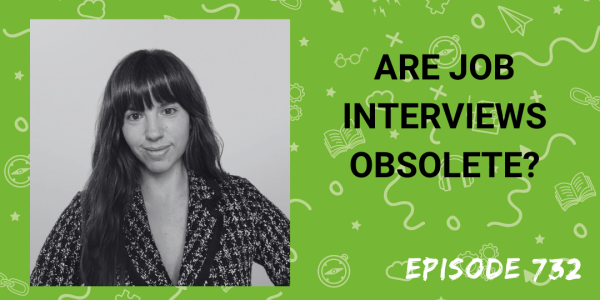
The job interview has been a part of the recruiting process for over 100 years, with Thomas Edison widely credited as the original architect of this central tenet of the recruiting process. But with so much change happening since then, are interviews still fit for purpose in their current format, and if they aren’t, what should they be replaced with?
My guest this week is Sarah Lamontagne, founder of Montagne Motion Consulting. Sarah has worked in all aspects of recruiting and talent acquisition and, based on her experience, strongly believes that employees should be moving away from interviews and looking at other methods of assessment to bring the recruiting process up to date.
In the interview, we discuss:
• The significant challenges in hiring at the moment
• The origins of the job interview and why they are no longer fit for purpose
• How is recruiting slow to evolve
• What should replace interviews, and how do you enable candidates to demonstrate their skills at scale?
• The role of technology
• A new generation in the workforce who are driving change
• What does the future look like?
Follow this podcast on Apple Podcasts.
Follow this podcast on Spotify.
00:00
Matt Alder
Outdated and finally out of time. Are interviews actually still an effective way of hiring? And if not, what could we replace them with? Keep listening to find out. Support for this podcast comes from smart recruiters. Are you looking to supercharge your hiring? Meet Winston Smart Recruiter’s AI powered companion. I’ve had a demo of Winston. The capabilities are extremely powerful and it’s been crafted to elevate hiring to a whole new level. This AI sidekick goes beyond the usual assistant, handling all the time consuming admin work so you can focus on connecting with top talent and making better hiring decisions. From screening candidates to scheduling interviews, Winston manages it all with AI precision, keeping the hiring process fast, smart and effective. Head over to smartrecruiters.com and see how Winston can deliver superhuman results. Hi Sarah and welcome to the podcast.
01:22
Sarah Lamontagne
Thank you so much. Great to be here, Matt.
01:24
Matt Alder
An absolute pleasure to have you on the show. Please could you introduce yourself and tell us what you do?
01:30
Sarah Lamontagne
Sure. So I am Sara Lamontagne. I run a consultancy called Montagne Motion Consulting, which is effectively providing a fractional head of talent services. So that’s helping organizations, whether it be startup or scale up, build their talent strategy, their people, processes, procedures, implementing HRIS and ATS systems, developing their careers, website, and of course hiring. Most importantly, tell us a little bit.
01:55
Matt Alder
About your backstory, how you got to do what you do now.
01:58
Sarah Lamontagne
Yeah, sure. So I started like so many people in recruitment in an agency. One of the big ones, very turn and burn 60 business development calls a day. Absolutely brutal. Very quickly realized that was not for me and wanted to be a bit more sort of an internal relationship building and how do we actually make the processes as best as it can be? So went internal from there and really just got a broad range of experience industry. Everything from not for profit tech, government, education, prisons, the works, and then went through Covid and post that obviously there was a bit of a bust with a lot of organizations making mass layoffs. And whilst I was fine, I lost 60% of my team. And I think at that point I was just seeing a real shift in the employment environment that I just didn’t like.
02:50
Sarah Lamontagne
And I just thought, no, I don’t want to be a part of this anymore. I’d like to do it myself and I’d like to do it with key stakeholders that I really feel are on the same kind of wavelength and the same kind of ideals. Really, so that’s why I started my consultancy.
03:05
Matt Alder
Fantastic. So what do you think the most significant challenges are at the moment for employers?
03:12
Sarah Lamontagne
Yeah, I think there’s probably three. If I. If I could sort of. I bring it down to that number. I think the first one is just the sheer volume of talent on the talent market at the moment. And I think, as I said, it’s been. Because we’ve had quite a significant couple of years of pretty extensive layoffs across the world, really. So that’s one, I think, to go on from that. Also the skills gap. So the European Commission, for example, and this is very much the same kind of sense within the UK as well, but the European Commission stated that about 68% of employers are really struggling to find the talent that they need with the right skills, which is pretty extraordinary when you sort of.
03:55
Sarah Lamontagne
There’s clearly something going wrong where we’ve got so much on the market, but on the employment side, employers are saying we just can’t seem to quite find the right skills. So I think that’s definitely another. And then I think number three would be how employers are managing this very much culture war that we’re having at the moment, which is how they’re managing performance and retention, whilst also trying to manage the hybrid work slash. Employers trying to bring people back into the office, you know, several days, four, five times a week. And the talent market, again, not really thrilled with that idea. So I think those are probably the three biggest issues right now.
04:38
Matt Alder
There’s certainly a lot going on and as you say, it’s really indicative of something that’s broadly wrong when there’s so much talent on the market, but still skill shortages and things like that. Let’s talk a little bit about the actual kind of recruiting process. You’ve obviously got a lot of experience of this from a number of different angles. Which parts of the recruiting process do you think are not now fit for purpose?
05:01
Sarah Lamontagne
I think there’s quite a lot, but I think the most blaringly obvious one are the interviewees and the way the interviews are conducted. So just to give a little bit of context, interviews as we know them today were really invented and popularized by Thomas Edison back in the 1920s. Now, that’s a good hundred years ago. Since that time, we’ve tripled in population. We’ve introduced extraordinary levels of technology, we’ve opened up borders and made freedom of movement pretty accessible. We’ve become aware and educated on neurodiversity and other different learning difficulties. We’ve also had huge social liberty movements. And just to give the context, this has all happened within the last hundred years and yet the interview process still hasn’t really shifted that much. We’ve introduced technology within those interview processes, but we’ve not really shifted to the extent that the world has.
05:58
Sarah Lamontagne
And I think it just doesn’t seem to really fit for people. It’s not bringing out the best of them, it’s not catering for the massive diversity that we have within candidates. And ultimately it’s a very, we’re going to ask question and you can perhaps answer, perhaps using AI, but ultimately some kind of ridiculous star situation, task action, result or a response that’s going to be highly embellished and we still have actually no idea how you’re going to perform within the interview. So I think that fundamentally the interview as it is, the traditional style interview, is certainly not fit for purpose and as my grandmama would say, needs to god.
06:42
Matt Alder
It’s kind of one of those things that lots of people would agree with, that there are people who wouldn’t. But it just seems that it’s just so ingrained in how we do recruiting. As you said, you know, 100 years of history there. Why do these outdated ways of doing things that don’t really serve people? Why do they stick around for so long?
07:00
Sarah Lamontagne
Do you think humans resist change? I mean, ultimately there’s a really good reason for that as well. Biologically, we’re hardwired to find comfort in patterns and routines, so that’s why we resist change. But also because it’s such a wide scale procedure, both within, across the board in terms of different industries, but also on a global scale. That means it’s going to be quite difficult for somebody to shift and change. It always is. When you’re starting or introducing something that’s new, there’s a lot of issues. I think there’s a lot of people that is like, oh, you’re going against the grain, that’s quite difficult to do. And also you’re taking a risk. We don’t necessarily will know what works. So you’re taking a risk, you’re going against the grain. You also have to educate people on why the shift is happening.
07:49
Sarah Lamontagne
So I think those are pretty key reasons as to why there hasn’t really been a major shift. It’s sort of, it’s comfortable, we know it, we’ve been doing it for a century. Just crack on.
07:58
Matt Alder
Yeah. And I guess that pretty much every person who is currently working, who currently has a job, has been through an interview process and it’s just kind of in the mental models about how we think about things. And I’d really hope that the point we’re at now with the challenges in the market, technology, all these kind of things, is the perfect point to actually sort of reinvent how we do a lot of these things. How can we fix it? What, what type of reinvention could there be?
08:27
Sarah Lamontagne
Yeah, absolutely. The best example that I have of the best interview I’ve ever been a part of was a chef in a kitchen. And that was we invited somebody to come and do a dinner shift, bring his knives. He did. We paid him for the few hours work that he did. And were able to see really clearly does he have the technical capability, but also more importantly, how does he work under stress, under pressure, how does he communicate? And also is the end product that he is delivering, is it of high quality? There is no fluff, there’s no embellishment, there’s nowhere to hide. And I think that ultimately is where we need to start heading.
09:07
Sarah Lamontagne
I think it’s really just having the ability to bring in people into the actual office place and pay them for their time, but get them to do the job. And I think on top of that, I think we need to start eradicating things like CVS and cover letters and instead focus more on an online application, for example, where it’s not asking you for great big long detail, but it’s asking the asking you, do you have the actual technical capability and skills? If so, where? And then we can kind of flesh that out on the actual day of, you know, hopefully bringing them into the office to do the actual tasks that they’d be willing to do.
09:52
Matt Alder
Is your TA function fit for the future? Over the last 10 years, I’ve done podcast interviews with hundreds of the world’s most successful TA leaders and discovered exactly what they all have in common. Four critical capabilities that drive their strategic impact, foresight, influence, talent and technology. I’ve created a free assessment specifically designed for busy TA leaders like you to benchmark your capabilities against these four essential areas. You’ll receive clear insights into your current strengths and opportunities with practical guidance on enhancing your strategic impact. The assessment is completely free, takes five minutes to complete, and you get your results instantly. Visit Mattalder.me/podcast. That’s Mattalder.me/podcast. That’s Mataulder Me Podcast. I mean, what about sort of doing that at scale or doing that kind of remotely? Have you seen people come up with ways to solve those sort of challenges?
11:09
Sarah Lamontagne
Yeah, definitely. So I think there’s ultimately we’re going to need technology to help us in some way, shape or form. So I think, you know, this is not to say we need to sort of expel technology in total, but I think it’s going to be very much a hybrid approach and that’s how I’m seeing it done at the moment. So for example, having large language models assess and source a lot of the applications based on the skills that they’re provided, for example, to help get through that real bulk within the talent market that we see at the moment. And as well as that there are sort of live instances where people can do the task at hand specifically for engineering as well. So they’ll be on the interview remotely with the, you know, head of engineering, et cetera, actually doing the task.
11:56
Sarah Lamontagne
So it really is doing an interview on the job interview with the task at hand, but you’re sitting with the engineer and head of engineering and the person is actually explaining, okay, this is what I’m doing, this is why I’m doing it. So they’re focusing on the technical capability rather than I would do this, you know, a hypothetical situation which what was, is what we’re so used to these sort of competency based questions. So I think that kind of approach is what I’m seeing rare, but it is working. And I think whilst it does take a bit of time, therefore it’s really important that we pay people to do the work that we’re asking them to do, to just to be respectful on both sides. I think the dividends of that really do pay off. Absolutely.
12:41
Matt Alder
That’s an important part of it because there is a scenario where this could just turn into yet another stage of an interview. So you’ve got seven stages, you’ve got a take home test, you’ve got doing the task in the workplace, you’ve got all of that kind of craziness. So this really is sort of paring things down to what is really going to demonstrate the information that we need to decide whether this person is the right fit for the job and for them to decide whether the job is the right fit for them, I guess.
13:10
Sarah Lamontagne
Exactly. It’s always a two way street and I think that’s really important as well. I think it’s. This is not just adding another stage to the process. This is no, we need ultimately an online application form followed by perhaps a very quick call just to make sure that they say who they are and then boom, let them actually do the job on site. That’s it. That three stages, absolute maximum for sure.
13:34
Matt Alder
One of the things that we haven’t mentioned yet, but is significant for employers is we have a generation coming into the workplace at the moment that doesn’t actually like the rules that are there and is kind of sort of very much questioning them and sort of trying to turn them on their head. We have sort of more generations in the workforce than we’ve ever had. I mean, what’s the impact for employers? What do employers need to think about here to make sure that their approaches and processes are keeping pace with the target audiences that they have?
14:00
Sarah Lamontagne
Yeah, I mean, this is absolutely fascinating. I’m enjoying immensely this time and I think there’s going to be, and there already is a time of reckoning. I don’t think it’s quite in the masses yet, but it is coming and I cannot wait. So I think ultimately employers need to really start taking heed on the fact that this whole concept of bringing people into the office five days, it’s not going to exist. This whole concept that you can just be a soldier and comply, it’s not going to work for these, the younger generations that are coming in, they’re overwhelmingly valuing things like flexibility, autonomy, work, life balance and meaningful work. So I think for the employer’s perspective, it’s really going to put the onus onto them to say, okay, we’re going to need to be more innovative.
14:49
Sarah Lamontagne
We’re going to need to have these generations that are digitally fluent to help us really be at the forefront of innovation. We need to get rid of the processes that are ultimately menial tasks that could be done by large language models or AI. And ultimately there needs to be a real accountability in terms of things like sustainability from the employer’s perspective. So I think there’s going to be a definite shift within the coming years, which I can’t wait for. I really think the workforce as we know again hasn’t really been shifted since the industrial post industrial revolution. It is well and truly time and the millennials, Gen Z and the further younger generations are really going to push that. And I think that’s exactly what we need. I think it’s what we’re all crying out for and it’s what we need. Can’t wait.
15:47
Matt Alder
Kind of goes back to our earlier point about resumes and interviews. Some of the beliefs and practices that define how we think about work are at least 100 years old. So five day working weeks, eight hour days, these were all things that were invented by, in both of those cases, a person for very good reasons responding to what was going on at the time. But 100 years later, 200 years later, it amazes me that more people don’t question some of these kind of fundamental tenants that make up our kind of work experience.
16:18
Sarah Lamontagne
Yeah. And look, I think it is slowly shifting. I think the real shift is that we’re seeing the backlash, you know, from the powers that be. For example, the major employer is saying, no, we are holding onto this power. We want, we want everybody to bring back into the office, which is just totally against the grain. Right. So I think it’s this kind of, you can sort of, there’s a bit of a concept that you can see happening in everywhere, effectively in the corporate world, where it’s kind of like they’re holding onto the last little ayotes of power because there is this questioning. We’ve had the pandemic. We’ve shown that we actually work better when we work four days and we’re not exhausted commuting 15 hours a week. In some instances, it’s sort of just obvious.
17:08
Sarah Lamontagne
But the newer generations are saying, well, no, actually my mental health is more important than my employer dictating that I have to commute for those 15, 10 hours a week. So, yeah, I’m going to question this. Why are we doing this when I have a team in France, I have a team in the US it’s not like we’re able to have in physical meetings with them anyway. But they are kind of really questioning the sort of status quo, which is great. I think it’s only going to happen more and more as the younger generations come in and really make that a kind of fundamental aspect of everyday work.
17:45
Matt Alder
And as a final question, what do you think the future will look like? I mean, there’s a huge amount of disruption to sort of get through with everything that’s going on. But how do you think things are going to look like in the future? Where are we going to land with all of this?
17:59
Sarah Lamontagne
Well, I mean, a crystal ball would be good. It’s so hard to say, isn’t it? Every day it’s sort of like, oh, okay, this is new, this is happening. I think there’s certainly going to be a bit of time of murkiness. I think there’s going to be an adjustment period which will last for a couple of years to really ascertain. Right. What is the strength of large language models. I think that will also then reverberate into what of this kind of tasks. And we’re already seeing it with a lot of the sort of menial tasks being outsourced to large language models in AI.
18:32
Sarah Lamontagne
But I think ultimately there’s going to be that shift that were speaking about, which is really the rise of the gig economy, for example, the ability for employees to determine they’re going to work when it suits them according to their schedule, not their employers. And that will come about in the form of more contracting work, freelance part time roles, et cetera. I think there’s going to be much more of a, well, a continuation, I suppose really of a push toward stem, which has already been happening for a few years. But I think equally as we have an aging workforce, we’re also going to see quite a bit of a push toward health care. So I think there’s going to be a few different layers.
19:16
Sarah Lamontagne
I think there’s going to be the world of work as we know it is going to change from that sort of everyday nine to five, Monday to Friday. I say nine to five. Everyone works pretty much, you know, eight or almost six, seven. So that’s been expanded. That will change. I think there’ll be less middle management roles. I think technology will help us advance in being able to eradicate the kind of menial tasks. And as well as that, I think we’ll be having a sort of more of a push toward the healthcare and the continuation of the push towards stem. That’s my prediction, but could be very well wrong. Who knows?
19:51
Matt Alder
Sarah, thank you very much for talking to me.
19:54
Sarah Lamontagne
My thanks to Sarah.
19:57
Matt Alder
My thanks to Zara. Don’t forget, if you haven’t already you can benchmarch your talent acquisition quality quickly and easily by completing the free Fit for the Future assessment. Just head over to Mattalder.me/podcast. It only takes a few minutes and you’ll receive valuable insights straight away. You can search through all the past episodes at recruitingfuture.com where you can also subscribe to our weekly newsletter, Recruiting Future Feast and get the inside track on everything that’s coming up on the show. I’ll be back next time and I hope you’ll join me.