
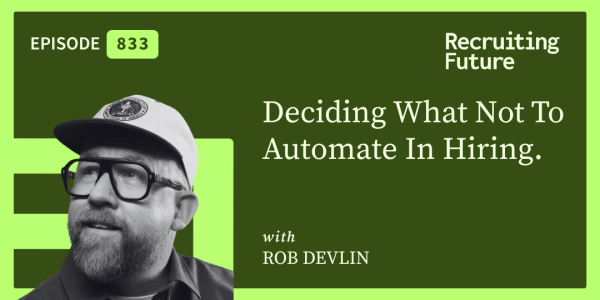
AI can automate a large and growing share of the recruiting process, and within a few years it may be capable of handling almost all of it. For employers, the question is what AI should be doing in hiring, not simply what it could, and that means deciding where people still need to be involved. Human in the loop is the standard response, but it can amount to little more than a person reviewing and approving what the AI recommends. A recruiter in that position becomes a validator rather than a decision maker, and a process built that way can feel just as impersonal as one with no human in it at all. Human in the loop is not the same as human agency, where recruiters apply their own judgment, context, and knowledge of the business to the decision. So how should employers decide not just where people belong in the process, but what they are there to do? My guest this week is Rob Devlin, founder of Devlin Talent.. In our conversation, Rob explains why the problem has to come before the technology, what human agency looks like in practice, what recruiters should do with the time AI gives back, and how choosing which parts of hiring to keep human can become a competitive advantage.
In the interview, we discuss:
- Starting with the problem, not the product
- What should AI be doing, rather than what could it do?
- Why AI won’t fix a broken process
- Using AI to improve the intake meeting
- Human in the loop versus human agency
- What to deliberately choose not to automate
- Six lenses for looking at any AI decision
- Where human conversations create competitive advantage
- What TA leaders can build themselves before buying new technology
- Why the AI decisions being made today are designing the future of work
Follow this podcast on Apple Podcasts.
Follow this podcast on Spotify.
Key takeaways
- Rob Devlin argues that TA leaders should ask what AI should do to solve a specific business problem, not everything a product says it could do.
- AI works best on well-defined processes, so interrogating and simplifying the recruiting process should come before investing in the technology.
- Having a human approve every AI recommendation is not the same as human agency, where the recruiter applies judgment, context and knowledge of the business to see what the data cannot.
- Rob Devlin proposes six lenses for looking at any AI decision, asking whether it is humane, efficacious, distributed, viable, adaptive and steerable.
- Candidates adopting AI does not mean they prefer it to a human conversation, and well-chosen human touchpoints can be the reason a candidate picks one employer over another.
- TA leaders can often start by building AI solutions inside their own IT infrastructure rather than buying new technology, solving one problem at a time and scaling once the business has confidence.
Transcript
Matt Alder 0:00
Most of the employers who are adopting AI in recruiting talk about freeing up their recruiters for higher value work. Far fewer can say what that higher value work really is, or which parts of the hiring process they’ve deliberately chosen to keep human. So how do you decide what AI should never do? Keep listening to find out.
Advert 0:23
Support for this podcast comes from Maki. Maki began by replacing the resume screen with a fair, structured voice interview that assesses real skills before anyone formally applies. Now, that same intelligence is extending across the whole funnel, from first conversation to final interview, giving hiring teams the insight they need while every decision stays in human hands. They recently announced Tomo, an AI interview assistant for hiring managers, the next step towards one connected system that screens, interviews and gives every candidate a consistent, fair experience at scale. See how the end-to-end picture comes together by going to makipeople.com. That’s makipeople.com. And Maki is spelled M-A-K-I.
Matt Alder 1:37
Hi there, welcome to episode 833 of Recruiting Future with me, Matt Alder. AI can automate a large and growing share of the recruiting process. And if the technology continues to develop at the same pace, it will soon have the capability to handle all of it. For employers, the question is what AI should be doing in hiring, not simply what it could be doing. And that means deciding where humans still need to be involved. The standard response to this is to talk about humans in the loop, but that can amount to little more than a person reviewing and approving what the AI has recommended. A recruiter in that position just becomes a validator rather than a decision maker, and a process built that way can feel just as impersonal as one with no human in it at all. Human in the loop is not the same as human agency, where recruiters apply their own judgement, context and knowledge of the business to the decision. So how should employers decide not just where people belong in the process, but what they’re there to do? My guest this week is Rob Devlin, founder of Devlin Talent. In our conversation, Rob explains why the problem has to come before the technology, what human agency looks like in practice, what recruiters should be doing with the time AI gives them back, and how to design a hiring process for competitive advantage. Hi, Rob, and welcome to the podcast.
Rob Devlin 3:08
Hey, Matt, how’s it going?
Matt Alder 3:09
It’s going great, thank you. And it’s brilliant to have you on the show. Start off by just quickly introducing yourself and telling everyone what you do.
Rob Devlin 3:17
Yeah, sure. So I’m Rob Devlin. I’m the founder and principal of Devlin Talent. So we are a TA transformation consultancy. We help businesses solve recruitment problems. And like most of us at the minute, we’re all very concerned with technology and AI. So I’ve been doing some really, really cool stuff for some clients around the world in that space. So really excited to be on the show with you today, Matt.
Matt Alder 3:37
Yeah, you’re in quite a unique position, actually, working with kind of sort of multiple employers on this type of strategy. How are people thinking about it at the moment? So is it a kind of a big strategic decision for employers to implement AI? Is it still at pilot and experimentation stage? Obviously, the pictures are going to be different in different markets and different geographies, but generally, what are you seeing?
Rob Devlin 4:00
Yeah, I’d say generally, there’s like a lot of curiosity and a lot of interest, rightly so, you know, in the area. But what I find is that clients and organisations are at really different stages of that maturity journey. Some are just at the very early tentative stage of the thinking, what does it mean for us? Others have already deployed technology and are seeing lots of wins. But also, I guess, those early adopters are the ones at the front that are identifying the risks and some of the issues as well. So it’s kind of a mixed bag, but definitely a lot of curiosity in the area.
Matt Alder 4:27
The kind of work that you’ve been doing, what sort of lessons have you learned from it so far?
Rob Devlin 4:33
Oh my goodness, we might need more than an hour for that one, Matt. But I think, you know, for me, the big lesson really is organisations starting with a singular focus on what is the problem that we’re trying to solve, you know, through this exploration. AI is a really, really, it’s cool, it’s shiny, it’s exciting. So what I find is that you can often get distracted by all the things that AI could do. But really, the question is, what should AI be doing rather than what could AI be doing? So a lot of the time when I’m talking to my clients, I’m like, what’s the problem we’re trying to solve? And what should we be doing with AI to solve the problem? Rather than looking at a product that does 10 things and thinking, wow, we should do all of these 10 things because their go-to-market salesperson is telling you you should do that. You know, try not to get too distracted by what you could do and just begin by starting on the real problem and what you should do to fix that one problem.
Matt Alder 5:28
And do you think that the process is important here? Because I’ve seen people buying technology to try and fix things that are broken in their recruiting process to fix those kind of challenges, but they actually kind of make it worse. So what are the first stages of thinking about this? So you have this problem, technology is going to be part of the solution, but how should you frame that?
Rob Devlin 5:51
Yeah, another really, really great question. So I wrote an article recently on, you know, don’t expect AI to fix broken processes. And I think there’s this kind of misconception that by investing in AI, that alone is going to improve how you operate your recruitment business. And that’s not the case because, you know, in many businesses, really, the level of process mapping or the level of maturity around processes alone is still quite problematic. So AI works best when you’ve got a really good set of processes that are written down, well-defined. And, you know, begin by looking at those processes. And before you even consider it, interrogate the processes. Can we make them simpler? What does this process feel like from a recruiter’s point of view? What does it feel like from a hiring manager’s point of view? What does it feel like from a candidate’s point of view? So one of the unintended things which has come out of AI, I think, has been this real back-to-basics focus on internal process and policy, which is always great. You know, as a consultant going in and helping a business fix, I often find that the processes are not quite as defined as they could be. And by investing the time up front to really, really make your processes great, you’re then going to have really much more success, I think, with the AI products.
Matt Alder 7:07
We sort of talk about AI in recruiting, AI in hiring as this thing, this thing that people are applying. But what we’re really talking about is lots of different types of use case here. So tell us about some of the use cases that you’re seeing this work really well in, where it’s being applied in a kind of experimental way. You know, what’s actually happening? What do we actually mean when we say AI in talent acquisition?
Rob Devlin 7:30
Yeah, definitely. So I think it works really well in some of the more repeatable high volume processes that we would run. So what I tend to find is that some of those processes are, I would consider like less risky to consider AI for. So things which might be looking more internal data points. But when you start to look at processes which involve assessment data and more related to decision making, rubrics and so on, the risk I think for organisations kind of starts to scale up because that’s where you really want to be clear on not just human in the loop but I would call it human agency and really, you know, not just saying oh well a human checked it but does a human really make a decision on it, you know, for me those are two very different things. So a good use case that I’ve talked to a lot of organisations about, Matt, is the intake part of recruitment process which for me is the most important piece, right, you know, that’s where you’re going to meet your hiring manager maybe for the first time, you’re going to have a really, really brilliant discussion and from that discussion you’re going to create a really great recruiting strategy for that role. And if you think about that process, it normally involves scheduling a meeting — well that can be automated from an ATS workflow. It means, you know, turning up for the meeting and having a great conversation, so you know every video platform now has a recording and transcription so you can use that to allow you to have a really great, you know, focused conversation. And then you can often take the notes from that transcript and run it through a prompt to help identify did we discuss everything we need to discuss? Was there anything maybe that we shouldn’t have discussed that we want to flag and remove from the conversation or go back and retract? And then you can structure those intake notes in a way that can often get pushed into an ATS to really save time and enhance the quality of the start of that recruiting process. Recruiters love it because, you know, it’s saving them time in note-taking. They can be really present in the conversation. Hiring managers love it because they’re getting really great outputs and branded content. And it can just, you know, work in a really nice measured way that creates value. So, to me, that’s a use case that a lot of organisations can go after to begin with, which I think will make everybody feel confident in AI. And from that first level, then start to think, where can we go next in terms of, you know, how we roadmap it?
Matt Alder 9:39
I want to just go back on what you were saying about human agency and human in the loop, because that feels particularly important right now, because I know that there are various bits of kind of regulation and legislation, where people are kind of really scrutinising, well, what does human in the loop mean? What does the decision mean, all that sort of stuff. So tell us a little bit more about what you mean by that and just so people can kind of be clear about, you know, what the difference between those two sort of positions is.
Rob Devlin 10:06
Yeah, so I think human in the loop is different from human-centric or like having human agency. So for example, an organisation could technically have a human approve every AI recommendation and still have a really dehumanising system, you know. So the role of the recruiter literally just becomes like a validator role, whereby for me, human judgement becomes much more valuable when the human is, of course, looking at what the recommendation AI made, but then applying their own thinking around judgement, ambiguity, context. So an AI might tell you which candidate most closely resembles historical success. It’s very good at doing that. But a human can ask, are we sure historical success is what we need? You know, so the AI is not having a water cooler moment with a hiring manager where they’re understanding some really interesting insight about the business, which could shape decision making. The AI is not in every meeting listening to stakeholders about future state. So I think there’s a difference between optimisation and imagination. And for me, it can make the average decision faster. But human judgement really creates advantage by recognising what the data can’t. So I’m kind of really curious about that part of the human agency thinking.
Matt Alder 11:33
Let’s talk about the humans in this, because I think it’s really interesting. We were sort of talking about this when we were planning this conversation. So AI doing all these repeatable tasks, creating value, but also, you know, giving people time back. What is it that’s happening to that time? Because when I’ve had a lot of conversations with employers about this, I always get very vague answers about, you know, AI’s making it more efficient. What do our recruiters do? And it just seems to me that there are lots of organisations that are kind of at risk of effectively losing that resource because they don’t have a coherent answer about what they’re doing with the extra time. What are you seeing? What do you think people should be thinking about in that area?
Rob Devlin 12:11
Absolutely. So the question that I think is an important one is, you know, if you imagine it was 2030, so imagine we were three or four years in the future, and AI can automate 90% of recruiting activity, probably more by 2030. So the question is, what do we deliberately choose not to automate, right? You know, so what are the bits that we don’t want to get AI to do? Because we could potentially automate every part of the recruitment journey. And some organisations are doing this, you know, very, very successfully. But why would a fully automated recruitment process necessarily be the future that we want? It’s not, surely. So for me it’s about asking, where does technology create value in the process, and where does removing human involvement actually destroy value, right? So I’ve thought a lot about this and there’s a framework I think that I’m starting to develop which has got six lenses. So the first one is, you know, is it humane? So does this make work better for humans, right? So does it maybe take some admin away but allow you to have that water cooler moment or allow you to have a really engaging conversation in person to get that hiring manager to think differently about recruitment? So humane would be the first one. The second one — this is my new favourite word, Matt — efficacious? I don’t know if this is in your…
Matt Alder 13:35
Good word.
Rob Devlin 13:36
Efficacious, right?
Matt Alder 13:37
It’s a word I’m familiar with. It’s not in my everyday vocabulary, but yes.
Rob Devlin 13:40
Well, it needs to be, this is like a top tip, get it into every conversation. So basically, is it more efficient? So did it provide the outcome that we actually wanted? And then I would say, you know, okay, so great. If it does, then is it distributive? So who gets that value? So exactly as you were saying, if the AI generates a 30% productivity improvement, who gets the 30%? Because if the answer is, well, we just use that to create headcount savings or efficiencies, I’m not really sure that’s the right way to go with it.
Matt Alder 14:13
And also, that’s not sustainable. You can only do that once. So I think that’s the aspect to it.
Rob Devlin 14:16
And I think organisations, understandably, have been a little bit seduced by the promise of all of the, you know, compelling ROI cases. But it’s interesting because when I talk to vendors, I do a lot of inbound pitch decks, because I’m like, but you’re not talking about what the business should do with those hours back. And like, that’s very short-sighted, I think. So the next one is viable. So this is really important. So the question I think we need to be asking is, can this really work in your organisation right now? So this is about getting the organisation to think about where are they on the maturity journey in regards to TA in general? And how ready are they for this deployment of AI? Because you know a classic one is to think, oh great, you know, we can automate interviewing and assessment, but are you really ready for that? Like, to do that you really need to have a robust assessment methodology, you know, you’ve really got to know what you’re doing. So that’s an important one. And then the final two are adaptive, so importantly, you know, can we change course? So once you’ve started to deploy this activity, how easy is it to pivot? And six, is it steerable? So can the humans still change the outcome of what it is you get the AI to do? So it sounds a little bit heavyweight, but I think those are six good reference points in a conversation to come out with a strategy which is human-centric.
Matt Alder 15:40
I think it’s interesting as well, because when you move past that sort of efficiency and speed thing, and you start talking about business value, it’s also about how this can make companies better at recruiting in terms of recruiting better people, isn’t it?
Rob Devlin 15:54
Completely. I mean, AI is such a great way to achieve competitive advantage, right? So, you know, if you think about it just from a candidate journey perspective, more and more organisations are automating the candidate journey. So for me, competitive advantage is by thinking carefully about where in the journey can Matt the recruiter talk to Rob and have a really brilliant human conversation which may be enough to actually think, you know, Rob’s going to choose this company over the other company that didn’t have a human conversation. Because what I’m interested in is, you know, candidates tend to like working with AI in general. I think the evidence that I’m seeing is strongly suggesting that the candidates are adopting AI pretty well. But I don’t think we should confuse candidates adopting AI with candidates preferring that to like a real human conversation. Like, for me, I would want AI to schedule, do things like that, but I’d still want an expert recruiter to be like, hey Rob, good luck tomorrow, are you all set for the interview, how can I help you, what do you want to know about Matt, what can I do to really, you know, get — and then the feedback call, hey, how did it go, tell me what went well, you know. Those human touchpoints are like so important. So how clear are you now being with your team over doing those things? Because a lot of people are being really vague. Oh yeah, our recruiters, they’re just going to use that time to — they’re going to use that time to be really human. How? What does that mean? How are you directing that within the business? How do you know that’s happening? Because my concern is that actually the recruiters are just getting more and more and more reqs. So we like to think they’re doing all of that, but in reality I’m not sure it’s happening.
Matt Alder 17:36
It’s interesting as well, because the point you make about candidates, because I think that candidates are happy to use AI. However, many of them don’t trust how they think employers are going to use it, which is an interesting thing. And I think that kind of human, that human aspect of it is really important. Without trying to sound like some kind of marketing textbook, those kind of moments that matter in the process for putting those humans in place. Do you think people do a good job at actually working out what those are? Or are people just sort of defaulting to what they think they are or what their recruiters like doing, which might not necessarily be the best use of their time in that kind of process?
Rob Devlin 18:16
Yeah, so I think it’s really mixed. So for me, these are the fundamentals of great TA and great recruitment. So you’ve got three or four very simple signature processes. You’ve got your intake, you’ve got your sourcing and application, you’ve got your assessment, and then you’ve got your offer and your onboarding. So even if you were just to think about those four signature processes which most organisations are going to be, you know, working that model, where are the most valuable human conversations in each of those four stages? So intake is all about the hiring manager, right? So it’s about how can AI help you show up as a more credible leader, earn a seat at the table, which is like an obsession ad infinitum for TA leaders, you know. And then when you get into sourcing and application, great opportunity — you’re going to talk to candidates, right? So how much time are you going to spend on the phone having those great conversations? Assessment, so again this is like a really interesting one. So I see a lot of organisations are deploying assessment technology with concern over candidate fraud and candidate cheating. But if you’re a good recruiter, you know what open questions are, then you’re going to ask three, four open questions on each answer and you’re going to quickly know, quite reliably, I would say, whether or not the candidate is being honest or how well they can articulate stuff. So obviously, that’s a really important human inflection. And then onboarding and offer, you know, it’s so important to get your arms around a candidate, get them engaged, get them ready for day one, maybe get some referrals. So I think what needs to happen is like more really clear definition of, in the new world, this is what we can do and this is how you do it and this is what a great conversation looks like, you know. Really spend time with your teams asking them the question, like, where do you think you could really differentiate yourself by having human conversations? The recruiters will say the answer. So yeah, that’s where I’m seeing the conversation shift.
Matt Alder 20:17
And let’s talk about the future. Obviously, this is going to evolve even more and probably even faster. I suppose two parts of this. What do you think the future might look like? And also, how should TA leaders be thinking about it right now in terms of how they should be sort of preparing for the way that hiring is going to evolve over the next couple of years?
Rob Devlin 20:38
Yeah. So I think we need to stop treating the future of work as something we’re waiting to discover. You know, AI gives us this like superpower, doesn’t it, gives us this extraordinary set of new capabilities, but capability isn’t destiny. So the interesting question isn’t simply what AI could automate. It’s what we actually want work to become. And I think, you know, going back to those six lenses, you know, if we think about every day now, Matt, we’re probably having to make decisions around AI. Like I would suggest that most of us now are having to think about AI on a day to day. So if every decision has got those basic tests of is it humane, is it efficacious, who gets the value, is it viable, can we adapt it, you know, increasingly is it steerable, I think you’re going to be going in the right direction. However, I also really want to emphasise that because we’re making thousands of really small decisions about AI right now, and collectively those decisions are designing the future of work, right. So I’d spend less time predicting the future and much more time deciding what kind of future we actually want based on what we’re doing right now. And I feel like we all need to really lock on to that. Like, we’re all making decisions today in the next meeting over AI. How consciously are we making those decisions? Or have we just now decided we’re on the bus? You know, we’re just going to go with it and see what happens. For me, there’s the danger, you know. Be intentional over what is the future that we actually want. And how can the decisions that I make today on AI inform how that future looks?
Matt Alder 22:32
Absolutely. And that’s how you get control of it, because you’re shaping the future in the direction that you want to kind of take it. And obviously, no one can control exactly what happens, but that’s a much stronger position to be in than, as you say, sitting back and waiting for the future to arrive in whatever form that looks like. Just sort of one last question for you. What sort of practical advice would you give to TA leaders listening in terms of, because there’s two things really, you know, just getting started in terms of thinking about AI strategy if they haven’t done that, or just keeping up to date with what’s possible and everything that’s going on?
Rob Devlin 23:09
Yeah, my best advice is just keep it really simple, you know. So, what’s the problem that you’re trying to solve today, this month, this quarter? What’s the big problem? And start with that, because the first thing is you’re going to have that alignment then on, you know, it’s probably your chief people officer’s number one problem as well. So the first thing is I would align on what the problem is to begin with and keep that problem statement, you know, as simple as you possibly can do. And then from there just really think about the solution. So which part of that problem might you be able to automate or augment, you know? And actually I’m a big fan of what can you build yourself. So you don’t have to go to market to spend hundreds of thousands of dollars on new technology. Often you can safely develop solutions within your own IT infrastructure that can also turn the dial. So I wouldn’t let investment be a barrier to success at this early experimentation phase. I would approach it sensibly and engage the relevant partners internally. Most businesses are going to have IT directors, maybe security experts and so on and so forth. So my strong advice is just really identify one or two problems that you can begin experimenting with. Win the confidence in the business in the way you’ve handled that. And then from that point, you can then start to scale up and out. Of course there’s loads of, you know, technical ways you can analyse processes. You can really get into the detail of how many process steps does everything do if you want to go that way, which is great. But we don’t all have the luxury of resource to do that. So I’d say most heads of TA or TA leaders can take a pretty good guess at where the majority of their time is being spent, and pick one of those and go after it. And I’m always happy to talk to TA folks and they can call me anytime, ping me on LinkedIn. I’m happy to share war stories, you know, the good, the bad and the ugly. So yeah, I think we’re all experimenting on it together, Matt.
Matt Alder 25:00
Absolutely. Rob, thank you very much for talking to me.
Rob Devlin 25:03
Absolute pleasure. Thanks, Matt.
Matt Alder 25:06
My thanks to Rob. You can follow this podcast on Apple Podcasts, on Spotify, or wherever you listen to your podcasts. You can search all the past episodes at recruitingfuture.com. On that site you can also subscribe to our weekly newsletter, Recruiting Future Feast, and get the inside track on everything that’s coming up on the show. Thanks very much for listening. I’ll be back next time and I hope you’ll join me.