Skills, tasks, jobs, activities. These terms get used interchangeably across HR and talent acquisition, but they mean fundamentally different things. Skills are attributes of people. Tasks are components of work. Jobs are bundles of activities.
Having clarity here matters more now than ever. As AI begins reshaping how work gets done, organisations need a precise understanding of their workforce at the task level. Without clear taxonomies, it becomes impossible to understand how to effectively implement AI for automation and augmentation. So how should companies be preparing to take the most advantage of the inevitable shifts AI will bring?
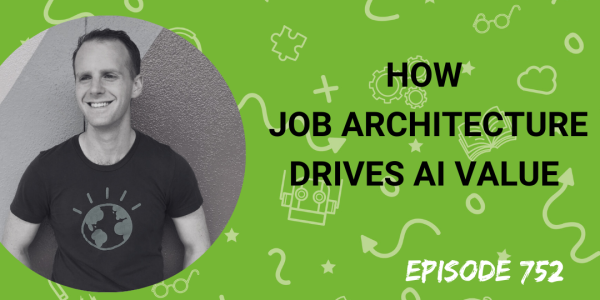
My guest this week is Ben Zweig, CEO of Revelio Labs and author of the new book Job Architecture. In our conversation, he explains how to build effective taxonomies cheaply and scalably with LLMs and why this foundation is critical for navigating change. Ben also teaches Data Science and The Future of Work at NYU Stern and talks through an invaluable framework for assessing the likelihood of AI-driven job displacement.
In the interview, we discuss:
• Why grouping people is the core of any HR analysis.
• What we get wrong about skills, jobs, tasks, and activities
• Why skills aren’t the right unit of observation to analyse jobs
• AI automates tasks and activities, not jobs and skills.
• The vital importance of taxonomies
• Using LLMs to build taxonomies cost-effectively at scale.
• What are the advantages of doing this properly?
• The three forces that help measure the potential for AI-driven job displacement
• What does the future look like
Follow this podcast on Apple Podcasts.
Follow this podcast on Spotify.
Transcript:
Matt Alder 00:00
AI doesn’t automate skills or jobs. It automates tasks, yet, most organizations have no clear picture of what tasks their people actually perform. Without that understanding preparing for AI workforce transformation is impossible. Keep listening to find out more
Matt Alder 00:21
Support for this podcast comes from talent pilot, the first end to end, AI native platform for recruiting. Let’s be honest, no one becomes a recruiter to copy and paste CVS Chase feedback or write interview notes. Talent pilot is helping the role of the recruiter to quickly evolve from a junior admin heavy one to one of the most strategic roles in the entire organization. With talent pilot recruiters can build their own hiring workflows by deploying AI agents at different touch points of the recruiting process to source, screen and select the best talent they’re offering a free demo for everyone who listens to recruiting future. So head over to talent pilot.com/matt to experience the new era of recruiting. That’s talent pilot.com/matt and it’s Matt M, A, T, T
Matt Alder 01:37
Hi there. Welcome to Episode 752 of recruiting future with me. Matt Alder, skills, tasks, jobs, activities. These terms get used interchangeably across HR and tele acquisition, but they mean fundamentally different things. Skills are attributes of people. Tasks are components of work, and jobs are bundles of activities. Having clarity here matters now more than ever, as AI begins reshaping how work gets done, organizations need a precise understanding of their workforce at the task level, without clear taxonomies, it becomes impossible to understand how to effectively implement AI for automation and augmentation. So how should employers be preparing to take the most advantage of the inevitable shifts that AI will bring? My guest this week is Ben Zweig, CEO of revelio labs and author of the new book job architecture. In our conversation, he explains how to build effective taxonomies, cheaply and scalably with llms and why this foundation is critical for navigating change. Ben also teaches data science and the future of work at NYU Stern and takes us through an invaluable framework for assessing the likelihood of AI driven job displacement. Hi Ben, and welcome to the podcast.
Ben Zweig 03:06
Thanks for having me. Yeah, happy to be here.
Matt Alder 03:09
An absolute pleasure to have you on the show, please. Could you introduce yourself and tell everyone what you do?
Ben Zweig 03:16
Sure. Yeah. My name is Ben Zweig. I am founder, CEO of revelia Labs. We’re a workforce data company, and we collect, analyze, curate and enrich all employment related information in the world. That’s, that’s our whole thing. You know, we, we collect anything and everything on the internet so that can be, you know, online profiles and resumes, online job ads, sentiment, ratings from review sites like glass, Storm, fish bowl, et cetera. And, you know, all these other tertiary data sets there could be layoff notices, immigration filings, freelance platforms. And we take that all in, and we try to make sense of what’s happening to the labor market and macro sense, but also what’s happening within firms, you know, where are they growing? Where are they shrinking? What were they recruiting people from, losing people to? What are the better, you know, markets or teams or strategies. So we really try to, you know, help organizations do better talent intelligence, workforce planning and just better analytics in general, by having all this nice and neat data that they could use.
Matt Alder 04:27
Fantastic. And you’ve written a book which is coming out, coming out soon. Tell us about the book. What’s it about? Why did you write it?
Ben Zweig 04:33
Yeah, that’s right. It’s called job architecture. So it’s really about taxonomies at its core. And I think, I think, you know, I’ve been in analytical HR for a long time. I started my career as labor economist, and then ran workforce analytics at IBM, and, you know, over that time, really, really found that that, you know, the core of any analysis, you know, within HR is about groups of people and the way that those people get grouped. It is really tricky, really complicated, and it is what good analysis lives and dies by. You know, what separates a good analysis from a bad analysis is the strength of their taxonomies of how they categorize people. It’s so important and doesn’t get enough discussion. And, you know, I feel like, I felt like there’s not a lot of authority in the space, you know, sometimes I see people kind of misusing terms like skills and jobs and, you know, tasks and stuff like that and and just wanted to write a book to give clarity into how all those things fit together and why it’s important and how to use technology to do it, you know, better, faster, cheaper, you know, I think, I think one lesson that I want to, that I want people to remember, is that you don’t need to, you know, spend 2 million bucks and hire, you know, consulting team for Mercer or something. That’s just not necessary for job architecture projects, and it’s really important, but it can be done cheaply and scalably using large language models. They’re really good at that
Matt Alder 06:01
sort of thing. Yeah, because I think that you come across the phrase taxonomies a lot when talking about skills based organizations and skills based hiring and all of those King things, really in the context of companies really struggling to classify the skills and the jobs they have within the organization, what are the common mistakes that people make. What are the, what are the sort of the wrong definitions that people are using? What’s the, what’s kind of going wrong? How’d you clarify it for everyone?
Ben Zweig 06:28
Yeah, it’s funny. I mean, even, even as as you’re you’re bringing it up, you know, I think, I think you’re saying it comes a lot up a lot in in skill based planning, skill based organizations. And it’s interesting. I mean, you know, it should, but I think so much of the attention has been, has been around using taxonomies when trying to become more skills based. And I think that is an issue, because skills are not the right unit of observation for analyzing jobs. Job, you know, they’re, they’re really independent concepts. So, you know, sometimes we see, we see, you know, vendors in the space talk about jobs as if they’re made up of skills, and that’s just fundamentally wrong. Skills are not attributes of jobs. They’re not parts of jobs. Skills are attributes of people, and jobs are really, can really be broken down into tasks and activities. So I think if you do want to do some sort of reconstruction and deconstruction, you know, deconstruction and reconstruction, so kind of, kind of reverse the order there, you really need to have a good taxonomy of work activities. That’s really important. And I think even even doing the, you know better. Skills analysis and skill based workforce planning requires you to have a good understanding of what the work activities are, because skills are really inputs into completing work activities, and without understanding the work that gets done, it’s very hard to have a good understanding of skills. So one big mistake is, is not not getting to the tasks and work activities level fast enough. I think sometimes people kind of hand wave their way past the importance of that. I think that’s a big mistake.
Matt Alder 08:13
And I guess also, and I think this is perhaps something we can talk about a little bit later in the conversation, it’s even more critical for organizations now to understand those tasks as they’re looking at AI and efficiencies and all these, all these kind of things. So it’s kind of critically important,
Ben Zweig 08:28
isn’t it? Yeah, yeah, exactly. I think it’s really bringing to light the importance of tasks, because, you know, AI, or really any technology for that matter, does not, you know, does not automate skills. You know, these things don’t have skills, and it doesn’t, it doesn’t, it doesn’t automate jobs wholesale. It automates components of jobs. And those components of jobs are really tasks and activities. So, so I think, you know, just, just having that be so in our face every day, you know, everyone’s talking about and thinking about, you know, how technology affects work. It’s really about how it affects the components of jobs, you know, parts of a workflow. So, so that that is really the right lens to think about, how does automation affect my workforce? How does it affect, you know, the people that that work here, the jobs that they do. So, so we really need to have a good, a good way to kind of deconstruct jobs into their components, and then, and then that has, that has implications into what are the attributes of people that that you want, you know, what’s, what’s the mix of skills and, and really, other traits, you know, experience levels and ambitions and and, you know, attitudes that that complement The the work activities that will be more important when technology can automate some of those work activities.
Matt Alder 09:46
Absolutely so. What is it that employers need to think about? How do they do this? Because, as you say, I think people sort of see this as a daunting task. They might not be going about it in the right way. An instant response is way to buy Exactly. Expensive software, or get some consultants in to do it. What’s the kind of solution to this?
Ben Zweig 10:04
Yeah, yeah. So, I think, I think just, you know, having the right framework is, is, is the first step, you know, knowing what’s, what’s a job, what’s a task, what’s a skill, you know, what’s a seniority level, what’s an industry, you know, just, just making sure these, these concepts, don’t get, don’t get muddied. I think that’s, that’s, you know, if you, if you can, like, have a good framework for that, you’re already in the lead. And then I think it really, it really rests on getting the right representation of, you know, each activity, job, skill, whatever it is. And by representation, I really mean, like, a mathematical representation. So what, what large language models are really good at is, is really finding similarities between certain certain entities or concepts. So let’s, let’s just take jobs. For example, you know you have a job title, and it could be, you know, you have a job title that says lawyer, another job title that says attorney, and you know, we know intuitively that those are really synonyms. But, you know, how do we do that at scale? You know, there’s a million other examples where we don’t know that intuitively, and we can’t, you know, do this manually. So, so we need to, you know, put, put these, you know, job titles, into a large language model, and get a mathematical representation of each one. So, so, just to get a little, little mathy here, you know, when, when we, when we put something like a job title, what we want is a a vector. A vector is just a list of numbers and and, you know, we get that for lawyer, and then we get another, another list of numbers for attorney. And then, you know, we can just compute distance. And distance is just, you know, the simple way we learned distance in grade school, it’s, you know, a squared plus b squared equals c squared. You know that. That’s just the distance between between two things. And, you know, we want, and if something has a sufficiently small distance between two things, we can say, all right, we can cluster them together. We can, we can say they are part of the same group, and that that, you know, has to be done kind of at scale, and if things are different, then we say, you know, if things have a have a large distance, then we say they’re part of different groups. You know, this is something that is not, it’s not so trivial, you know, can’t be done in a day, but it’s, it’s not something that needs to, you know, take big teams, you know, many months to do. It’s relatively straightforward. I think, you know, a talented team that knows how to use, do, do math and write, write basic code. I think, I think can do this in a matter of weeks, and, and so, so, there’s really, there’s really a few steps, you know, there’s, there’s the embedding, which is getting the set of numbers for each for each thing that you want to find numbers for. That could be a job title, could be a skill, could be a sentence that describes what people do in their in their work activities. And once you have a set of numbers, then we need to find similarity and group them together. And that’s really, that’s clustering. So, so we have to do, we have to do clustering, and we have to find groups of these, of these entities. So there’s, there’s embedding, there’s clustering, and then there’s labeling. You know, once you have a group of all these, of all these job titles, you know, let’s say you have, you know, lawyer, attorney, counsel, Associate Attorney. You know, you have all these different sets of job titles, you have to find a label for that group. Maybe you can just use the most common title. Or maybe you want to do some summarization. Sometimes, if you have physical therapist and speech therapist and occupational therapist, you don’t just want to pick the most common one. You don’t want to say, oh, that’s the cluster of speech therapists. Maybe you want some title that’s like therapeutic professions or something, and that’s also what llms are really good at, you know, generating summarized labels. So, so there’s, there’s a way to to kind of just, just label them and get, and get a good, a good, intuitive name for that group. And then, you know, this is, this is, this is something that I think doesn’t get enough attention, but is really important. We have to think very carefully about versioning. So, so, you know, when we have groups, those things change. You know, the labor market evolves and transforms all the time. And even if the labor market doesn’t change, businesses may change, and their priorities may change. They may have a merger with someone else, and, you know, expand their the professions, or, you know, you want some alignment to lines of business, or something and that. And with that versioning, I think we really have to think about what, what? What’s the criterion where, where we think that something is emerging, you know, we have to be able to introduce new jobs. And then, you know, maybe we have some obsolescence. Maybe, maybe something is becoming obsolete, and we don’t really care about it anymore, and we want to like group it in with something else. We have to have a process for making sure that that can happen, so that we don’t have to go back to the drawing board every year or two.
Matt Alder 14:52
And obviously, you know, it’s not, it’s not a simple task, but it’s something that’s now much more accessible as technology has kind of moved on. What. Are the advantages for companies of doing this, from a from a talent management, a talent acquisition, a business process perspective? What’s the kind of the upside of having having this done properly?
Ben Zweig 15:10
Yeah, I mean, the the short kind of tongue in cheek answer is, so that their analysis doesn’t suck. So, you know that that’s, that’s one way to think about it. You know, if you don’t do this, then you’re going to end up comparing groups that just make no sense. And you know, I mean, I had this example when I was doing this at IBM, where we were ranking, kind of like the occupations that were like most in demand and least in demand. And at the top of the list there was like SAP consultant, and at the bottom of the list. It was like, SAP implementation consultant. And we were like, okay, you know, these are really the same thing. Like, why is one showing up? Like, you know, really healthy, and the other, like, you know, really unhealthy. And, you know, it was, it was, it was really just, you know, an artifact of these being poorly categorized to begin with. So, so we weren’t really able to, you know, have good results until we, you know, created a meaningful taxonomy. And that was, and that project was really about identifying, like, where, where we wanted to hire more, and where we wanted to, you know, shrink the business. So that was, that was really just for workforce planning, you know, aligning the the, you know, workforce of the business to the needs of the business. And so once, once you have a good, you know, grouping, you know, set of people, then of course, you need, you need metrics for all of those to identify, you know, what’s strategic, what’s important, and where demand is high and availability, and compare that. So, so just kind of knowing what you need and how much you need really rests on on having good groupings of people, and also for talent acquisition. I think it’s, it’s particularly important as well, because you know you’re, you’re going out there to the market where, where you know the market has some language of, of what, of what is, what’s similar, and what’s not. And if you’re using the wrong the wrong words, the wrong titles, you know, the wrong the wrong skills to to recruit people, you’re gonna end up finding the wrong people, or finding the wrong the wrong pools of talent. So you know, I mean, we see so many examples where you know, companies, you know, try to try to source from a certain location, and they go in and they say, Well, you know, they find out that, you know, the these locations or these markets just don’t have the people they need, and then they’re kind of stuck. So I think being really, you know, deliberate about, about where to find, you know, the right pools of talent is critical for sourcing, and then just for actual recruiting as well. You know, we want to make sure that that the actual individual people coming through the pipeline are, are pursuing the the opportunities that they think they’re pursuing. Yeah, we don’t want to put them in front of something and then, and then, you know, whoops, two weeks later they realize, oh, this actually isn’t the job I thought it was.
Matt Alder 18:07
Now I want to come back to I want to come back to AI, but also in the context that you also teach future work at NYU. So I’m just interested sort of pulling this all together where you think we’re kind of going with the the AI jobs situation, you know, is AI going to take jobs away? What do you think is going to happen? How is this sort of, how is it going to pan out?
Ben Zweig 18:31
Yeah, I mean, this is, like the big question that, you know, economists have been asking for at least 100 years. So, you know, are we going to see Technological Unemployment, you know, Does, does technology displace labor? Huge question, hugely important. It hasn’t in the past. I mean, I think there’s very limited cases where, where technology has has created any sort of unemployment. So this idea of technological unemployment is, you know, historically, just been an idea. Now, that’s not to say it couldn’t happen in the future and and, you know, you know, sometimes this time really is different. You know, this technology really could be just fundamentally distinct from from technological shocks in the past. So I think the way, the way that I think about this is that there’s really three, three kinds of forces which which are important to pay attention to when we think about labor displacement. One is the sensitivity of firms to new technology. So, you know, firms are the organizing unit of labor. You know, they represent the demand side for labor markets, and they, they can adopt technology quickly or slowly. And you know, if they adopt technology quickly, then that that’s more of a shock. If they adopt technology slowly, then that happens more slowly. So, you know, it depends like, like, you know, we have to, we have to think about how, how quickly is, is adoption taking place? How quickly are firms adopting new technology? If it’s slow, then then that that gives plenty of time for for workers to kind of, you know, select into, into companies that that you know, that companies or roles that they’re like, less vulnerable to automation. So that’s one factor. I think what we’re seeing is that firms are pretty slow, so that makes me a little less nervous. I mean, not great for productivity, but like, you know, probably good for unemployment. The other is the you know, how sensitive are workers to new technology? So, you know, workers are the supply side of labor markets. You know, are they responsive to new technology? Do worker, you know, if workers can, can change their their career, change their occupation, very quickly, then great, we have an adaptive workforce. And we don’t. We have nothing to worry about if they, you know, if, but if someone you know, decides what they’re going to do, you know, the minute they enter the workforce, the labor force, and then, and then, stick with that, and they can’t really budge. Then, then we’re then we’re in trouble, then we have a rigid, a rigid labor force and and so I think, I think that’s a bit of a mixed story. So, you know, I think, I think young workers, excuse me, are learning more general skills. And I think there is more of an ability to kind of, you know, reestablish someone’s career. You know, I think the one of the one of the best examples of clear automation at the occupation level. And I should say automation typically happens at the task level. Very rarely happens at the occupation level, but one example where it did happen in the occupation level was in the case of telephone operators. So, you know, there was a telephone operator, and there was a totally new system where, you know, telephone operators were just not, just not needed at all, and and that job just completely went away. And that really also didn’t result in technological unemployment, mostly because labor markets, you know, the the labor supply was very responsive. So, you know, people who were telephone operators went into other, other professions. They became, you know, secretaries at the time. Now, administrative assistants, typists. You know this there was, they got absorbed into the labor market very quickly, so that that really didn’t result in much of a in much of a labor market shock. And the third, the third factor, which I think is actually the most important factor, is, is about how responsive jobs are to to reconfiguration, to reconfiguring themselves, to technology. So, you know, we have, we have, you know, a job is, you know, you can think of it like a bundle of tasks, a bundle of work activities. And you know, let’s say someone’s brought in to do 20 things, and you know, four of those get automated, and they’re left doing, you know, 16 things. You know, do they do more of those 16 things? Do they do those, you know, are they just more concentrated? Do they introduce new tasks and, and, you know, expand back to 20, and there’s some four new tasks that we, you know, didn’t think about, or didn’t know about, um, and I think, you know, there are some organizations where that can happen very fluidly, very, very quickly. And some organizations that are really, really procedural, and jobs are just very rigid, and someone’s, you know, brought in to be a specialist in a certain process, and they can’t easily adapt, they can’t easily change their job. So I think that’s the factor that I I’m really paying the most attention to, because I think if, if workers can, can kind of reconfigure their job. Sometimes it’s called job crafting, then, then I think we’ll have nothing to worry about. But I do get very concerned about these, like large bureaucratic, procedural organizations that don’t have a lot of flexibility and adaptability in their jobs, and that that is making me nervous
Matt Alder 24:08
Absolutely, and it kind of makes the whole taxonomy thing even more important, doesn’t it?
Ben Zweig 24:13
Yeah, I mean, I think, I think part of it is that I think they’ll be able to adapt more flexibly if they have the right taxonomy of work activities, because then you’ll be able to see when there’s some, you know, technology creep, and you can say, Oh, well, you know, a year ago, they were doing these sets of activities, and now it’s shrunk. So I think, I think that, you know, can, can act like a call to action, and just, you know, an alert system where you can, you can, you know, show the Strategic Workforce Planning Group, or the heads of HR, whoever, or, you know, the business units ideally that that people aren’t being properly utilized and there. And, you know, I think, I think when people’s jobs are narrow, that typically is worse for the worker. I think, you know, workers enjoy having more diversity in their role than. Less so. I think, you know, if that starts to happen, I think you know, there should be concerns in the organization. I think, I think you know, they should start, you know, trying to, you know, reconfigure who does what, shift the borders of the organization. I think, I think that, you know, really calls for some sort of, some sort of action, whether it’s reorg, or whether it’s, you know, hiring different types of workers, or whatever it is. I think that, you know, just tracking that is
Matt Alder 25:29
useful Absolutely. And as a final question for you, if we kind of look ahead, sort of 345, years time, I mean, how do you think things are going to evolve? Let me sort of put it this way to you, if we’re having this conversation again in three years time, what would we be talking about?
Ben Zweig 25:47
It’s a great question. I’ve been thinking and kind of hoping so, you know, part of this is, you know, a hope more than a more than a prediction. But I’ve been, I’ve been really hoping, for the last, you know, seven to 10 years, that that labor markets start looking more like capital markets in the world of capital markets. And, you know, I should mention, you know, labor markets are twice as big as capital markets. You know, there’s about two thirds of the economy is, is of economic output is attributable to labor, and about 1/3 is attributable to capital. But capital markets are really efficient. You know, that that’s, that’s finance. There’s a whole field of finance which is allocated to the, you know, which is, which is really responsible for the efficient allocation of capital. And, you know, there’s, there are some people who think about the efficient allocation of labor, but they’re very few and far between. And there’s not a lot of science, there’s not a lot of math, there’s not a lot of rigor, and there’s not a lot of data. I think we’re trying to change that by introducing more data and rigor, but I really think and hope that that in three to five years, you know, if and if and when we we have this conversation Again, we’ll really be looking at a labor market that that is is scientific in new ways, where we’re just going to have more ubiquity of information, more shared definitions, more adaptability in how people think about how employees are categorized, in how organizations can react to shocks. I think there will be, you know, more conventional wisdom, more science, and I think that will result in, you know, organizations that are more adaptable, smarter and allocate labor much more efficiently. So that’s my hope. I don’t know if we’ll get there in three to five years, but I think we’ll get there in in 10 years.
Matt Alder 27:49
Absolutely. Ben, thank you very much for talking to me.
Ben Zweig 27:52
Thank you. Yeah, thanks for having me.
Matt Alder 27:55
My thanks to Ben. You can follow this podcast on Apple podcasts, on Spotify, or wherever you listen to your podcasts, you can search all the past episodes at recruiting future.com on that site. You can also subscribe to our weekly newsletter, recruiting future feast, and get the inside track on everything that’s coming up on the show. Thanks very much for listening. I’ll be back next time, and I hope You’ll join me.