How do we move from reactive recruiting to predictive talent acquisition? In an era where performance metrics drive every business decision, recruitment often remains stubbornly intuition-based, especially when evaluating soft skills like empathy, communication, and critical thinking. What if AI could help us predict performance before a candidate even starts? And what happens when we connect hiring decisions to actual performance outcomes, creating a feedback loop that makes recruiters smarter over time? Can technology help us understand which risks are worth taking, and which gut feelings we should trust?
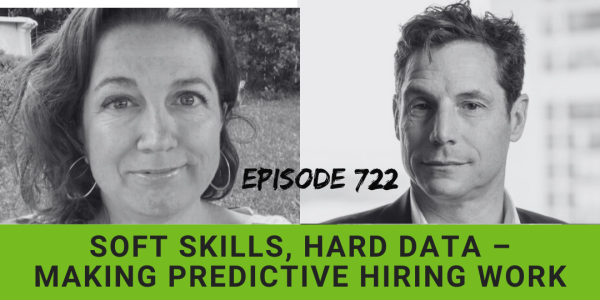
My guests this week are Veronique Lacasse, Senior Manager at Bell Canada, and Stephane Rivard, Co-founder and CEO of HiringBranch. In our conversation, Veronique and Stephane walk us through Bell’s integrated approach to talent acquisition, which utilizes AI assessment data on soft skills to create a predictive, performance-driven hiring system that is still very much driven by human recruiters.
In the interview, we discuss:
• Soft skills and business performance
• Measuring soft skills with AI driven assessments
• Challenges in high-volume hiring
• Building a feedback loop in recruiting, onboarding, and training
• Showing recruiters the performance outcomes of their decisions
• The candidate experience
• Why human recruiters aren’t being replaced
• What does the future look like?
Recruiting Future helps Talent Acquisition teams drive measurable impact by developing their strategic capability in Foresight, Influence, Talent, and Technology.
If you’re interested in finding out how your TA function measures up in these four critical areas, I’ve created the free FITT for the Future Assessment. It’ll give you personalised insights to help you build strategic clarity and drive greater impact immediately.
Just head to mattalder.me/podcast to complete the assessment; it takes less than 5 minutes.
Follow this podcast on Apple Podcasts.
Follow this podcast on Spotify.
00:00
Matt Alder
Recruiting has always been about gut feel and best guesses. But what if hiring could be properly predictive and performance driven? What if you could measure success before day one and set up a feedback loop that shows your recruiters in real time the business outcomes of the decisions that they’re making? Keep listening to find out how Bell Canada have done just that. Support for this podcast comes from Hiring Branch, creators of the world’s first soft skills AI. In today’s AI driven workplace, soft skills are the new currency. That’s why, even before the interview, top hiring teams are using Hiring Branch to measure what matters. Empathy, critical thinking, collaboration and more than 50 other soft skills are detected with 98% accuracy from hiring Branch’s conversational assessments this is skills based hiring at scale. Visit hiringbranch.com to see how you can start hiring for the right skills.
01:28
Matt Alder
Hi there. Welcome to episode 722 of Recruiting Future with me, Matt Alder. Recruiting Future helps talent acquisition teams drive measurable impact by developing their strategic capability in foresight, influence talent and technology. If you’re interested in finding out how your TA function measures up in these four critical areas, I’ve created the free Fit for the Future assessment. It’ll give you personalized insights to help you build strategic clarity and drive greater impact immediately. Just head over to Mattalder.me/podcast to complete the assessment. It takes less than five minutes. This episode is about talent and technology. How do we move from reactive recruiting to predictive talent acquisition? In an era where performance metrics drive every business decision, recruiting often remains stubbornly intuition based, especially when evaluating soft skills like empathy, communication and critical thinking. What if AI could help us predict performance before a candidate even starts?
02:47
Matt Alder
And what happens when we connect hiring decisions to actual performance outcomes, creating a feedback loop that makes recruiters smarter over time? Can technology help us understand which risks are worth taking and which gut feelings we should trust? My guests this week are Veronique Lacasse, Senior Manager at Bell Canada, and Stephane Rivard, co founder and CEO of Hiring Branch. In our conversation, Veronique and Stephane talk us through Bell’s integrated approach to talent acquisition that uses AI assessment data on soft skills to create a predictive performance driven hiring system that is still very much in the control of human recruiters.
03:32
Matt Alder
Hi Stephane, hi Veronique, and welcome to the podcast. It’s brilliant to have you both on the show. Could we just start off with you Introducing yourselves and telling everyone what you do.
03:44
Stephane Rivard
Yeah, definitely. Thanks Matt for having me on our show. Yeah. My name is Stephane Rivard. I’m the co founder and CEO of Hiring Branch where we help companies who hire for soft skills and improve performance.
03:55
Veronique Lacasse
That’s it. And I’m Veronique Lacasse, senior manager at Bell Canada and I take care of the recruitment, training and onboarding of our new agents.
04:03
Matt Alder
Fantastic. And we’ll sort of dive into all of the details around that as we go through the conversation. But just to start with Stephane, can you give us a little bit of scene setting here in terms of everything kind of around soft skills and how they’re kind of really impacting business performance and individual performance and how important they are?
04:23
Stephane Rivard
Yeah, I think that’s a great question. You know, I think the easiest way to answer is to give an example. You know, nowadays imagine that you have two employees starting on the same day and they both have identical resumes and technical know how one excels quickly, becomes a team lead and consistently delights customers and the other struggles despite their qualification. What’s the difference? Well, I think what we know is it’s soft skills. It’s really the ability for them to communicate clearly, collaborate effectively, show empathy, adapt quickly, think critically and well from, we understand from our customers this outweighs hard skills both in the short term and the long run, especially in customer facing roles. And I think Vevo has lots of great examples of that.
05:05
Matt Alder
And I suppose one of the things in the past is it’s always been quite difficult to kind of assess those in a recruitment process, hasn’t it?
05:10
Stephane Rivard
Yeah, it’s been very difficult, you know, and we know that in the past this has been done either through looking at CVs, doing interviews, which is at the end of the day, especially in high volume, it’s a gut feeling you’re not going to spend hours and hours interviewing someone then when you have hire 5,000, 10,000 or whatever number it is. So it’s really using AI and science data driven approach to hire for these people.
05:33
Matt Alder
So Vernique, give us a bit of background about your kind of hiring situation, as it were. I mean, what are the challenges that you have with your high volume hiring and how have you been sort of going about solving them?
05:45
Veronique Lacasse
Exactly. So hiring a high volume is not just about a number of agents that you want to bring in, it’s the quality of agents that you also want to scope and really gather their intel on, but also doing it in a timely manner. So for us it’s not just high volume. We need to usually act quick so we can serve our customers better and faster. So in that approach, leveraging assessments such as again, a pre IR assessment following on soft skills will allow us to really capture the essence of the agents we’re looking for and really have a good pool of strong agents that whenever we need to hire for, we can go and really have them come in for interviews.
06:26
Veronique Lacasse
So it’s speeding up the process in a way where candidates are able to apply, do the assessment and really helping us in that speed to quality that we need to deliver.
06:37
Matt Alder
Absolutely. And I know you’ve done some interesting things as well with the way that you’re combining recruiting, training and onboarding. I mean, tell us a little bit about that and what it allows you to do differently.
06:49
Veronique Lacasse
Definitely. So bringing a team like recruitment, training and also the onboarding of agents together really is helping us to capture every step of their journey, but also looking at the benefits and how they influence one another. So hiring strong candidates will definitely help with training results and obviously performance results. So how can we look at the overall journey of the agent and understand how we can influence also one or the other of the pillars? Right. So if we know we’ve hired certain candidates with a profile A and they’re doing X in training that we know we can give feedback to the recruitment teams as well as the training teams, but also looking at performance globally.
07:35
Veronique Lacasse
So I think that’s something that were able to achieve where the recruiters have access to the performance of the agents that they hire and they know how they are doing in training as well as onboarding. And we provide a recruitment information also to operations and training. So it’s easier for us to build coaching and realign our strategies in a way.
07:55
Matt Alder
And is that sort of improved your hiring over time as you’ve been. Has you been doing that?
08:00
Veronique Lacasse
Yes, it has. Because the way we can share all this information, it’s easy to look for as a recruiter level to better understand did they make the right choice? Because in the end, talking to what Stephane was saying about the bias, the assessment, the pre assessment of soft skills is one step in the overall funnel activity of recruitment. So sometimes as a recruiter, you know, you see the strong abilities of a candidate, but you’re still like, okay, you know what, I’m going to give it a chance. So giving them access to the performance and how they’re doing afterwards is also reassuring as a recruiter because, you know, you made the good call. Or maybe it didn’t pay off the decision you made. You made, you took a risk because recruitment is about taking risks too. Right.
08:43
Veronique Lacasse
So there’s so much you can know about the candidate. So as they go in and they see this, they understand better what type of chances maybe they took and which one paid off or not.
08:54
Matt Alder
Yeah, that’s kind of really fascinating. Really, really kind of fascinating in terms of just the kind of the human decision making aspect there kind of going, just going back to the kind of the soft skills and using AI as part of this. Stephane, where does that kind of sit in the picture? I mean, is it able to predict performance? How does it shape the kind of approach to recruiting right at the beginning or as it kind of goes through the process?
09:21
Stephane Rivard
Yeah, I think that’s a great question. I like the, you know, the word predict is a good word, but I think I like to say better it measures performance because the way that the AI works is that you’re actually putting the candidate in the role that is a typical customer service or sales roles and you’re actually measuring how well they do it. And the interesting about using this kind of approach is like before we would really use your resume or gut feeling to try to figure out if they had great soft skills and now you’re using data driven insights. And we do this by analyzing thousands and thousands of real world outcomes like sales conversions, customer satisfaction, retention, by correlating them back to performance.
10:02
Stephane Rivard
Therefore it’s actually translating and then you’re just replicating that process to an AI process that identifies them very quickly and knowing that in sales you need empathy, you need to build rapport and very specifically. So it really helps you to predict performance and reproduce this process over and over again, especially in high volume. Like it’s very difficult to do this by an interview or resume.
10:28
Matt Alder
I suppose the other interesting part of this is how the process feels from a candidate perspective because more and more we’re kind of seeing comments pop up online about people hating AI interviews or AI assessments or things like that. I mean, what kind of level of personalization can go into this process? How do the candidates feel about going through it?
10:50
Stephane Rivard
Yeah, I think the difference between an AI interview and what we do, which is like a conversational assessment where you’re actually talking to real life scenarios where you have to do critically thinking. You know, it’s interesting when you’re doing an interview and you’re trying to elicit information like about past history or things you’ve done by using this as you’re actually Doing the job. So back to the candid experience. You’re setting expectations really early of what the job entails. So and that’s how I think is really different compared to an AI interview tool, you know, and you can personalize it exactly for the exist all the existing roles you have and they require different soft skills.
11:28
Stephane Rivard
So if you’re in a sales and loyalty like they have at Bell, you have different types of questions, different types of scenarios and different kinds of ways that the candidates to object or you know, I don’t need to upgrade. There’s lots of different scenarios you can put them in compared to customer service, compared to healthcare. And these are all different skills. So you can’t have a one size fits all. And I think by doing this is where you really be able to reach the performance metrics that you want.
11:54
Matt Alder
And in this case Veronique. Is this kind of assessment, has it replaced CVs and interviews? Is this how does your recruitment process kind of work using this kind of technology?
12:04
Veronique Lacasse
So it hasn’t replaced CVs and interviews as of yet. What it really does is it brings the strongest candidate with the abilities we’re looking for at the forefront of the process. So as a recruiter, instead of seeing so many candidates without even having that filtering process, sometimes like okay, why am I sometimes even meeting that person? They don’t have the minimal requirements I’m looking for. The resume said so. However, by the time I meet the person I don’t know, I rely on paper with an assessment like this one, they actually performed conversations, right. So they did apply some of their abilities for soft skills.
12:41
Veronique Lacasse
So as they come in and the recruiter gets access to the information and how they scored, they kind of know already that they have what it takes to perform on the job so they can really focus on those specific questions they have about the role and not so much having to redo again all of that soft skills validation, which makes a process much longer. We know time is of essence for anybody who’s again in the process of applying for a job. If your process is too long, it doesn’t really help you really be a winner in your field. And in call centers, there’s a lot of them, right? There’s lots of companies out there. So if you’re known as a company who’s taking very long to hire, the process is lengthy.
13:24
Veronique Lacasse
It can also, I’m going to say, repulse some of the candidates because they’ll be concerned that they may not be successful because it’s too long. This is really at the top of the funnel. So the candidates were sending the test to them, they do it and then we continue with our funnel activities and recruitment.
13:42
Matt Alder
And I suppose it’s like, you know, what are the implications for recruiters in this? Do you still see them as an essential part of that process? Is this replacing them?
13:52
Veronique Lacasse
It’s not replacing them. No, no, no. I want to reassure. So it’s not replacing them, it’s really using their time with valuable candidates. Right. So we know recruitment is a fast paced environment like especially like in call centers, eye volume. We need to react fast. If I have a team of recruiters, I really want for them to focus on what’s really critical and if I can make it easier for them to meet with the candidates that I know have a good chance of being happy on the job, performing well for our customers, then might as well just give them those candidates first. Right. So it’s really making sure that for them any time that they have that they can even do other things in the recruitment activities, then let’s have them focus on those things and it’s hearing back from them.
14:42
Veronique Lacasse
We are again, we work with recruitment teams and they are sharing their feedback on how the test is going, everything. So it’s really also sharing best practices. We want to make sure that the assessment is really at the top all the time. So no, there’s no, we’re not planning on replacing them, just making their lives easier.
15:00
Matt Alder
Yeah.
15:00
Matt Alder
And I suppose there’s two things about that, aren’t there? There’s the top rated candidates that you really want to get into your business. The sense that there is a human advocating for them in the process is probably really important and I think very important. Going back to what you said about taking risks, it’s allowing the recruiters to sort of do that creatively and kind of really sort of, I suppose find out more about how to recruit for these roles. Stephane, did you have some thoughts on this?
15:25
Stephane Rivard
Yeah. And I think what we’re seeing with a lot of our people that we work with is that the interview has changed, especially using AI as both mentioned. You know, they’re using a screening technology like ours at the top of the funnel and then the interview becomes an operational cultural fit interview. So you’re not losing the interview to figure out if they can do the job. You know, someone the AI has done that. You’re just making sure that they’re going to be a great fit for your organization. So the, you know, the recruiter plays a more important, vital role and they have more time to actually spend with the qualified candidates. So I think that’s how part of it, how the recruiter role is changing nowadays.
15:59
Matt Alder
Yeah, 100%. I think that makes perfect sense. And I suppose almost kind of the same question about call centers because we constantly sort of see headlines in the news with AI taking jobs and people trying to replace customer service with AI and all that kind of stuff. Do we still need humans to work in call centers? How does that kind of role evolve as we move forward?
16:18
Veronique Lacasse
And we do. Right. So we still need humans to work in call centers. AI is really, we’re using it really to work on specific tasks that can help the agent even have a better conversation. Right. With the customer. So if we can use AI to facilitate any type of process enhancement, transaction based type of activities, and the agent really have a focus on the customer because we can leverage AI around them in solutions and systems, then the customer will win in the end. So again, you’ve been in the industry for years. I don’t see the time where a human won’t want to meet with a human over the phone to fix something end to end. There may be transactions that. And again, I do them myself.
17:04
Veronique Lacasse
Like I go on websites with service providers and I complete those basic tasks that maybe before agents were doing. But to see that we’ll erase all this and just change to just machine. I don’t. Again, maybe one day, but not now, that’s for sure.
17:20
Matt Alder
But yeah, I suppose also with things like complaints or queries or loyalties, there’s that real human sense of wanting to be seen and heard as part of that process, isn’t there?
17:30
Veronique Lacasse
Yes, it’s very important. Right. And again, some people are comfortable working with AI and even chatting with bots. And that’s great. We’ll still have a part of the population that want to get that human reassurance and really work with an agent on the phone. For sure.
17:47
Stephane Rivard
Yes. Authentic voice of your brand, you know, you want to be authentic with it.
17:51
Matt Alder
So yeah, no, 100%. And kind of as a sort of final question, I mean, where is talent acquisition and assessment going? Because you know, these are already some kind of quite fundamental shifts on how we’ve worked in the past. What do you think, sort of the credible visions of what the future might look like? Where are we heading?
18:11
Stephane Rivard
Yeah, I think that’s a great question. I think you know for sure AI is fundamentally reshaping talent acquisition and assessments and it’s changing it from being reactive to predictive and performance driven. So I think that’s one of the things, and it’s going to continue to do that. Historically, there’s been a lot of resumes and hiring on gut. That’s changing. And we’re going into an era now that we are into where the AI models are proactively identifying the right talent at the right time with a high degree of precision that deliver the right results. And I think that’s really where we’re seeing, you know, what’s going to happen in the future.
18:48
Stephane Rivard
And, you know, you can see AI tools that are constantly scanning for the right fit, making sure that, you know, candidates, employees will be dynamically evaluated for fit AI as a career coaching right now, we can see that sometimes you can’t always get, you know, the perfect fit, but you can identify skill gaps. And what I mean by skill gaps, it could be the person who’s not very good at active listening, but they could probably fill in that role. Or maybe they have great verbal skills, speaking skills, but their written skills aren’t as great. So we can see that. And more importantly, we can see bias. Free hiring at scale. I think that’s really the number one. Our customers tell us they’re hiring people that they would have never, ever hired if they had used traditional CV screenings, resume screenings or interviews before.
19:34
Stephane Rivard
It’s like it completely removes the bias out of the process. I think that overall AI is going to move from intuition to intelligence for organizations not to hire faster, but smarter and fairer. And I think the last thing I like to say is that the future of talent acquisition will be more human, not less, because we’ll finally deceive people for what they are and what they can truly do. And I think back to the comment I said before. Many times people get passed because of bias by using an AI. First, you’re going to hire people that will do the job remarkably well. So I’m hoping that the human, and I’m quite optimistic that the human will still play a key role. The end of day, people want to talk to people. So you’re going to need people in the whole recruiting process.
20:18
Matt Alder
Stephane, Veronique, thank you so much for talking to me.
20:22
Veronique Lacasse
Thank you.
20:23
Stephane Rivard
Thanks, Matt. It’s been great.
20:25
Matt Alder
My thanks to Veronique and Stephane. If you haven’t already, you can benchmark your talent acquisition capability quickly and easily by completing the free Fit for the Future assessment. Just head over to Matalder.me/podcast and you can get some valuable insights straight away. You can follow this podcast on Apple Podcasts, Spotify or wherever you listen to your podcasts. You can search through all the past episodes at recruitingfuture.com and you can also subscribe to our weekly newsletter there Recruiting Future Feast and get the inside track on everything that’s coming up on the show. Thanks very much for listening. I’ll be back next time and I hope you’ll join me.