
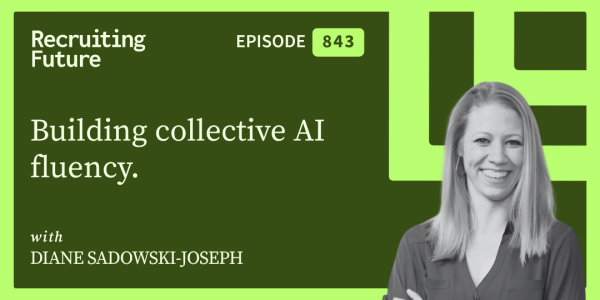
In many HR and TA teams, the use of AI has grown through individuals trying the tools out and developing their own ways of working with them. Individual skill of that kind does not automatically make a team or an organization good at using AI collectively. Collective fluency goes beyond familiarity with the tools, and depends on people understanding the technology well enough to make good decisions about how a whole team uses it. So how do HR and TA leaders build that kind of fluency across their teams?
My guest this week is Diane Sadowski-Joseph, Co-Founder of Clarinet, a firm that helps organizations adopt AI and get value from it. In our conversation, Diane explains what decision-grade AI fluency means and how to assess it when hiring, how employers should respond to shadow AI, and where HR and TA leaders should focus as AI use moves from the individual to the collective.
In the interview, we discuss:
- How AI is changing jobs and creating new work
- What is decision-grade AI fluency?
- How to assess AI fluency in the hiring process
- The difference between individual AI skills and collective AI use
- What data readiness means in practice
- Shadow AI and the importance of psychological safety
- What would your team do with 30% more capacity?
- Why AI fluency for leaders should be the first priority
- Hiring for openness and the ability to learn quickly
- What does the future look like?
Follow this podcast on Apple Podcasts.
Follow this podcast on Spotify.
Key takeaways
- Decision-grade AI fluency means understanding the tools well enough to make good decisions about how they are used, which goes beyond being familiar with what they can do.
- A team of people who are each skilled with AI does not automatically become an organization that uses AI well; that also takes agreed ways of working and shared infrastructure such as clean data and a common source of truth.
- AI skills can be assessed in hiring by letting candidates use AI on a task and then asking them to walk through how they did it, including where they applied their own judgment and where they overruled the tool.
- Shadow AI use is a major data risk for organizations, and it often comes from employees who have not been given permission to use the tools or who are worried about what using them means for their jobs.
- Leaders can make AI feel safer for their teams by answering one question in concrete terms, which is what the team would do if it had 30% more capacity.
- Clarinet’s co-founder expects 2027 to be the year organizations move from individual to collective AI use, and recommends making decision-grade fluency among leaders the first priority.
Transcript
Matt Alder 0:00
Over the last few years, much of the focus around AI in HR and talent acquisition has been about getting individual team members to experiment and get good at using the tools. However, a team of people who are good with AI is not the same as a team that have worked out how to use it together. So how do teams move from individual experiments to collective fluency? Keep listening to find out.
Matt Alder 0:28
Support for this podcast comes from Ashby. Ashby All-in-One is a fully integrated solution combining ATS, CRM and sourcing, scheduling and analytics into a single source of truth, giving recruiting teams precise control over every stage of the hiring journey. With embedded AI assistance and automation at its core, Ashby empowers talent acquisition teams at companies like Snowflake, Ramp, Deal, Zapier and Deliveroo to reach the highest talent density. So they can better serve customers, close more deals and ship products faster. Visit ashbyhq.com slash recruiting future today to see how it all works. That’s ashbyhq.com slash recruitingfuture.
Advert 1:25
There’s been more of scientific discovery, more of technical advancement and material progress in your lifetime and mine, than in all the ages of history.
Matt Alder 1:40
Hi there, welcome to episode 843 of Recruiting Future with me, Matt Alder. In HR and TA teams, the use of AI has tended to grow through individuals trying the tools out and developing their own ways of working with them. Individual skill of this kind does not automatically make a team or an organisation good at using AI collectively. Collective fluency goes beyond familiarity with the tools and depends on people understanding the technology well enough to make good decisions about how the whole team uses it. So how do HR and TA leaders build that kind of fluency across their teams? My guest this week is Diane Sadowski-Joseph, co-founder of Clarinet. In our conversation, Diane explains what decision-grade AI fluency means and also how to assess it when hiring, how employers should respond to shadow AI, and where HR and TA leaders should focus as AI use moves from the individual to the collective.
Matt Alder 2:42
Hi, Diane, and welcome to the podcast.
Diane Sadowski-Joseph 2:45
Thank you. Thanks for having me.
Matt Alder 2:47
An absolute pleasure to have you on the show. Please, could you introduce yourself and tell everyone what you do?
Diane Sadowski-Joseph 2:54
Yes. So, hello, my name is Diane Sadowski-Joseph. I’m the co-founder of Clarinet. And Clarinet is an organisation that helps other organisations adopt and see value from AI.
Matt Alder 3:08
Fantastic. Lots of things I want to talk to you about, but obviously, lots of headlines around at the moment about what AI is doing to jobs and doing to work. What are you actually seeing with the organisations that you work with?
Diane Sadowski-Joseph 3:21
All right. So what we’re seeing on the job front when it comes to organisations is most of the organisations we work with are actually not interested in displacing or replacing their humans. Most of them are interested in essentially using AI to unlock additional capacity so that the humans they have can accomplish more. And that’s largely because we work with a lot of mid-market organisations where there is always more that you want to do than there are time and people to do it. And so I think like that’s a really important dynamic to understand is one is, you know, what stage is the organisation at? Because the stage of the organisation really dictates the value of kind of human power to accelerate growth, for example, or turnaround. I also think it’s really important to look at market dynamics, because what we’re seeing is that AI’s impact on jobs is mirroring the market’s impact on jobs generally, right? So for example, in times of, for example, tech expansion and contraction, you see job expansion and contraction. And so we’re seeing the curve of that align when it comes to AI as well, for better or worse.
Matt Alder 4:41
Yeah, absolutely. And I think a lot of the narrative has been that companies using AI as a cover story to make cuts that they were coming to anyway. Do you think that there is something behind it, though? Are we seeing AI displace humans at all?
Diane Sadowski-Joseph 4:56
There definitely is something behind it in the sense that the way that roles were previously designed did not account for AI. And so when you factor in AI’s capabilities, it is now possible to do a lot more with a lot fewer people in certain areas, not in all areas, but in certain areas. But a good example of this is coding. So if you look at, for example, Anthropic itself, there is no way that they could have built kind of the volume of models and so on with the number of engineers that they have five years ago. Like there’s just no physical way. They would have had to be five times the size. So I think that for, you know, in organisations where that is your bread and butter, that is where the value of your organisation comes from. It is likely that there are going to be changes and shifts there. What we are seeing, though, is that AI is also making new work. So a good example of this, and I don’t mean like, look, I am not starry-eyed about this idea of AI won’t replace humans, humans who know AI will replace humans. That’s not true. If your job is entirely consisted of tasks that AI can do faster and cheaper, then that job is going to go away in a lot of places. However, what we are seeing is that it is not always straightforward because a good example of this, and we were just talking with a client about this today, is, they have their software engineering team has increased the velocity of production. So they’re able to produce more and more and more. Well, guess what that means for marketing? For account management, for all of the people downstream of that, who are now essentially having to launch and support more and more and more new products. And so it’s one of those things where, you know, the energy and intensity of the work of the human side of the work might decrease in some areas, but it is increasing in others. And that being said, AI might start to be more capable in those areas too, at some point. And so, I mean, I think we’re just in a phase where it’s all about just trying to like keep your eye on the ball of what is AI good at and where does it make sense to, potentially where can it realistically take over from humans and where is it evolving and what new work is emerging as a result of that evolution because that’s that’s where we’re seeing a lot of the the kind of net new roles start to emerge but again this whole thing is very disruptive to an individual. So I’m not at all trying to make light of this from like an individual job seeker lens.
Matt Alder 7:38
And it’s ever evolving as well. It’s probably changed about 50 times since we’ve been having this conversation.
Diane Sadowski-Joseph 7:45
Exactly.
Matt Alder 7:45
What it does mean though, is employers who are hiring are keen to hire people with AI skills. But I think a lot of very vague about what that actually means. What is it at this point in time, at the sort of the back end of 2026, what does it mean to be fluent in AI from your perspective?
Diane Sadowski-Joseph 8:07
Yeah. One term that we like to use a lot is decision-grade fluency. So it’s how can you not just be familiar with the tools, which more and more people are, especially because they’re using them in their personal lives so it’s not just knowing like what buttons do what. It’s also how do you understand the tools and their capabilities enough to make good decisions about them? So what that means is, for example, do you know how to use AI so that you don’t produce AI slop, right? So that’s a good example of like decision-grade fluency. As a leader, do you understand enough about kind of the pros and cons of different kind of AI tooling to be able to make good decisions about how to help your team perform or achieve your goals better or faster? What role should AI and tools play in that versus what role should the humans on your team play? So those are examples of what I would call decision-grade fluency. Another thing that is important is understanding the safety and risk side of things. So understanding what does safe AI use look like? De-risking and even things like cost management as well. So how do you optimise your AI use so that you’re not overspending on tokens and things like that. So to me, those factors all roll up into the idea of not just familiarity with the tools, but decision-grade familiarity.
Matt Alder 9:35
And how do you assess that when you’re hiring? How do people need to be thinking about their hiring process to make sure that they are spotting these skills and bringing them into their organisation?
Diane Sadowski-Joseph 9:45
Absolutely. So I will quickly plug, we have an AI fluency assessment that we developed not for exactly this reason at Clarinet, because a lot of organisations were really struggling to identify this. And a number of organisations that we work with do use it as an input in their hiring process. But to go under the hood of like, what exactly are we looking for in our assessment? Because then you can look for it too. Is you’re looking at not just tell me about your AI use or do you use AI? It’s show me how, show me your approach, right? So it’s the way that you evaluate any other skill of, you know, don’t just show me the mock proposal, walk me through how you got there. So I would say the same thing when it comes to AI. And it would be something like, hey, here’s, for example, a take-home assignment and I want you to, you know, give the assignment back, feel free to use AI in the assignment but I want to walk me through how you did it, walk me through what you did like what did you use what did you prompt what did you pull in where did you exert judgement where did you where did you overrule the AI because it’s helping understand kind of the thought process behind it as well not just, kind of a unilateral like you use it or you don’t. We’re getting into an era where it’s more about the skill level as opposed to a binary yes or no.
Matt Alder 11:14
You mentioned earlier, or you sort of alluded to, a bit earlier, you kind of alluded to people using AI personally. Now, there’s a difference, isn’t there, between an organisation that has lots of people who know how to individually use AI and an organisation that is good as an organisation using AI. Just explain that difference to us.
Diane Sadowski-Joseph 11:37
Matt, this is such a fantastic point, because I think that so many organisations kind of took this tack. Of, or this tactic of saying, all right, everyone go get good at AI. And then like magically through osmosis, this was going to transform the organisational operation. But to me, it’s, it would be like saying everybody get good at, you know, shooting baskets, but that does not make for a winning basketball team, right? Like a bunch of people who are good at scoring does not make for a winning team, because a winning team is about collective efficiency. So not individuals all working autonomously. And so I think what you see is the difference between a bunch of individuals who are fluent in collective efficiency is the systematisation of AI use, which is to say, and that’s on two dimensions. One is kind of determining and offering guidance on when do we move from I do it my way, you do it your way to this is the way we do it. And it’s the same thing as any sort of systematisation, right? So, you know, the way that we choose to, I don’t know, do meeting agendas or whatever it is, like this is a normal part of organisational evolution. And so it’s just putting the same kind of rules and rigour in place when it comes to AI. So it’s, all right, when do we go from I do it my way, you do it your way to we do it this way? And then it’s also, how do we create the infrastructure to support collective use? And this is one of those things where how do we give everyone access to safe and clean data? Are we all pulling from the same sources of truth, right? This is a really big one when we go into organisations is they’ve thrown open the floodgates and everyone’s kind of trying to generate, I don’t know, reports or things like that. And they’re all pulling from different data sources. So they’re all getting different inputs. And nobody knows what’s what, right? So that’s an example of organisational infrastructure and kind of that, you know, when you hear things like data readiness, your eyes might glaze over and you’re like, what on earth does that mean? Honestly, what’s the source of truth? Is it accurate? Like that’s a good example of what data readiness means in practice.
Matt Alder 13:57
Absolutely. And I think it’s a really interesting point because sort of thus far in the last two years or so of this AI journey, and certainly in the talent acquisition space, there’s been a real kind of focus on getting people to go individually, use the tools, experiment, get good at them. And we’re kind of really past that phase now. This is about, as you say, pulling together as an organisation and actually working out how you work as a team or an organisation using these tools. I suppose the other aspect of this is there are still a lot of people who are using AI, perhaps outside of their corporate guidelines, who don’t want their company to know because they might be worried about their job or they might be using it in a way their company doesn’t approve of. How do organisations deal with that? Because there’s obviously risks to the organisation, but there’s obviously a lot of skills that people are developing and knowledge that people are developing that is not sort of being collected together.
Diane Sadowski-Joseph 14:53
Yeah, yeah. Yeah, I think it’s one of those where I will say that a bunch of individuals developing fluency is still a very good thing, because one thing that we see time and time again is that people who are more fluent in the tools make better decisions on behalf of the organisation. I don’t want to downplay the fact that everyone needs that decision-grade fluency. However, to get back to this specific question, how do you overcome what is often called shadow AI use? And I will say, shadow AI use, when it comes to risk on the organisational level, it is one of the biggest risks. If you’re worried about data leakage and all of that stuff, shadow AI use is the number one thing you need to tackle because it’s not about your Claude Enterprise going rogue. That’s unlikely to happen. If it does, you can sue them. But it’s about the fact that you’ve got someone using it on their phone because they have not been given permission or they’re scared. And so I think there are two things now. One, I firmly believe that psychological safety is a business imperative if you want to make any progress with AI. People who are scared for their jobs are not going to perform the best, especially if perform the best involves using a tool that takes over from aspects of what they have been doing. And so a big thing, something that I encourage all leaders to do, no matter what your organisation’s policy on AI is today, all leaders, is you need to ask yourself what I call the 30% question, which is if your team had 30% more capacity, what would you do with it? Because what you need to do is you need to paint a picture of what is on the other side of AI efficiency. Yeah. Okay. If AI takes this away, what replaces it? I think because that is the big unknown and that is what is going to keep your people potentially, hiding or even sabotaging your AI efforts is because they’re saying to themselves, well, if half my job gets taken away, then they’re not going to need me anymore. And therefore, I’m not going to give them any reason to think that that is possible. Yeah. Whereas if you ask yourself and you say, wait a second, it’s not, you know, like I often make the joke, it’s not like we’ve reached peak work. And like all that’s left is to automate the current state and then everything will be great. You know, it’s like there are so many instances where you’re like, oh, if only we had time, we would do this and it would be so much better. But you need to make that concrete. It can’t be the abstract because people don’t feel safe if they’re given abstractions. I also think it’s an important question for leaders to ask because if there is going to be disruption or displacement, it is going to come from the answer to that question, which is if your team is given 30% more capacity, what would you do with it? Sometimes what you would do with it is you would say, all right, we’re going to redirect the money to another place in the business. And you got to get clear on that. And then you have to figure out, all right, how do we handle that situation, you know, humanely and with integrity and valuing our employees? Like, is there the opportunity to move people around? If not, what can we do to offer people kind of a safe place to land? But I think that’s really the biggest thing is as a leadership team, you need to answer the question of what’s on the other side of this so that you can then be communicative with your people about what’s on the other side.
Matt Alder 18:28
And what advice would you give to TA and HR leaders listening who are sort of working on their AI strategy, their approach to AI, just in terms of the skills they need and where to start with that?
Diane Sadowski-Joseph 18:41
I think I said it already, but the more people who have decision-grade fluency, the better. And I would say specifically around leaders, every leader is an AI leader at this point. And what I mean is every leader is going to have to make decisions around how AI interacts with the work, right? And they’re going to have to guide and coach people who are using AI or, you know, encouraging people to not use AI, etc. So decision-grade fluency for your leaders in your organisation, I think should be priority number one for 2027. If you have any control over the strategy and is also a capability I would recommend hiring for. And look, the reality is if you are out looking in the market and you’re looking for decision-grade fluency, a lot of people aren’t going to have it. So then look for people who are open and fast learners, right? Because I would say that, you know, these are skills that can be acquired, right? This is not something where you actually need 30 years of experience. I mean, that’s not even possible. But like, so it’s like, it’s saying, all right, hey, candidate, you’re brilliant. It seems like maybe you don’t have decision-grade fluency yet. How do you feel about that? Would you be open to taking it on? Tell me the last few things you learned. Show me examples of what you’ve learned and how you’ve applied it immediately. Looking for that kind of openness, readiness, willingness, that appetite for learning and application, I think allows you to select leaders who are going to really be able to handle the cycle of kind of learn, do, relearn, redo, learn, do, relearn, redo, which is honestly the cycle that we have been in and will persist for the next few years at least, while the technology, because the technology has not yet reached its limit.
Matt Alder 20:28
And I suppose that brings me into a final and difficult question because thinking about those next sort of two or three years, how do you think this is going to develop? What are we going to be sort of talking about in a few years’ time? What do you expect to happen?
Diane Sadowski-Joseph 20:42
Oh well let me get out my crystal ball and my tarot cards, read those tea leaves. I’ll start with kind of what’s in front of us. So if 2026 was the year of like, let’s all build agents. To me, 2027 is going to be the year of collective AI use, right? It’s like going from individual to collective. I’m calling it. That is, I’m comfortable taking that stand that 2027, the year of collective AI use. And all of the annoying work that goes into doing that from getting your people to fluent to the data readiness to all of that stuff. So it’s going to get messy before it gets clean again. But I think what’s on the other side of that is I do think that you are going to see more and more companies either emerging as AI native or going AI native. And what the key component of that is the idea of this self-improving loop. So imagine a process that kind of self-improves. So a good example, this is already happening in software. So for example, the way that Claude like continues to build its models is it has AI agents that can write the code. Then it has other agents that will optimise the code. Then it has other agents that learn from past write and optimisation cycles to essentially kind of almost enhance the code when it’s coming out. And so you can imagine how this starts to compound and compound and compound and compound. Now, I don’t think it’s going to be like AI native is going to look very different depending on the sector that you’re in. Right. Software is its own animal because AI applies to software very distinctly. But I think you’re going to start to see more and more of that kind of self-improving process element across other areas, for example, law or marketing or things like that. And so to me, the biggest thing is, as humans in the workplace, how do we start to become self-improving humans? Right. How do we lean into the idea of, you know, at the end of the day, if it all nets out and everyone’s got access to similar tools, what’s going to make one company stand out above another? It’s going to be the ingenuity and the capability of its humans. So you can’t go wrong with investing in good people is basically that’s my prediction for the future. You can’t go wrong investing in good people.
Matt Alder 23:14
And I think that’s a fantastic message to end on, definitely. So Diane, thank you very much for talking to me.
Diane Sadowski-Joseph 23:20
Thank you so much, Matt. It has been an absolute pleasure.
Matt Alder 23:24
My thanks to Diane. You can follow this podcast on Apple Podcasts, on Spotify, or wherever you listen to your podcasts. You can search all the past episodes at recruitingfuture.com. On that site, you can subscribe to our weekly newsletter, Recruiting Future Feast, and get the inside track on everything that’s coming up on the show. Thanks very much for listening. I’ll be back next time, and I hope you’ll join me.