
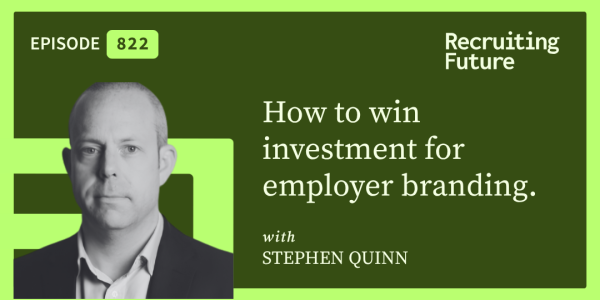
Hi there, welcome to episode 822 of Recruiting Future with me, Matt Alder.
Employer branding teams are still under sustained pressure. Budgets have shrunk and headcount has been reduced across many organizations, even when the hiring the business needs has become more specific and more critical. Despite all of the cuts, some employer brand leaders are still winning investment and influence.
What sets them apart is how closely their work connects to what the business is trying to achieve and how effectively they communicate its impact.
So what does it take to make employer branding matter to the business?
My guest this week is Stephen Quinn, CEO of Atomic, an insight-led agency working with employer brand leaders at some of the world’s largest organizations. In our conversation, Stephen shares what the most effective employer brand leaders do differently, which metrics carry weight with the business, and how to plan employer branding for the long term.
In the interview, we discuss:
- Trends and challenges in Employer Branding
- What separates the most successful employer brand leaders
- Attaching Employer Branding to the critical needs of the employer
- Where should employer branding sit in the organization?
- Building relationships across the business
- Measuring and reporting on impact and ROI via the right metrics
- Long-term strategy thinking rather than short-term campaign thinking
- What does the future of Employer Branding look like
Follow this podcast on Apple Podcasts.
Follow this podcast on Spotify.
Key takeaways
- The most successful employer brand leaders attach their work to the critical needs of the business and report on how their programs help meet those objectives.
- Long-running programs such as campus activation and sponsorship need the same honest ROI scrutiny as new campaigns, even when everyone in the business likes them.
- Long-term employer brand planning starts with an honest baseline of strengths and gaps, followed by a multi-year roadmap and a dashboard senior leaders can understand.
- An unexplained rise in candidate declines is a signal worth investigating, because it can point to problems with hiring managers, the candidate experience, or a competitor targeting the same people.
Transcript
Matt Alder 0:00
It’s been a tough few years for employer branding, with budgets and teams being cut back across many organisations. Some employer brand leaders, though, are still winning investment and influence in these difficult times. So what is it that they’re doing differently? Keep listening to find out.
Advert 0:20
Support for this podcast comes from Juicebox. If you’re a recruiter, sourcing can quickly become your full-time job. You’ve got open recs, you’ve got a deadline, and you’re spending the first two hours of your day trying to find people who might be a fit, scrolling the web, tweaking Boolean strings, sending faulty messages to get three replies. That is what Juicebox was built to fix. Juicebox is an AI recruiting platform that actually understands what you’re looking for. You describe who you’re looking for in plain English, and it surfaces candidates across 800 million profiles from GitHub, Stack Overflow, Google Scholar and more. No Boolean, no manual filtering. And it doesn’t stop at search. Juicebox personalises outreach for each candidate automatically, pulling in from their past experience or even flagging mutual connections at your company. You can send hundreds of personalised outreach messages weekly at scale. Recruiting teams at 5,000 plus companies like Notion, Ramp and Cursor use Juicebox to source faster, reach further and delegate the most manual parts of their sourcing work so they can focus on what makes the recruiting process feel more human. You can try Juicebox free today by going to juicebox.ai and also use the code matalder15, that’s matalder15, to get 15% off your first annual plan.
Matt Alder 2:11
Hi there, welcome to episode 822 of Recruiting Future with me, Matt Alder. Employer branding teams are still under sustained pressure. Budgets have shrunk and headcount has been reduced across many organisations, even when the hiring the business needs has become more specific and more critical. Despite all of the cuts, some employer brand leaders are still winning investment and influence. What sets them apart is how closely their work connects to what the business is trying to achieve and how effectively they communicate its impact. So what does it take to make employer branding really matter to a business? My guest this week is Stephen Quinn, CEO of Atomic. In our conversation, Stephen shares what the most effective employer brand leaders do differently, which metrics carry weight with the business and how to plan employer branding for the long term.
Matt Alder 3:10
Hi Stephen and welcome to the podcast.
Stephen Quinn 3:12
Thanks Matt, great to be here.
Matt Alder 3:14
Well it’s a pleasure to have you on the show. Just to start off with, could you introduce yourself and just tell everyone what you do?
Stephen Quinn 3:21
Yeah, sure, happy to. My name is Stephen Quinn, I’m CEO of Atomic. So we’re an insight-led agency focused on B2B and employer brand. And on the employer brand side then, we work with employer brand leaders in large corporates like Salesforce, Heineken, Microsoft, L’Oréal, Primark, Ericsson, to name a few. And really what we focus on is embedding their employer brand right into the heart of their organisations. So leaders live it, is really important that they are leading from the front. If we have an employer brand or an EVP that feels a little too polished and addy, they’re not going to use it. And then everyone, of course, has an excuse to not do what the boss says. Employees advocate for it. Look, everyone’s got a personal brand so if you’ve got an employer brand that feels not in sync with how people feel about it then they’re not going to go to bat for you. Applicants need to feel it, yeah, and then we need TA and hiring managers to actually use it. They’re busy people, you know, if we’re not giving them the tools they won’t use it.
Matt Alder 4:23
Absolutely, I think they’re really interesting points that you raise there and I’m sure we’ll kind of get into some of them as we sort of go through the conversation. Just to set the tone of things, it’s obviously a very disruptive time for employers at the moment in terms of talent, talent acquisition, internal mobility, you know, everything really. How is that impacting employer branding? You know, what’s going on in employer branding at the moment? What are the trends? What are the biggest challenges?
Stephen Quinn 4:52
Yeah, lots of stuff that I think will resonate with your audience as well. So we’re seeing a lot of the same issues for most of our clients. Reduced budget is the classic one, and reduced headcount in employer brand and talent marketing as well. So maybe there was five, six, seven people in a team, maybe they’re down to two, but the demands have stayed the same if not gone up. So they’re under pressure, there’s no doubt.
Matt Alder 5:18
No, absolutely. And do you think, I think really over the last sort of few years we’ve seen a lot of pressure on employer branding teams in terms of the resources that they have, is that likely to continue or are employers now seeing the value of what employer brand can bring in a different light?
Stephen Quinn 5:35
There’s definitely more sophistication and understanding of employer brand now. I’d say still from a reasonably small base. I think there’s also a mix of excitement and fear around AI for employer brand leaders. You know, they’re trying to sort of think about how they can sort of work within the zeitgeist of reduced headcount but also needing to hire very specific roles, niche roles. So how do you have a message on one side which is maybe more almost, you know, corporate reputation management, and then on the other side have this positive, you know, come join us, we’ve got some really interesting things that we’re trying to do? So kind of hard to have those two ideas in your head at the same time, I think.
Matt Alder 6:17
No, absolutely. And yeah, I think it’s really interesting as well because, you know, I know in lots of cases it’s just producing lots of slop when it comes to marketing, so it’s kind of an opportunity and a threat, isn’t it?
Stephen Quinn 6:27
Yeah, absolutely. Like I think some trends have been around for a long time, you know, this lack of clarity around workforce planning is a classic one we see. So, you know, say if we’re working with a client and they want to do a recruitment marketing campaign, okay, great, but how does this fit into a broader context? Like what’s the business trying to achieve at a more broad level? Then how does workforce planning fit within that? And then there’s a risk of creating some of these campaigns in isolation of the bigger picture.
Matt Alder 6:59
I suppose that kind of really feeds into the stakeholder buy-in and the funding, the resources and all those kinds of things. And I suppose on that note, you’ve worked with a lot of employer brand leaders within some very large, impressive organisations. What separates the really successful ones from those who aren’t? You sort of mentioned in the conversation about getting things implemented and getting people to take things up. What is it that separates the best leaders from the people who can’t quite get it right?
Stephen Quinn 7:28
I don’t think any employer brand leader gets it wrong because all activity is a good idea at a baseline. But I think the ones that really, really knock it out of the park attach themselves to the critical needs of the organisation. I’ve mentioned this already, that they understand what the business is trying to do, and that could be at a macro level, it could be at a regional level, it could be at a role level, you know, we’re setting up a new plant in Germany, or you know, we’re developing a new AI centre of excellence over here. So they need to know what’s going on at a business level in order for them to start designing programmes to help the business achieve those objectives. So I just think if they’re isolated from what the business is doing, then naturally they’re going further and further down the food chain. So they’ve got to really sort of grapple their way right up to get that access as much as possible, and then to make sure that they’re reporting on the impact of the programmes that they’re creating in order for the business to help hit those objectives.
Matt Alder 8:29
And over the years I’ve seen employer branding sitting in all kinds of different places in the organisation — in comms, in recruitment, marketing and acquisition. Where do you think it should sit in the organisation, and also how should it kind of integrate through the organisation?
Stephen Quinn 8:46
Yeah, so two really interesting points there. I think we will come on to the integration one in a minute. Like, for us, I don’t think it matters where it fits, but it is interesting to see, depending on where it fits, what their strengths and relative weaknesses are. So if they’re sitting in TA, not always but can be quite recruitment campaign focused, very metrics driven, but sometimes quite short term. If it’s in HR, maybe it’s more retention, culture, engagement, it’s about the experience of employees. And then if it’s in marketing, it can be quite brand led. So they’re all important, but if you’re sitting in the TA function as an employer brand leader, then you know, it makes sense that you are thinking about culture, you’re thinking about retention, you’re thinking about experience, you’re also thinking about the brand. So I think it’s about not just having the blinkers on depending on where you fit.
Matt Alder 9:40
I mean, do you have any advice to people who, for example, might be sitting in TA doing this, in terms of how they can develop the right relationships and conversations with, you know, the marketing team or the comms team to really make sure that the employer brand is kind of being integrated and talked about properly, rather than just kind of getting a set of rules on what they can and can’t do?
Stephen Quinn 10:01
Yeah, I think that’s absolutely key. And I don’t think it’s just marketing and brand, I think it’s across the business. I think finance, HR obviously, marketing, sales, product, customer experience — like, to actually start having conversations with people in totally different teams gives you that rounder picture. Certainly within marketing is a funny one because employer brand people are brand people, are marketing people generally, yet I think sometimes marketing people and even creative teams, a lot of the times they don’t have the time to actually work on these programmes. But they’re some of the most interesting projects for a creative or a marketer to work on. I see two schools of thought — one, keep marketing away, and the other school of thought is bring marketing in and actually maybe talk to some of the younger creatives or younger marketers, bring them in as part of the project, let them experience what it’s like to actually create campaigns for employees, not for customers, and partner with them a little bit more. I know it’s a cliché, but certainly if you can break down silos as much as possible, you get more permission then when you need to ask a favour or ask to go on a shoot because we want to get the employee side of that particular story. So yeah, lots of conversations and a lot of socialising, I think.
Matt Alder 11:23
I think that’s a really great bit of advice. Let’s talk a little bit about metrics and measurement, because there seems to have been a discussion going on for as long as I’ve worked in this area about how you measure success when it comes to employer branding. What do you see? How should people be measuring the effectiveness of these programmes?
Stephen Quinn 11:44
Yeah, well, maybe I’ll focus first on a personal bugbear of mine, which is the raw metrics. So I think there’s a lot of focus on views, likes, engagement, shares of content. And I think that’s fine to a degree. But certainly, if you go to the CFO and say, hey, look, my LinkedIn campaign or my YouTube campaign delivered X thousand likes and 4,000 views until, you know, completion, they will just look at you with a glazed look. So, and they are the people who are wondering, what is this money for? How is this going to impact what we’re trying to do as a business? Back to this point about syncing with the critical business needs. So in Atomic we have what we call the Atomic Diagnostic, and it’s a way to actually really set some benchmarks but also focus on metrics that matter and maybe downplay some of the metrics that don’t matter. So look, every customer is different, but there are definitely some commonalities that we see again and again. So cost per qualified lead will be a classic one. Okay, so we’re paying X amount of money for a LinkedIn campaign, what did it cost us, did we get — or why? Time to hire is fairly standard, I think. Some interesting ones are things like reduction in declines. So, and this is where, you know, syncing in with TA and sourcers are really important. So okay, so we have good people in the pipe and now they suddenly dropped out and they didn’t tell us why. Okay, so why is that? Is there something to the hiring manager and how they’re showing up? Is there something wrong with the experience? Is somebody aggressively targeting the same people we are? So like, that’s a cost, and painful as well if you feel good people are dropping out. Referral rates, really important. Like, most companies have a referral programme. I would probably say most of them are quite underpowered. So, you know, are we getting more people through referrals rather than having to use recruitment agencies or paid campaigns? Or ROI of programme investments, I think that’s a big one. You know, so we’re investing in, I don’t know, a campus activation or sponsorship every year, okay, great, we’ve been doing it for 15 years, everybody loves it — do the metrics actually stack up and do we need to have a tough conversation?
Matt Alder 13:57
Yeah, and again I think they all make a lot of sense. And I suppose linked to this, because as you sort of hinted at earlier, there is a lot of short-term thinking around employer brands, you know, real campaign thinking as opposed to programme thinking or strategy thinking. How should employers be planning employer branding programmes for the long term? I mean, you know, what are people getting wrong? What’s your advice to the employer brand people listening?
Stephen Quinn 14:29
I think it starts with setting a baseline. It’s the one thing we see again and again, that there isn’t that sense of what are we doing right, what are we doing wrong, where are we showing up really badly? So like, yeah, we might have a great group marketing campaign, but our Glassdoor scores are rubbish, or the recruiters aren’t showing up in the right way. Onboarding is wrong, or we’re not leveraging the amazing programmes that we run around CSR, or DE&I, or L&D even. So I think what we have as part of our diagnostic is 32 measures that we can score against, and some of it is self-scoring from our clients plus also external analysis. So I would always start there. And then I think that gives you permission to create a roadmap to say, okay, look, we’ve got gaps here and here and here, we’re doing fine on these, we can let them sit for a little while, and then other areas we’re scoring well, and create that two or three year, quarter by quarter roadmap, or however the business manages their timescales. Create a dashboard showing the impact and showing the baseline and showing the difference between where we started and where we are now. And then definitely make sure it’s socialised to senior people in the business in a format that they can understand. So classic one I hear all the time is HR thinks in PowerPoints and finance thinks in spreadsheets. So if you’re going to the finance people and you’re looking for money, make sure you don’t give them a PowerPoint if they use spreadsheets. Give them a nice boring Excel with all the numbers in it and the ROI, if that’s the way that they measure value. So that’s where I’d start.
Matt Alder 16:13
And as a final question for you, what do you think the future looks like? You know, we talked about AI a little bit. You know, what impact is it gonna have? How is employer branding going to evolve over the next few years?
Stephen Quinn 16:24
Yeah, well, I think it’s evolving an awful lot even in the last while. Hard to know, are we at the top of a hype cycle when it comes to AI, or are we somewhere in the middle or beginning? There’s no doubt there’s been massive highs and massive lows. I think as an efficiency amplifier, it’s absolutely amazing. But I think a lot of EB people are thinking, okay, well, my job is potentially at risk. So I think there’s a lot of messaging about how this is going to radically change the experience for employees. I still think you’ve got to have a human talking to a human as part of the process, and we need to think about, you know, why would somebody consider joining this organisation and how do we give them a great experience? There’s one thing that is no doubt though, that as companies have done headcount reductions because of AI, some of them are going to hire those same people back, no doubt. Others that don’t, I think it’s going to create this new wave of entrepreneurs and innovators. And I think possibly where the next wave of really interesting stuff when it comes to HR or TA or employer brand is potentially going to come from.
Matt Alder 17:35
Yeah, I think that’s really interesting. I mean, the human-to-human stuff is kind of vital in this, and yeah, the kind of the makeup of the workforce is certainly going to be changing. Yeah, Stephen, thank you very much for talking to me.
Stephen Quinn 17:48
Pleasure, thanks for having me, Matt.
Matt Alder 17:50
My thanks to Stephen. You can follow this podcast on Apple Podcasts, on Spotify, or wherever you listen to your podcasts. You can search all the past episodes at recruitingfuture.com. On that site, you can also subscribe to our weekly newsletter, Recruiting Future Feast, and get the inside track on everything that’s coming up on the show. Thanks very much for listening. I’ll be back next time, and I hope you’ll join me.