
Redundancies have become a constant feature of the talent market. AI is taking a lot of the blame, but the drivers behind this are much broader. Jobs and skills are changing faster than most organizations can keep track of and the conventional response is to restructure the workforce and then hire in the new skills that are needed. That approach relies on a ready supply of perfectly qualified candidates, and in a fast-moving skills market those candidates are increasingly hard to find. It also assumes that employers already have a clear view of the skills and potential within their existing workforce, which is rarely the case.
So what does a smarter approach to restructuring look like?
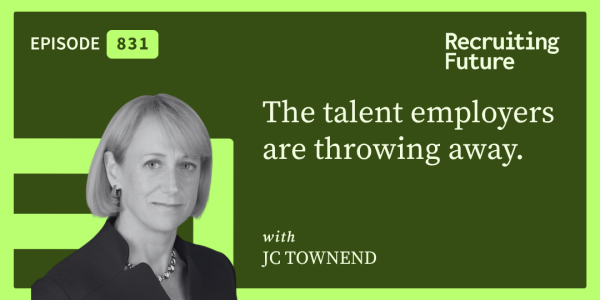
My guest this week is JC Townend, President of The Adecco Group for the UK and Ireland and CEO of LHH, the Adecco Group business that supports individuals through redundancy. In the UK alone, LHH works with more than 20,000 people a year who have been made redundant, which gives JC a rare view of both the decisions employers are making and where the people affected end up next. In our conversation, she explains what is really driving the current wave of restructuring, why the financial case for replacing people rather than redeploying them has changed, and how the best employers are rethinking workforce planning.
In the interview, we discuss:
- How the pattern of restructuring has changed over the last eight years
- What is really driving the current wave of redundancies
- AI, automation and the skills mismatch that goes well beyond them
- Why companies understand skills within teams but not across them
- The employers letting people go and then rehiring for similar skills
- Why the perfectly qualified external candidate is getting harder to find
- Changing how internal moves are perceived and helping people sell their transferable skills
- Agile workforce planning and a matrix of opportunities rather than a single career ladder
- Five careers in a lifetime, all at the same company, and what the future looks like
Connect with JC on LinkedIn:
https://www.linkedin.com/in/jeannetownend/
Read the 2026 LHH Career Redeployment and Outplacement Trends Report:
https://www.lhh.com/en-gb/insights/the-mobility-breakdown
Follow this podcast on Apple Podcasts.
Follow this podcast on Spotify.
Key takeaways
- Restructuring that once happened every few years has become an annual event at many organizations, carried out in smaller rounds.
- AI is only one of the reasons employers give for redundancies; a wider mismatch between the skills people have and the skills roles now require is at least as significant.
- Employers tend to understand the skills within individual teams well but have very little visibility of which skills transfer between departments.
- The traditional calculation behind letting people go and hiring in exact skills is breaking down because perfectly qualified candidates are harder to find in a fast-changing skills market.
- Leading employers are replacing annual restructuring exercises with continuous workforce planning that looks three to five years ahead and prepares existing employees for the roles that are coming.
- Redeploying people internally requires the same rigor as external hiring, including managers who are incentivized to grow talent that may move to other parts of the business.
Transcript
Matt Alder 0:00
Redundancies are dominating the headlines at the moment, and AI is the most common reason being given for them. The reality, though, is much more complicated. Employers are letting people go and then hiring for very similar skills just a few months later. So how well do companies really understand their own people? Keep listening to find out.
Advert 0:23
Support for this podcast comes from VONQ. VONQ’s talent attraction platform is now unified as Echo. One platform, six connected stages, a shortlist that you can explain. Instead of disconnected hiring tools, Echo brings together job content creation, distribution, attraction, screening, interviewing and scoring in one continuous agentic workflow. Delivering up to 70% faster time to hire and 75% fewer candidate drop-offs. Trusted by over 350 enterprise organisations, including Adecco, Danone, DHL, SoftwareOne and Randstad, and a five-time strategic leader in the Fosway 9 grid, Echo runs as a standalone platform or natively embedded into over 85 ATS and HCM platforms through VONQ’s hiring API. Stop managing hiring tools, start running one workflow. You can learn more by going to vonq.com. And VONQ is spelt V-O-N-Q. That’s vonq.com.
Matt Alder 1:54
Hi there, welcome to Recruiting Future with me, Matt Alder. Redundancies have become a constant feature in the talent market. AI is taking a lot of the blame, but the drivers behind this are much broader. Jobs and skills are changing faster than most organisations can keep track of, and the conventional response is to restructure the workforce and then hire in the new skills that are needed. That approach relies on a ready supply of perfectly qualified candidates, and in the fast-moving skills market, those candidates are increasingly hard to find. It also assumes that employers already have a clear view of the skills and potential within their existing workforce, and this is rarely the case.
So what does a smarter approach to restructuring look like? My guest this week is JC Townend, President of the Adecco Group for the UK and Ireland and CEO of LHH, the Adecco Group business that supports individuals through redundancy. In the UK alone, LHH works with more than 20,000 people a year who’ve been made redundant, which gives JC a rare view of both the decisions employers are making and where the people who are affected by them end up next. In our conversation, she explains what is really driving the current wave of restructuring, why the financial case for replacing people rather than redeploying them has changed, and how the best employers are rethinking workforce planning.
Hi, JC, and welcome to the podcast.
JC Townend 3:29
Hi, Matt. It’s great to be here.
Matt Alder 3:30
A pleasure to have you on the show. Please, could you just introduce yourself and tell everyone what you do?
JC Townend 3:36
I’m President of the Adecco Group for the UK and Ireland. Adecco Group is one of the largest staffing and professional recruiting and end-to-end talent solutions companies in the UK. I’m also CEO of LHH, which is a subsidiary of the Adecco Group. And what we focus on is supporting individuals through redundancy.
Matt Alder 3:59
Redundancies just seem to be everywhere in the news at the moment. Lots of talk about them, LinkedIn full of people looking for work. What’s actually going on in the market? And how does the wave of restructuring that’s happening at the moment compare to what you’ve seen in the past? Because you’ve been watching this for quite some time.
JC Townend 4:19
Yes, I’ve been the CEO for the last eight years. And I do see a very big change in the markets in that time. So if I think back to eight years ago when I first started working with companies through redundancy, you’d see a lot of major restructuring. So companies doing, you know, 500 or 1,000 people redundancies all at once. And that tended to happen only every maybe five years for a company. Or we had lots of companies who hadn’t done a redundancy in 20 years.
Now, however, we’re finding a large number of companies doing redundancies and doing them every single year in smaller bite-sized pieces. So we recently did a survey and we found that 87% of the companies in the UK and Ireland are intending to do a redundancy this year and or have already completed it in 2026.
Matt Alder 5:17
That’s a big number. And what’s driving it? Because all the headlines are about AI and AI displacing jobs, those kind of things. Is that actually happening? Or is that just a convenient explanation for decisions that companies were going to make anyway and something else is sitting behind all of this?
JC Townend 5:37
It’s a little bit of both. It’s a little bit of mix. So if I think back three or four years ago, the surveys that we were doing then of clients found that redundancies tended to happen for three core reasons. So 40% said they were actually making redundancies because they had overhired during boom times. Another 40% found that they were making redundancies due to some kind of restructuring or M&A or something like that was happening.
Nowadays, we’re finding 20% report that they’re doing redundancies because of AI or some kind of digital or automation improvement. But 20% said they’re really seeing a skills mismatch. And that goes well beyond AI, where we’re finding that jobs and skills are evolving so rapidly that companies are finding the people that they have in roles are no longer fit for purpose for the roles that they need today.
Matt Alder 6:46
I think that’s really interesting because, as you say, things are evolving very, very quickly and it’s a much more nuanced picture than just AI is taking away jobs. In terms of how companies understand their own organisations, do you think they actually understand how the work gets done? Because with so much restructuring going on, can that be effective without actually understanding how the individual roles and tasks and everything fit together and how the company actually operates in practice?
JC Townend 7:18
I think where companies are missing the boat is the understanding of the transferable skills from one department to another. So, for example, within teams and departments, we find that there’s a very strong understanding of the skills they have and the talent they have. However, between different departments, we see almost no understanding of what skills are transferable to another area of the business. So in the past, companies wouldn’t think about, for example, someone in finance being able to move to a position in marketing, right? Those just seem completely different.
But what we’re finding is in the UK and Ireland, we work with more than 20,000 individuals a year being made redundant. And we’re finding 60% of those after they’re made redundant are moving into an entirely new career. Very different from the role they had been in. Partly because of their interests and partly because their skills and roles are no longer relevant. So if they’re doing that once they’ve left a company, we’re trying to spread the message that they can actually be doing that within a company very successfully.
Matt Alder 8:29
Absolutely. I think that’s really interesting. And it’s a different way for companies to think. And I suppose we’ll dive into that in a bit more detail in a second. But before we do, just to talk to something else that seems to be happening quite a lot, which is obviously related to this, is that companies are making people redundant because of the whole skills issue. But then they’re rehiring for very similar skills further down the line. Why is that happening? And what is it that employers are getting wrong? What should they be doing differently?
JC Townend 9:00
You know, what came to mind is, I think six years ago, I spoke with a CHRO of a financial services company in London. And at the time, the sense was, he said, actually, he was very happy to let people go and then hire skilled, trained people precisely fitting the role that they wanted in the new role. Right. So there was a sense that your existing employees could not precisely match the new role that you’re trying to fill. And so there’s a sense of being willing to accept that huge cost, the redundancy and severance cost, and then the hiring and upskilling costs of the new employee for the benefit of getting this very perfectly trained person in the market.
What’s changed is those perfectly trained people in the market don’t exist anymore because every, you know, because the roles are changing so quickly, somebody has to train those skills. And so you’re getting people who are maybe 70% qualified or 80% qualified for those new roles. Because of that, that changes the financial calculation of the benefit of transitioning someone within the company compared to the kind of more typical old style fire and rehire methodology.
Matt Alder 10:34
That’s really interesting because it’s always something that has really bugged me about the world of work really right from the start of my career is, you know, companies really not appreciating or not having the mechanisms to really see the full potential of people, the other skills that they might have that aren’t relevant to their job or the potential they’ve got to develop. It seems to be a problem forever. Are companies getting better at it? Is it changing? Obviously, there is considerable pressure to do so now because of the skills issues that you’re highlighting. But are companies starting to think differently about this?
JC Townend 11:06
They are and they should. I think we did this to ourselves, right? So in the early days, a lot of our central departments would create requirements that people couldn’t be made redundant if 60% of their skills matched into another department. Those rules actually became a negative impact on the perceptions of people moving within companies where hiring managers felt disappointed that they had to accept someone who wasn’t necessarily a perfect fit.
The problem is, nowadays, I think people are being much more understanding about how a really quality person in one unit can move to another unit. And what we are doing is teaching individuals how to interview for those jobs with just as much rigour if they were interviewing externally. And learning to sell themselves, how to identify their transferable skills so that the new department and the new manager is actually excited to have this really outstanding employee who is very loyal to the company, who understands the culture, who has very little kind of start-up time because they already know the company. And having those new managers and new departments actually being excited about bringing this really high quality person into the group.
Matt Alder 12:42
Do you think that there is an onus on the employers here to kind of really rethink the processes they go through for internal hiring in order to sort of facilitate that? Because external hiring and internal hiring are treated very, very differently, aren’t they? Should they just be seen the same way? What would your recommendation to employers be around this?
JC Townend 13:02
Yeah, so we’ve just written a report on this specifically, which is freely available in the market. But what used to be like restructuring used to be kind of an annual planning process, and it used to be like massive kind of cost control or done at a single point during the year.
Now we’re finding what the best companies are doing are adopting a more agile workforce planning process. So this is a continual process of thinking about what skills they’re going to be needing, not just in the coming year, but three years out and five years out, and deliberately giving their employees some of that upskilling for the future and the understanding of the ability to be mobile within the company, not just in the old traditional form of moving up a ladder in a single career path. But actually moving out into a matrix of opportunities and other departments and other similarly qualified roles. Especially as you get into the managerial levels, those kind of really outstanding managers can transition to departments that are leading people that aren’t necessarily what they did when they were a junior person.
Matt Alder 14:27
And as a final question for you, because this is obviously a kind of a highly significant time in terms of the change that’s happening and the disruption. What do you think the future looks like? How might employers be thinking about all these things in two or three years’ time? What do you think might happen?
JC Townend 14:47
We used to say that, you know, 20 years ago, people would have kind of a career for life. We’re now saying that new graduates starting now might have five very different careers in their lifetime.
A thing that’s different is we’re finding that people can actually have those careers at the same company. And having companies kind of embrace that understanding and give employees the tools for them to develop their careers in really creative ways within the company, they then get all those benefits of not transitioning staff out and transitioning staff in while allowing the individual to advance in their career in lots of different ways. And filling those skills gaps that the companies are going to have.
But that requires an investment, a change in the culture to this concept of lifetime learning, giving individuals direct opportunities to upskill, teaching them about how to think about expanding their role in the company without feeling like they’re being disloyal to their current team. And bringing managers into the process as well and incentivising them for growing talent in ways where talent might move off of their team into other really valuable parts of the company.
Matt Alder 16:12
JC, thank you very much for talking to me.
JC Townend 16:14
Thank you very much, Matt.
Matt Alder 16:16
My thanks to JC. And I’ve put a link in the show notes to the report that she was referring to, the Mobility Breakdown, which is LHH’s Redeployment and Outplacement Trends Report. You can follow this podcast on Apple Podcasts and on Spotify, or wherever you listen to your podcasts. You can search all the past episodes at RecruitingFuture.com. On that site, you can also subscribe to our weekly newsletter, Recruiting Future Feast, and get the inside track on everything that’s coming up on the show. Thanks very much for listening. I’ll be back next time, and I hope you’ll join me.