
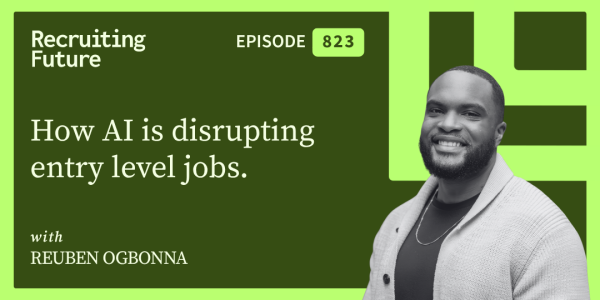
In software development, AI tools now write much of the code, and at a growing number of organizations junior developers are no longer doing that work themselves. Tech is where the impact on a first job is clearest, and likely a preview of what other industries will see next. When the tools handle the technical work, what is left requires judgment, collaboration and communication, capabilities that take much longer to develop. That changes how people are prepared for work and what employers should be hiring for. What should the pathway into a tech career look like now? My guest this week is Reuben Ogbonna, Co-Founder and Executive Director of The Marcy Lab School, a one-year alternative to college in Brooklyn that prepares young adults for careers in tech. In our conversation, he explains why the traditional college model is falling behind, what people are still needed for when AI writes the code, and how employers should rethink entry-level hiring.
In the interview, we discuss:
- The impact AI is having on first jobs
- The rising bar of expectations for early careers
- What skills should students now be learning
- Why developing judgment matters and why it is difficult to teach
- The difference between tasks and jobs
- How do educators keep up with changing needs?
- Learning that has to mimic the real workplace
- How should employers redesign entry-level hiring?
- What does the future look like, and how might AI drive job creation?
Follow this podcast on Apple Podcasts.
Follow this podcast on Spotify.
Key takeaways
- Entry-level work is not disappearing, but the bar for what someone in a first job is expected to accomplish is rising sharply.
- The core skill at the entry level is shifting from carrying out tasks to managing AI to do them and judging whether the output meets the business need.
- Writing code is the task and producing software is the job, which still needs people who understand the problem well enough to guide the tools.
- Taste, judgment, collaboration and communication take much longer to develop than technical skills and can only be built through practice, which the lecture-and-exam model of college cannot deliver.
- Employers should give candidates open-ended, real-world problems in the interview, let them use AI, and use the results to understand how they think.
- The current focus on AI as a cost-cutting tool is a product of economic conditions rather than the technology, which in the longer term will create demand for software, productivity and roles that do not yet exist.
Transcript
Matt Alder 0:00
AI is disrupting entry-level jobs, and in tech, the change is already well-advanced. Junior developers used to learn the job by writing the routine code that AI tools now write for them. If that traditional first step on the career ladder is gone, where does a career actually begin? Keep listening to find out.
Advert 0:21
Support for this podcast is provided by Proof, the identity platform built for hiring. You’ve probably heard that by 2028, one in four job applicants is predicted to be fake. In fact, you’ve probably already seen that in your recruiting pipeline. Today, scammers are sending one person to get the offer and a totally different person to start the job. But most identity tools either only screen an application or verify a candidate’s ID. Proof does both, integrated directly with applicant tracking systems like Lever from the first interview through to onboarding. So you have proof that the person you interview is the same real person you hire. You can learn more by going to proof.com. That’s P-R-O-O-F dot com.
Matt Alder 1:30
Hi there! Welcome to episode 823 of Recruiting Future with me, Matt Alder. In software development, AI tools are now writing much of the code, and at a growing number of organisations, junior developers are no longer doing that work themselves. Tech is where AI’s impact on first jobs is clearest, and a likely preview of what other industries will see next. When the tools handle the technical work, what’s left requires judgment, collaboration, and communication. Capabilities that take much longer to develop than tech skills. That changes how people are prepared for work and what employers should be hiring for. So, what should the pathway into a tech career now look like? My guest this week is Reuben Ogbonna, co-founder and executive director of the Marcy Lab School, a one-year alternative to college in Brooklyn that prepares young adults for careers in tech. In our conversation, he explains why the traditional college model is falling behind, what people are still needed for when AI is writing the code, and how employers should be rethinking entry-level hiring.
Matt Alder 2:42
Hi, Reuben, and welcome to the podcast.
Reuben Ogbonna 2:44
Matt, it’s a pleasure to meet you. Thank you for having me.
Matt Alder 2:46
An absolute pleasure to have you on the show. Please, could you introduce yourself and tell us what you do?
Reuben Ogbonna 2:51
My name is Reuben Ogbonna. I’m the co-founder and executive director of the Marcy Lab School, based here in Brooklyn, New York. The Marcy Lab School is a financially accessible alternative to college for students who are looking for a post-secondary education and a fast track to a role in the tech sector. We serve students primarily ages 18 to 24 and are looking to make an impact into what feel like societal challenges. One, the fast-raising price of college and how therefore inaccessible it is to young adults. And then two, just the fast-changing nature of not just the tech ecosystem and knowledge work in general and the need for post-secondary learning to be more adaptive and more innovative to meet the needs of the economy today. So our students have gone off from the Marcy Lab School, our full-time one-year fellowship, to engineering and analyst roles at companies like Google and Apple and JP Morgan and the New York Times, Spotify, Pinterest, and the list goes on. So we’re proud to be building a program that we think is the future of higher education.
Matt Alder 3:56
It’s such a disruptive area at the moment, isn’t it, in terms of sort of early careers? There’s a lot of anxiety around about AI taking away entry-level work. I mean, what are you seeing happening to first jobs and the people trying to get them? What’s going on in the landscape at the moment?
Reuben Ogbonna 4:12
Yeah, well, you know, let’s just zoom out for a moment and think about what an entry-level job means just a year ago before, you know, AI had completely changed the narrative about what entry-level work could be in the future. I say that because if we look at this moment in context, we can see that we are already in a trajectory of what has been defined as entry-level roles, being kind of an increasing bar for rigour and complexity. Think about an entry-level role, I don’t know, 40 years ago. You might be in the mailroom. You might be transcribing things on a typewriter. You might be fetching coffee. You think about an entry-level, like the most junior person on the marketing team. They’re putting together complex decks. They’re building content. They’re using Microsoft Excel to do complex data analysis. They’re reaching thousands or tens of thousands of potential customers. And so in many ways, this AI evolution is just a continuation of that. The entry-level job is not going away, but the bar for what entry-level employees expect to accomplish is significantly rising.
Matt Alder 5:14
How is that evolving? What are the expectations around someone who is now taking their first role? Because, as you say, things have moved on dramatically.
Reuben Ogbonna 5:23
This is definitely a step function change. This is a significant deviation from what the expectations of an entry-level role have been with the advent of the kind of rapid advancement of AI. When you think about the traditional entry-level role pre-AI, it is the person who is implementing a function or implementing a task. If you are a software developer, if you are implementing some relatively low-level or entry-level operation, whether that be writing tests to ensure that software is working or building more simple components on the visual front end of a web application, the drop-down bar, the menu. If you were a, again, if you were a marketing intern and you have a marketing person, you might be putting together a pitch presentation decks or you might be drafting copy for advertisements that may be going out. And what seems like the trend that is emerging is entry-level folks are now expected to leapfrog that really essential point in someone’s career to be able to manage an AI to do those tasks. And so essentially young people are now being asked as an entry-level employee to essentially be what was previously a mid-level manager. The skill is no longer building the PowerPoint deck or writing the test, but it’s managing an AI to do those things and using your own judgment and discernment to ensure that those things are being done in a way that meets the business need.
Matt Alder 6:51
As an educator and building curriculums and things like that, with things moving so fast, it must be really challenging to keep your curriculum current. I mean, how do you do that? How do you keep up with the way that things are moving at the moment and those expectations changing for those entry-level jobs?
Reuben Ogbonna 7:10
It is a challenge, and I think it’s a challenge that is incumbent upon every single education institution, not just higher ed, to be able to contend with in this moment. I think there is a natural pressure or hesitancy for particularly higher education institutions to adapt and evolve. A typical response is to say, well, you know, we’re college. We teach the foundational skills of learning how to learn, and we teach the foundations of these disciplines that will last you as the industry changes. So we’re not going to adapt, but we’re going to trust that if we continue to teach what we always have, you will be able to adapt once you get out into the field. And that feels a bit negligent for today’s world. We have to be in conversation with employers. We have to be in conversation with graduates of our institutions to get a sense for how they’re faring as they transition into the working world and as they navigate upward. And especially at a time like this, every year, every six months, we need to be looking at curricula and determining how we can iteratively change to keep pace with this moment. You mentioned me being an educator myself and my co-founder, Maya Bhattacharjee, and we founded the Marcy Lab School in 2019, both of us previously having backgrounds in education and school leadership. One of the first things you learn as a first-year teacher is this beautiful framework called Bloom’s Taxonomy. It’s almost like the food pyramid of teaching. And the idea is that it kind of lays out a series of kind of like educational attainments with the bottom being essentially just like recall with the top of that pyramid being creation and evaluation. And the idea is that teachers are charged with like moving students further and further up that taxonomy as a way to reflect a deeper mastery and understanding of the content that you’re teaching. And so it used to be the case that those top-level tiers of creation and evaluation, those were the nice to haves. It was the holy grail for teachers to be able to say that, you know, we’ve moved our classroom to the place we’re doing that. Now it’s a non-negotiable. When I think about the work that we’re doing, data analytics and computer science and software development, you know, the lower rungs of that taxonomy are essentially asking, can a student replicate a process? Can they build a thing? And in this world where Claude Code and Cursor and all the AI tools are going to be making it so that the implementation is no longer a student’s concern, they have to be able to look at multiple implementations of the same thing, identify trade-offs, and determine which of the two things, neither of which are wrong, by the way, are going to best meet a business need and which risks each of them will pose in the long run. That’s a hard job as a teacher, but it’s a challenge that we have to rise to.
Matt Alder 10:00
I think that’s really interesting. And following on from that, we sort of always talk about technical ability and skills, but you’re kind of highlighting there the broader skills that are kind of now needed because work is changing so much. What else is it that students need and why are these things so important?
Reuben Ogbonna 10:17
It used to be the case that the critics or the bear’s case against AI was that the tools just weren’t that good or that they would hallucinate often or that you needed to frequently check over their work. And yes, that is still the case. But I think as we have seen over the past, not even just a year, but the past six months, the tools are getting better and better at a rapid rate. And what that means is that it’s not just about being an error catcher. It is more and more akin to managing a really high-functioning junior or mid-level person to do a task. And therefore, these non-technical skills like taste and judgment, management and supervision, collaboration and communication, those are very much human skills. And unfortunately, those human skills take a lot longer to develop and they take a lot more intentionality than some of the kind of more binary, observable, technical skills. And they’re also messier. Like you can only develop them in practice. It means the traditional college model of the majority of your learning being in lecture halls and the majority of your assessment being in problem sets and exams. That just won’t work anymore. And we have to be mimicking real-world experiences if we want our students to be able to develop these competencies.
Matt Alder 11:40
Just to dive a little bit back towards the technical side of things, and you were saying there about things like Claude Code getting better and better and better. Is there an assumption that people are now using AI to write this code? So, I mean, is there a difference between someone who can produce output with these tools and someone who knows whether the output is good? Where do the coding skills sit in this new world?
Reuben Ogbonna 12:04
We’ve been tracking this for some time. And again, because we view it as our responsibility to be in frequent communication and collaboration with our employer partners to inform our curriculum. You know, we’ve had a number of conversations over the past couple of years, and there are a couple of questions that I ask each time to see the trends. One of them is what percentage of your code that’s being committed to your code bases have been written by individuals versus their AI agents? And it’s so interesting to see how that number has changed. Of course, in the early days, our startup partners were moving really fast with these tools, but our enterprise clients had to exercise a lot more kind of restraint. And then over time, whether they be like, you know, some of the country’s largest banks or insurance companies to, you know, public sector government agencies, I’m just hearing more and more that the default is trending towards people aren’t writing the code anymore. They’re prompting agents to do that. And so then the question becomes, OK, well, if people were previously writing the code and now agents are doing that, does that job go away? And one of the things that I think a lot about and reading a lot about is the difference between a task and a job. And I think we often kind of equate the two where they’re different. That the task is writing code, but really the job is producing software. And so the idea is, if you are no longer writing code and an agent is doing that for you, what is now the role of the person who is overseeing the job of writing software? Well, the analogy that I always use is, you know, we all have like peers, friends, collaborators at work. Most of us are using, you know, Claude or ChatGPT to write emails and to write presentations and to write memos. And most of us have had the experience of working with a colleague or getting something from a friend where you can just tell that this is AI. And the issue isn’t that you can tell that it’s AI and using AI is inherently bad. The issue is that you can tell that it’s AI because it’s missing something. It’s not quite connecting with you in the way that you would expect if someone wrote that themselves. And, you know, software is very analogous to English. And in the same way that, like, there are certain signals, you know, developers use the word smell, like there’s like a smell to it, you know. And again, it’s not about kind of deceiving an end user just for the sake of it being human, but that smell is indicating that there’s something about the way this code is written that might not fully meet the problem at hand, or that might pose some risk, or that might kind of have some kind of hidden landmines in there. Or that simply isn’t, you know, designed to meet the need of the end user. And so, you know, it becomes incumbent upon people who are training folks to enter into the tech sector, not just about writing code, but building products and building presentation design. Yes, you may not have your hands on the files in the way that you once were, but having an understanding of what problems you’re trying to solve in different implementations so that you can guide that agent to meet the need is still a very tall task. Therefore, we’re still going to need a ton of talented technologists to deploy these tools.
Matt Alder 15:28
There are lots of people listening who are doing entry-level hiring or designing programs around entry-level hiring. What advice would you give to employers right now in terms of that and what they should be doing differently?
Reuben Ogbonna 15:43
The first is embracing it. We’re often in spaces with our partners who are in talent and HR. And, you know, I have a ton of empathy for, you know, you all who are in the midst of an organisational transition and, you know, have to be the people on the front lines determining what to do with all of this. I think the reality is, you know, for most institutions, most organisations, it will be the expectation that you’re leveraging AI in your job. And so to the extent that it’s possible, how do you pose open-ended questions and tasks in the interview process that allow people, that allow candidates to demonstrate fluency with these tools? The thing about AI is like, it’s like a… You know, it’s like imagine having an intern who was infinitely smart but had zero restraint. You can imagine having that infinitely smart, productive intern and still not being able to kind of meet the goals of the KPIs of your department. And in fact, you can imagine yourself going off on a bunch of tangents and side quests. And so, you know, the question is, like, how do we go towards an interview process or a selection process that poses more open-ended, real-world grounded problems to candidates, allowing them, ideally creating the container for them to leverage AI to pose solutions. And then using that as a way to get underneath their thinking process, and let that guide the interview as opposed to the traditional channels of, you know, just falling back on merit and elite degrees and GPAs and all those things certainly matter but are clearly on their own not reflective of what the working world looks like today.
Matt Alder 17:38
And there’s a final question for you. Where is this all going if we sort of look out two or three years ahead? How is that path into a career going to change? And what does it mean for how we’re going to bring people into the workforce?
Reuben Ogbonna 17:51
It’s an uncertain and unstable and therefore a bit of a scary time right now. And there are a number of reasons for that. But one of the things I think about is it’s a bit of a shame that this particular inflection point in AI happens to coincide with this particular moment in the economy and in the world. Because of that, because there is so much like kind of fundamental instability in the economy, the narrative around AI has been one of job disruption. How do we use AI to cut costs? But every other technological revolution that looks like this, and of course, this is a beast of its own, but every other technological revolution that we’ve had, it’s been viewed through the lens of like, how do we then enhance productivity? And so I say that because for the near term, the conversation will be about job displacement and cutting costs because that’s the mandate of companies right now because free cash flow’s crunched, interest rates are bad, and there’s a war going on and all the reasons why a company would need to hunker down. But the reality is, this is going to drive demand for software in a way that we’ve never seen before. It’s going to drive demand for productivity in a way that we have never seen before. This is going to drive demand for design, accounting, in ways that we can’t fathom. And I think about what it looks like to prepare and create pathways for entry-level talent, for early career talent to come into organisations, both small and large, and transform operating systems. I think about how much more productive individuals will be able to be to an organisation. The example that I always use is the Marcy Lab School is a relatively small team. We’re a 30-person team. We’re six years old in terms of operating budget. We operate on a $7 million budget a year. Under no circumstances pre-2024 would it ever make sense for a nonprofit organisation of our size to think about building out a tech or IT department. Because you need a certain amount of headcount and a certain level of seniority to be able to produce at the right level. In 2026, it would be incredibly advantageous for an organisation like the Marcy Lab School to hire one or two technologists and the amount of software and tooling and solutions they will be able to provide for the organisation would be transformative. And the only reason why we’re not talking about Marcy adding jobs for this moment for people who can leverage AI to solve problems is because we’re in a tougher fundraising environment than we were three years ago because of the economy. But that time will come. And so I think organisations and companies need to be thinking right now about new roles and new job descriptions that don’t currently exist for people who can come in and leverage AI to solve really big problems.
Matt Alder 20:55
Reuben, thank you very much for talking to me.
Reuben Ogbonna 20:57
Matt, I really appreciate it. Thank you.
Matt Alder 21:00
My thanks to Reuben. You can follow this podcast on Apple Podcasts, on Spotify, or wherever you listen to your podcasts. You can search all the past episodes at recruitingfuture.com. On that site, you can also subscribe to our weekly newsletter, Recruiting Future Feast, and get the inside track on everything that’s coming up on the show. Thanks very much for listening. I’ll be back next time, and I hope you’ll join me.