
Skills have been on the HR agenda for decades, but they rarely became the basis for real decisions; frameworks took so long to build that the business had moved on before they were finished. What’s different now is that AI agents are starting to handle work that used to require a person, and that changes the question employers need to ask. It’s no longer just about who to hire; it’s about whether the work needs a human at all. When you can map work to the skills it requires, you have a basis for deciding what stays with people and what moves to an agent. Making that shift isn’t straightforward, though; it raises questions about what HR itself needs to look like and what capabilities the function needs to develop. So what does it take to make skills the basis for deciding how work gets done?
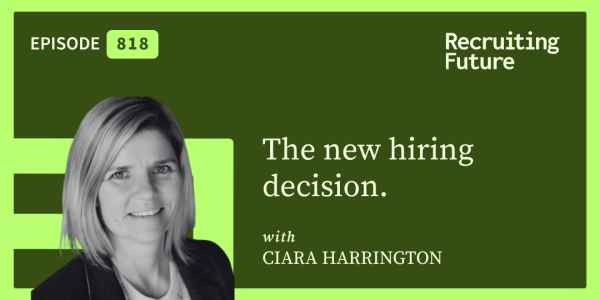
My guest this week is Ciara Harrington, Chief People Officer at Skillsoft. In our conversation, Ciara shares how Skillsoft is rethinking which work needs a person, why HR has to become more technical to lead that conversation, and what happens when you add “bot” to your talent strategy.
In the interview, we discuss:
- How is AI changing the way we think about skills?
- Build, buy, borrow, bot
- Helping leaders understand what work could be done differently
- Tasks, skills, jobs, and units of work
- How understanding skills underpins this transformation
- AI can be more expensive than humans
- Building an effective governance model
- Hiring technical skills into HR and connecting the data
- Critical human skills and why they need to be developed faster
- What does the future look like?
Follow this podcast on Apple Podcasts.
Follow this podcast on Spotify.
Key takeaways
- Skills frameworks historically failed because they took so long to build that business needs moved on; AI may have removed that constraint by making skills data analyzable at scale.
- A build, buy, borrow, or bot framework treats every hiring request as a broader decision about whether the work needs a person, an AI agent, or both.
- HR functions need more people with technical skills, because advising on human-or-agent decisions demands analytical and workflow expertise the function has rarely hired for.
- AI adoption increases rather than reduces the need for human skills; with career timelines compressing, organizations can no longer wait for judgment, critical thinking, and leadership to develop through years of experience and need to find ways to build them faster.
- The role most organizations are missing is the translator who understands both business requirements and AI capability; these people cannot be hired ready-made, so the practical route is upskilling people already in functions like HR, finance, and legal.
Transcript
Matt Alder 0:00
Whether it’s a new role, a backfill, or a skill the team is missing, the first conversation is usually the same. We need to hire someone. Are AI agents changing that? And if so, how should employers decide which work still needs a human and which work could be done by an agent? Keep listening to find out.
Advert 0:23
Support for this podcast comes from Cyberr, the professional network for cybersecurity. If you’re hiring for cybersecurity roles, you’ll know that they are more complicated and time-consuming than more generic requisitions. The briefs are full of acronyms. Filtering through candidate pools is incredibly complex, and outbound response rates are a fraction of what you see elsewhere. Specialist agencies will take away the burden, but at a high cost. And every week a role stays open, your organisation is at heightened risk. Cyberr Recruiter is built to close that gap. Saving you time, effort, and money in the process. Every Cyberr member profile carries a trust score. Certifications are validated through Credly, and identity is verified at sign-up. Through their custom search agent, CIRA, your team brief in a role in plain language and get a qualified shortlist within minutes. You can find out more by going to cyberr.ai/hire. And Cyberr is spelt C-Y-B-E-R-R. That’s cyberr.ai/hire.
Matt Alder 1:51
Hi there, welcome to episode 818 of Recruiting Future with me, Matt Alder. Skills have been on HR’s agenda for decades, but they rarely become the basis for real decisions. Frameworks took so long to build, the business had moved on before they were finished. What’s different now is that AI agents are starting to handle work that used to require a person. And that changes the question employers need to ask. It’s no longer just about who to hire. It’s about whether the work needs a human at all. When you can map work to the skills it requires, you have a basis for deciding what stays with people and what moves to an agent. Making this shift isn’t straightforward though. It raises questions about what HR itself needs to look like and what capabilities the function needs to develop. So what does it take to make skills the basis for deciding how work gets done? My guest this week is Ciara Harrington, Chief People Officer at Skillsoft. In our conversation, Ciara shares how Skillsoft is rethinking which work needs a person, why HR needs to become more technical to lead that conversation, and what happens when you add bot to your talent strategy.
Matt Alder 3:08
Hi, Ciara, and welcome to the podcast.
Ciara Harrington 3:12
Hi, Matt. I’m very excited to be here and thank you for having me.
Matt Alder 3:13
An absolute pleasure to have you on the show. Please, could you introduce yourself and tell everyone what you do?
Ciara Harrington 3:19
Absolutely. So my name is Ciara Harrington and I am the Chief People Officer at a company called Skillsoft.
Matt Alder 3:30
Fantastic. Tell us a little bit about Skillsoft and what it does.
Ciara Harrington 3:30
Our primary goal is to help both learners and organisations grow together. I have been here for almost five years now and it is just a really exciting time to be in an industry like this as we move to be a world of AI and a world that’s going to be much more focused on skills and development of those skills. It’s a really exciting industry to be a part of right now.
Matt Alder 3:54
We’ve been talking about skills for a really long time. I was kind of looking back through the podcast archive and you know for years and years and years there’s been a conversation about skills-based organisations, skills-based hiring, whatever it is. The conversation is shifting, isn’t it? What’s changing around the way that we’re talking about it now?
Ciara Harrington 4:09
It’s just so true that we’ve been talking about skills forever. I think anybody in my role can look back 20 years ago when we had these giant, giant spreadsheets of competencies and skills attached to those competencies. But it was one of those areas where it was so overwhelming, first of all, for us to manage. A lot of it was being done manually. And it was one of those things too, Matt, that it took so long to build. By the time it was ready, the organisational needs had a lot of times moved on, right? So I think skills largely got abandoned because it was just so difficult to actually track and manage against them. And because there’s so much subjectivity and qualitativeness to skills too, it’s not tangible ones and zeros, right, where a computer could comb through and help you figure it out.
So what I think has massively changed is, I think it’s the introduction of AI primarily, right? And that has driven a need for us to change how we think about how work gets done. So as we think about a world where we have hybrid workforces, so we have both human beings and AI working together, and we now think about units of work, as we’re calling them, that need to get done, how do we as humans make those decisions about does an AI agent do the work? Does a human do the work? And one of the easiest and quickest ways to do that is to think about it from a skills perspective. And what are the skills needed to do this work? And then do AI agents or humans have those skills? And then how do we take it forward from there?
Additionally, AI is helping because AI is a tool in and of itself that can comb through HR data and analyse it in a much more meaningful way than we’ve ever had the ability to do before. So I think the two of those things coming together are actually creating this world where we have a stronger need for skills than ever before. And we actually have a tool that can help us to identify what those skills are and learn how we can develop them.
Matt Alder 6:11
To dig into that piece about how work gets done and hybrid workforces and tasks and those kind of things, I think that, you know, many employers are still, when they’re looking at how work gets done, they still default to seeing that as people or need to go and hire a person to do the job. How does their thinking need to change in this age that we’re rapidly developing into?
Ciara Harrington 6:34
It’s got to start with HR, right? Because that’s the first gate into, I need to hire a person. And I talk about this so much, but every leader still starts the conversation there. They still come to my team and say, I have work that needs to get done. I need to hire a person. We had to shift leaders’ thinking from, I’m going to hire right here in this location beside me to, well, hang on a second, we can have a pool of people over here that can do this work 24/7 quicker and easier and for a lot less expensive.
I think over time, this needs to become part of that same conversation where the conversation today more goes, all right, I need a person to do the work. We say, OK, what’s the work? Do you need a leader? Do you need an individual contributor? What level do you need them at and how much money do you have and what’s the functional expertise you need? The HR person will then advise you, OK, here’s where we think you need to put the person.
We need to integrate AI into that equation. And that’s where we talk about like, you know, our build, buy, borrow, bot framework where we think about, OK, introducing the bot or the AI agent into that conversation. And that’s really where it has to start.
But for that to start, the HR organisation themselves need to also understand, right, how to ask the right questions and what is the type of work that they can help direct leaders to. Because the reality also is my organisation’s not building any AI agents, right? We are helping leaders understand what work could be done differently.
But then there needs to be an increased partnership with your internal IT team or your new AI org or however that works. And this is where organisations absolutely need to rethink workflow. Because if you don’t integrate that question and the ability for an agent to be built and for finance to quantify the agent, right? How does that flow? And I’ve had examples in my own org where there are some really great AI tools out there, but actually the reality is the tool was a lot more expensive than the person. Now, that’s not to say that you shouldn’t invest in moving forward for the future, but all of these components matter when you think of workflow and you think of decision making. And every step along the way, we’ve got to be able to think about an agent the same way we think about a person. And that’s, I think, where we’re still struggling to get that thought process. And that’s where I think skills can really underpin this. Being able to say to finance, we’ve identified the right skills for this — this is an agent, not a human. This is how we now need to go versus at this point, we’re still confident this is a human, this is where we need to go next.
Matt Alder 9:09
And there’s some complexity around this as well, isn’t there? Because I suppose there’s a few things. There’s regulation, there’s human in the loop judgement, there’s also things that AI is good at, things it’s not very good at. How can employers work out what at the task level, what’s right for humans, what’s right for AI, what’s right for a more hybrid approach?
Ciara Harrington 9:28
It’s a really interesting point you’re bringing up. And just to go back to your first point, we think about compliance and employee relations issues a lot. So today, if an employee says something inappropriate and someone overhears it, they will typically escalate to HR and we’ll do an investigation. Like what happens when an AI agent says something inappropriate, right? That also needs to be escalated. And we also need to figure those out. So that’s back to, these do need to be weaved into every single workflow. And this is where your governance model becomes really important and a governance model that can oversee your agents and can flag to humans when the AI agents may step out of line. So that’s definitely a really important part of it.
As you get down to tasks and units of work, that’s really getting down to the skills framework again. So if you come to me with a task that needs to mine a lot of data quickly, that is repetitive, that can work 24/7, right? Any of these things make it right for an AI agent. And the other thing people need to remember is it doesn’t have to be all or nothing. Like I use a really simple example, right? We’re using an AI agent now for our tier one employee support. Right. That doesn’t mean I don’t have human beings still looking at employee tier one support. It just means we’re starting with the agent. And we have the agent built in ways that it can help us flag where data is inconsistent or inaccurate. Like, for example, if you asked it, is July 3rd a holiday in the United States? And if my agent goes out and there’s two different pieces of information out there and one says yes and one says no, that then needs to flag it to my humans. Then my humans in tier one support will go and figure out where the inconsistency is and get it fixed.
But I think these are all examples of where you just need to start taking steps towards it. And you also need to think about how you use it to make itself better. There’s a lot of talk about data right now, because what’s an AI agent in that situation really doing, right? It’s really just reading all of the data that I have out there, the policies, the procedure documents, our knowledge articles, and it’s just answering the question that way.
Not having perfect knowledge documents is a pretty standard thing at most companies. And if you are waiting to have everything perfect before you put in your agent, like skills in the past, you’ll never get there. So I also think thinking about where can it add value, not necessarily at 100%, even if it’s at 40, 50, and then how can you use it to make itself better, faster? Like if you think, if I have three people in tier one support and they constantly have to find these errors and look for the articles, whereas an agent can do this so much faster with so much scale.
Matt Alder 12:17
Absolutely. There are new models coming out all the time. So we’re recording this in the second week of June and Claude released a fable a couple of days ago, which is quite insane in terms of some of the things that it can do. So where does this sort of leave employers and skills? So if AI is sort of increasing its capability, effectively has sort of deep functional knowledge in a lot of areas. What does that mean for the skills that employers should be hiring for? What are the important skills moving forward for humans?
Ciara Harrington 12:50
So how I like to think about it is to try to put it in terms we can all understand from the past. So one of the examples I like to give is there was a world where we didn’t have ERP systems, right? And then ERP systems came on the scene and we had all these technical people who knew how to build a system and all these business people who knew what they wanted the system to do, but these people couldn’t speak to each other. So we had IT people building these very complex systems and business people being continually frustrated because these systems didn’t actually do what the business needed them to do.
That evolved into this role of sort of a business transformation or business requirements person whose job it was to understand the business needs enough, and enough technical knowledge of a system to actually be able to translate between those two people, right? In order to move forward you need people who understand the whole landscape. And I think right now we’re still struggling with that gap, that person who can translate business requirements and really understands the risks with AI and how AI can help and what the right, to your point, what is the right technology and AI to work with? Is it Copilot? Is it Claude? Is it ChatGPT? Like, is it all these other tools that other companies have built on top of those?
So I think there’s a huge need, first of all, for this type of role within organisations, because if it’s nobody’s job to drive the organisation forward to AI adoption. Like anything, we’ll all keep talking about it, but it’s going to be very difficult to move forward. And that’s a big area where I see a gap right now.
And one of the areas where I really think organisations can upskill is taking people who currently sit in business areas. So somebody in HR, finance, legal, and really getting them up to speed on the technical capabilities of AI. We’re not going to find these people out there. There are not people that have done five-year degrees in how to translate business requirements into AI. We’re just not there.
That’s, I think, one of the most important roles right now. Once we get that role in, second things we need to start thinking about are the leadership versus individual contributor skills and that entry-level development. Because as much as we need to understand and learn AI and the skills that has available, that actually also increases the need for human skills to get better faster.
Right now, most people don’t become a first-line manager until 10 years into their career. And then they go through management, director, VP, before they get to the C-suite executive level. Most C-suite executives have been managers for 20 years, right, before they ever take these roles.
What’s going to happen now is that 10 years at this level is going to shrink, shrink, shrink, shrink, shrink. So how do we get human beings to be more improved at human-centric skills? So there’s a need on two sides. Human beings need to upskill in AI and what it can do, but we also need to upskill in human-centric skills.
And something that’s really interesting out there that you see in the workplace is there is a lot of — that more experienced, more senior people are actually the ones that are integrating AI into the organisations rather than the more junior people who you would think are stronger in those skill sets. But the reason is because these first-level employees lack the critical thinking and that experience and the human judgement and all of the things that are required to take AI and think about it in terms of how it actually drives a business forward.
So there’s two big tracks for this and companies absolutely need to be thinking about both.
Matt Alder 16:30
In terms of those human-centric skills, you mentioned a couple as you were talking there. Are these things that can be developed or do things like judgement come with experience? How does it sort of break down?
Ciara Harrington 16:44
So it’s a good question. I generally believe all skills, what I like to say is the will and the skill are both important when it comes to upskilling. So both things need to be true to develop someone. You need to have both the will to want to be developed and coached and guided. But you also need to have the ability to get there, right? Once someone has the will and the skill, I do believe that they can be upskilled in anything. It’s not a matter of it can’t be done. We have to figure out how to do it.
Do I think people naturally fall into different categories? Absolutely. And one of the things companies have all fallen victim to in the past is promoting technically brilliant people into managerial roles. And then realising really quickly, technical brilliance does not translate into excellent leadership skills.
So we’ve always had this scenario where most people tend to lean one way or the other. I think that will still exist. I just think it’s the people that lean leadership. We need to get them to be better leaders a lot faster than we have in the past. And it’s also the critical thinking and those kinds of that creativity, that ability to like look holistically at problems and solve them. That’s going to become hugely important. And I agree functional silos will break down because there’ll come a world where people — if I’m not an HR person, but I want to run an annual compensation review cycle, I can probably ask AI and it can give me here are seven methodologies. And if I’m a good critical thinker, even if I’m not an HR expert and I understand the business outcomes I’m trying to drive, I can probably figure out how to do that now, right? Where historically, you needed years of experience and exposure to how these things work.
So I also think AI will speed that up and it allows us to test things out. Like, give me the negatives of this. Give me all the positives of this. In the past, a lot of times we learn that by rolling it out, right? So I do this cycle for 10 years in a row. And in the end, I’m an expert in what works well and what doesn’t. I think AI allows us to get some of that information faster.
Matt Alder 18:48
Yeah. And also, I think a lot of the skills that we’re talking about, we’ve just taken for granted that people learn those with experience and never actively looked at training people or speeding that up. So I think there’s probably some underlying beliefs about work and experience that can be challenged here as well, aren’t there?
Ciara Harrington 19:06
No, absolutely. And like I said, building leadership skills is currently my biggest focus in my organisation, I’ll tell you. Building AI skills is absolutely hugely critical as well. But building leadership skills, in my opinion, is as important because if I don’t have leaders who can lead my team members through this change, it doesn’t matter how good they are at AI if they’re not being led in the right way. So I really think this really does become hugely important in an area companies really do need to start investing more in.
Matt Alder 19:38
And this is a massive revolution in work. It’s really clear here. What role does the HR function or should the HR function be taking in this? And how does it need to change itself to be able to do that?
Ciara Harrington 19:54
A very good question. This is something I think about a lot. This is the thing that keeps me up at night. I think, you’re seeing an interesting shift in a lot of people will have gone into HR originally because they’re people people, right? They like people, they’ve got good people skills, good influencing, coaching, and they like spending their time dealing with people.
The HR organisation of the future needs to be dealing with both humans and AI agents. It needs to be skills focused, and all of these things just require more technical thinking. I absolutely believe HR organisations of the future will continue to have individuals with those really strong people leadership skills. But I also believe 50% of it will be people with technical skills because and even the people with people-based skills, they still need to be able to identify where work needs to be done by humans versus AI agents. So HR organisations need to, number one, become massively more technical than they are today.
They need to become significantly more analytical. Traditionally, HR analysis has been very qualitative, right? So like I use culture survey comments always as an example. Traditionally, back in the day, my team would literally sit down and everybody would read every single comment. Then we would have a discussion about which were the common themes we thought came to the surface, that would be how we would build our action plan. The following year, could we ever really show how much we moved the needle? Not in again, a ones and zeros numbers type way.
When we think of what AI can do now for culture survey comments, it can comb through them so fast. You can ask it to help dive deeper into things. You can ask it to, you can challenge it on things. And it just, the wealth of information it gives you is so fascinating. If you think of skills-based analytics, trying to understand what are the skills I need? What are the skills I have? How do I develop those skills? And can I prove I’m moving the needle on that development?
All of those things require very strong analytical and data-driven skills. So while I think HR organisations will continue to hold some of that, they are going to need to get more technical and HR are going to need to get more comfortable working with technical information and not being as strong in the people space as they were.
I think they also need to understand a lot more about workflow. So like we talked about before, when a leader comes to you and has a unit of work or a piece of work they need to get done, if HR is going to really advise and guide appropriately, they need to understand what’s flowing into that, what’s flowing out of that. They’re going to have to come up out of maybe I’m the HRBP for sales and I’m the HRBP for finance to maybe I’m the HRBP for this workflow or this piece of work or this outcome. And I think there’s going to be an evolution that’s going to go that direction too. And then they’re going to have to become really good at getting leaders to be good leaders faster. And again, that’s where that, I think, leadership and human skills are still going to be really important.
Matt Alder 23:01
How would you sort of translate this into sort of practical advice that HR and talent leaders can really sort of do things that they can be doing right now to sort of get their organisations going on this kind of journey?
Ciara Harrington 23:15
The first thing I always say is you need to hire more technical people. And I have been making a really conscious effort on my own team, you can go back and look at my last few hires. Most of them are IT or engineering degrees. Now, they’ve spent a lot of time working in the HR function, so they have that functional expertise, but I’ve been leaning a lot more into strong technical project programme management skills to complement my human skills that I already have. I think that’s the first thing. If HR doesn’t have that technical expertise in their own function, they will not be able to move the needle forward.
Data and analytics is another big area I’ve been investing in. I have dedicated individuals to that task within HR right now, whose job it is to start looking holistically across organisational data. I want to understand things like, I want to connect the dots between performance reviews, between increases we give, between skills, between nine-box scores. And I want to start to be able to look holistically at all of the data I have. I want to be able to take that to my leadership team and help them make better hiring decisions and better talent decisions.
Then the next thing I think is you’ve got to bring in the skills, right? So I started there. And then you’ve got to start moving forward. Like I said, don’t try to boil the ocean. I gave the example of a tier one support agent. Really easy to put in place. Most HR orgs already have a lot of knowledge articles out there. Build it in a way that helps make it better itself. Make sure your team are utilising existing AI tools. Like Workday has an AI assistant built in. You know, there’s a lot of other areas where a lot of the recruitment tools right now have AI agents built in to help you review your résumés, but it’s just really important. Start using those. And as you start using those, you’re going to get to think more and more about, see what they can do and think, how could that go across everything? How could we do a better job?
Our next step is going to be an onboarding agent, right? We’d like to have an agent that onboards, but by onboarding, I’m not saying there won’t be any human. I’m saying the AI agent will do all the tick the box, you know, who are your dependants? What’s your address? Would you like a Dell or a Mac PC, right? All of these things don’t require a human. I would then love my human to have a conversation with the oncoming employee that helps get them up to speed on the strategy, who their leader is, what they’re going to be spending their first 30, 60, 90 days, instead of my team spending their time on the phone going through those just tick the box questions, right?
So that’s my other advice. Get the skills you need into your org and you’re going to need to bring in some of those. You can absolutely build some, but you are going to need to bring them in. And the second thing is just start small. Start with things that you can wrap your arms around and very quickly you’ll learn how to do it. Everyone will learn how it works. And the last thing I say is don’t be afraid of the agent making mistakes. One of the biggest things I tell people is when I hire a new employee into my tier one support, okay, you may log a question, that employee may answer it incorrectly. Then we will have a conversation where we will say, you know, I’m sorry, this person’s new. And we will say, hey, listen, this is actually where this answer comes from.
We’ve got to think of AI agents the same way. If they make a mistake, the employee who they make the mistake to should flag it and we will fix it to make sure. Just like any human being taking on a new job, the AI agent also is new in role and is going to have to learn. So I think it’s not being afraid to — of letting people know it’s an agent. Yes. But if it gets it wrong, you flag it and we’ll fix it. Same as systems, right? And even systems do stuff wrong. Sometimes we get flagged back, we go, we fix it.
Matt Alder 26:53
As a final question, where is this leading us? What do you think work is going to be like in two or three years’ time?
Ciara Harrington 27:00
Here’s what I think. I think humans can only move at a certain pace. So I think AI can move as fast as it wants. But until humans are well-equipped with how to integrate it, I don’t think we can realise its full potential, right? So I do think that’s going to play a part in how fast we can move.
I think you’re going to see organisations take different approaches to this. I think you’re going to see organisations who go all in on it. Everything will be done through AI. Then I think you’ll see organisations like the example I just gave you that deliberately and intentionally integrate more humans into their process because that’s the experience that they want to give. And these are, I think, decisions from a cultural perspective organisations are going to have to start thinking about.
I think the traditional job architecture, and I came up through Total Rewards, so I love my job architecture. I do think it is going to shift. I think as we move towards thinking more about skills and using skills as a way to make decisions on talent, the job architecture will need to collapse down a little bit to allow room for skills to become that bigger decision point.
I don’t see it completely going away, but I do see it flattening and shrinking. I see a lot less functional designations. Like a lot of companies today would have a functional area, a function, a sub-function, then into the job. I do think that’s going to collapse down a lot.
And I do think you’re going to see things like rewards and money following certain skills, right? So I do think as opposed to today, we know that still happens today if you think about it, right? Like traditionally, people in a sales role typically have a higher pay band than people in a back office corporate role. But I think that will shift a little to be less functionally driven and a little more skills focused. But again, I think what I can’t tell you is how exactly that looks or it’s going to happen, but that’s the way I believe the world is going to go over the next two to three years.
Matt Alder 29:00
Ciara, thank you very much for talking to me.
Ciara Harrington 29:04
Thank you too. This was great.
Matt Alder 29:05
My thanks to Ciara. You can follow this podcast on Apple Podcasts, on Spotify, or wherever you listen to your podcasts. You can search all the past episodes at recruitingfuture.com. On that site, you can also subscribe to our weekly newsletter, Recruiting Future Feast, and get the inside track on everything that’s coming up on the show. Thanks very much for listening. I’ll be back next time, and I hope you’ll join me.